Make an enquiry
Let us know your needs and we’ll be in touch shortly.


Check out all the latest updates, insights and advice from our expert team.
A defective product can expose more than its maker to a claim. Product liability insurance for a defective-goods claim can cover compensation and legal defence costs. According to UK Parliament, the Consumer Protection Act 1987 can make businesses that manufacture, import or supply a defective product strictly liable for resulting injury or damage, without proof of negligence; the claimant must show the product was defective and caused the harm.
It’s understandable to assume responsibility rests with the manufacturer, but other businesses in the supply chain may also face liability. This article explains what the insurance can cover, who may be liable and how the Act applies to defective goods. It also clarifies the difference between a legal claim and a commercial decision to reimburse a customer, so you can better understand the risks your business may need to manage.
Product liability insurance can cover compensation and legal defence costs when a business is legally liable for injury or property damage caused by its product. The policy wording determines which claims and costs are covered.
Cover may meet compensation awarded for a third party’s injury or property damage, as well as legal costs for defending a covered claim. This can help a business respond to allegations without treating every complaint as proof of negligence or liability.
Public liability insurance generally concerns injury or property damage linked to business activities, while product liability insurance concerns harm caused by goods after they have been supplied. If a complaint arrives, preserve the product and retain batch records, test results, labelling and customer correspondence. These records can help establish what happened and identify the goods involved.
Policy exclusions set out losses the insurer won’t cover. UK product liability policies typically exclude another business’s financial losses caused by a product. They also generally don’t cover voluntary payments made for commercial reasons, rather than to meet legal liability. Whether exemplary or punitive damages are covered depends on the policy wording.
Typical limits vary with the business and product risk. A common starting point for small businesses and sole traders is £1m, although contracts often require at least £2m. Growing SMEs and distributors commonly carry £2m to £5m; manufacturers, importers and exporters may need £5m to £10m or more, depending on risk.
Defences can affect whether a producer is legally liable. Under the Consumer Protection Act 1987, a producer may rely on the development-risks defence if relevant scientific and technical knowledge at manufacture wouldn’t have enabled the defect to be discovered. A producer may also show that the defect didn’t exist when the product entered circulation.
When handling a product liability insurance for defective goods claim, notify the insurer or broker as soon as a complaint or letter of claim arrives. Preserve the goods and related records. A product liability insurance for defective goods claim may depend on evidence connecting the alleged defect to the injury or damage.
Liability can reach several businesses in the supply chain, not just the manufacturer. According to UK Parliament, the Consumer Protection Act 1987 makes businesses that manufacture, import or supply defective products strictly liable for resulting injury or damage, without requiring proof of negligence. A claimant must still prove the product was defective and that its defect caused the harm.
This means a retailer or importer may face a claim alongside a manufacturer. Liability may be joint and several, allowing an injured person to sue any or all parties found liable. A consumer who didn’t purchase the product may also bring a claim under the Act. For example, someone injured by a faulty item received as a gift doesn’t need to have bought it themselves.
The Act allows claims for death, personal injury and damage to private property, but not pure economic loss. Compensation may also include loss of income linked to personal injury. The rules distinguish physical harm and damage to belongings from a business’s financial loss caused by an unsafe product. Product liability insurance can respond to third-party claims for injury or property damage, subject to the policy terms.
For property damage claims in England, Scotland and Wales, UK Parliament sets a £275 minimum under the Consumer Protection Act 1987. That minimum doesn’t apply to death or personal injury claims. The Act’s property-damage route concerns private property, rather than the defective product itself; a claim cannot recover the cost of the faulty product under this route.
Product liability insurance isn’t a legal requirement in the UK, but manufacturers, importers, distributors and retailers may consider it because each can face exposure when supplying goods. Online sellers can also fall within the supply chain if they supply the product. For tailored guidance on managing business risks, explore business insurance advice.
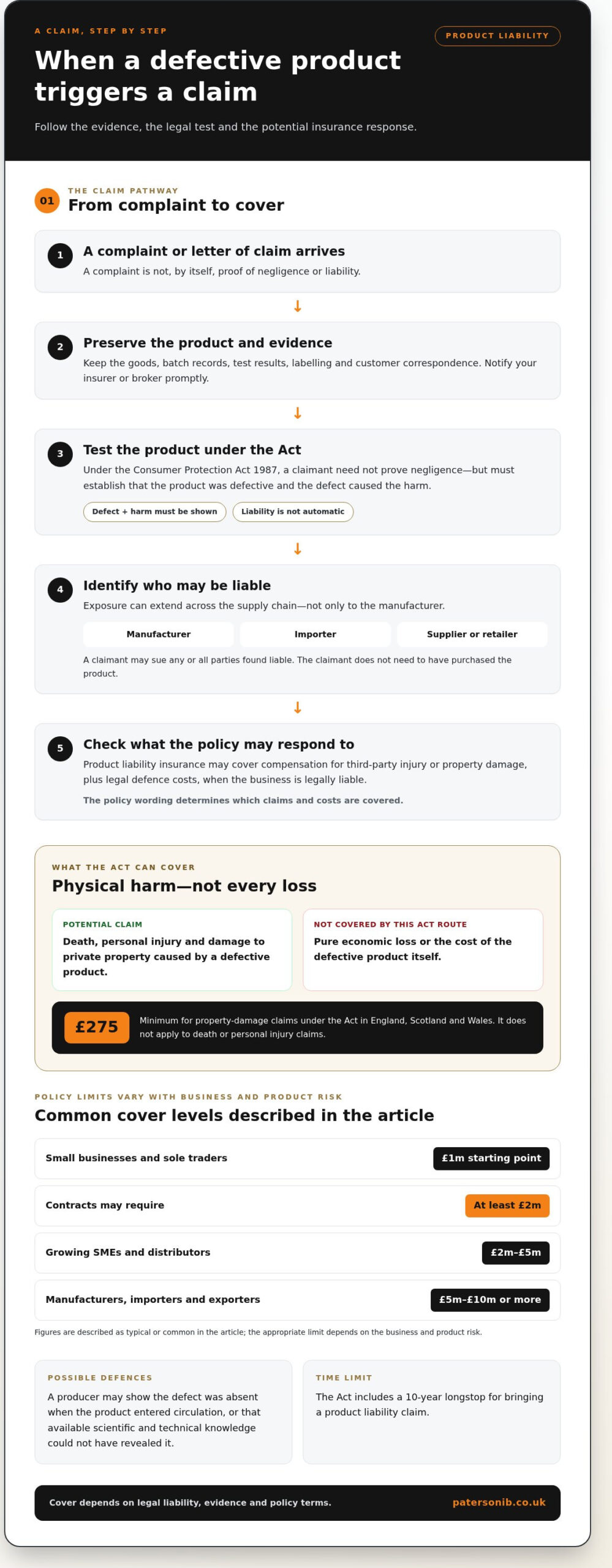
The Consumer Protection Act 1987 creates a route to compensation when a defective product causes injury or property damage. Strict liability means the claimant doesn’t need to prove negligence. However, the consumer must establish that the product was defective and that its defect caused the loss. Liability isn’t automatic simply because a product failed or caused disappointment.
A product is assessed against the safety people are generally entitled to expect. Its presentation, instructions, intended use and the time it entered circulation can all matter. For example, a warning label may affect what safety expectations are reasonable. A fault that causes a household appliance to catch fire may support a claim for resulting injury or damage. The Act doesn’t allow recovery for damage to the defective product itself.
Producers may rely on specific defences. They could show that the defect didn’t exist when the product entered circulation, or that the scientific and technical knowledge available at manufacture couldn’t have revealed it. A product isn’t defective merely because a safer version appeared later. Contract terms cannot exclude liability under the Consumer Protection Act 1987, so a supplier’s agreement with a buyer doesn’t remove a consumer’s statutory rights.
There are also time limits. According to UK Parliament, a UK product liability claim under the Consumer Protection Act 1987 cannot be brought more than 10 years after the producer first put the product into circulation. A separate limitation period generally runs for three years from when the claimant knew, or ought reasonably to have known, about the damage and its cause. These deadlines make the product’s circulation date and evidence of when harm became apparent important.
A defective item can create risks across its supply chain. For example, a faulty electrical component may cause a fire after a retailer has sold the finished appliance. The manufacturer, importer and supplier may each face questions about the product, their role and the damage caused. Product liability insurance addresses legal liability to third parties, not every cost arising from a product problem.
Responsibility between businesses can also depend on their contracts. In a UK business-to-business dispute, liability clauses, warranties and indemnities can determine which party ultimately bears the loss. A distributor may have a contractual right to recover costs from a manufacturer, even while a separate claim concerns injury or property damage. These agreements don’t remove a consumer’s statutory rights.
Keep records linking specific goods to their production and supply. Useful evidence may include the allegedly faulty product, batch and distribution records, quality-control documents, safety-test results, packaging, labels and customer correspondence. Batch records, for example, can help establish whether a complaint concerns one item or a wider production run. Preserve original records and avoid altering the product while a claim is being assessed.
Product liability cover commonly forms part of a public liability policy, but the policy wording determines its scope. Cover may respond to strict liability under the Consumer Protection Act 1987. It generally follows an occurrence basis: the policy in force when injury or damage happened may respond, even if the claim arrives later. For exported goods, the policy must include the territory where the product was sold; USA and Canada sales are often excluded unless declared and specifically covered.
Recall expenses are a separate exposure. Product recall insurance can cover costs associated with withdrawing goods from the market, while product liability cover addresses legal claims for damage or injury. Notify your insurer or broker promptly after a complaint, letter of claim or legal proceedings arrive. Review your business insurance arrangements with the product supply chain and export territories in view.
Paterson Insurance Brokers helps businesses consider insurance in light of their work, supply chains and liability exposures. If your business manufactures, imports or supplies building materials, a defective product could create risks beyond the construction site. Construction Insurance can form part of a wider review of your business risks and policy needs.
The right arrangements depend on your activities, the goods you supply and the contracts you enter. A conversation can help you understand how your insurance fits those circumstances without assuming one policy covers every product-related claim. For a personal discussion about your business, contact Paterson Insurance Brokers or visit patersonib.co.uk.
At your next policy review, consider how products move through your business, from sourcing and manufacturing to sale and delivery. Changes to suppliers, product lines or customer contracts can alter your exposure. Keep your risk information current and discuss how your insurance arrangements reflect your operations.
Paterson Insurance Brokers offers Construction Insurance, Agriculture Insurance and Retail & Wholesale Insurance. If you’re considering product liability insurance for a defective goods claim, Paterson can help you explore cover relevant to your business and sector. Its advice-based approach recognises that each operation has different risks.
Contact Paterson Insurance Brokers to discuss your business insurance needs and take a considered next step.
For a Consumer Protection Act 1987 claim, the usual limitation period is three years from when the claimant knew, or ought reasonably to have known, about the damage and its cause, according to UK Parliament. A separate longstop prevents claims more than 10 years after the producer first put the product into circulation. Keep incident dates and product history records, as both may matter.
A product is defective if it fails to provide the safety people are generally entitled to expect. The assessment may consider its presentation, instructions, foreseeable use and when it entered circulation. For example, a toy with a sharp edge may be assessed differently from a tool carrying clear safety warnings. A newer, safer model alone doesn’t make an earlier version defective.
Liability may involve the manufacturer, importer or supplier, depending on each party’s role and the legal basis of the claim. A retailer may also be involved, particularly if it supplied the goods or can’t identify the responsible producer. For example, a business selling goods under its own name may be treated differently from a shop that can identify the manufacturer. Contracts can also shape disputes between businesses.
No. Product liability insurance isn’t a legal requirement for UK businesses. However, a business can still face a claim if its goods cause injury or property damage. A buyer, distributor or trading partner may also require insurance under a commercial contract. Review the wording carefully: contractual insurance requirements and statutory liability are separate matters.
A claimant generally needs to establish that the product was defective, that damage occurred and that the defect caused the damage. Useful evidence may include the item itself, photographs, purchase details, instructions and records of how it was used. For a business, traceability records can help identify the relevant batch and the parties involved in making or supplying it.
A Consumer Protection Act claim can seek compensation for death, personal injury and damage to private property. Loss of income may form part of compensation linked to personal injury. The Act doesn’t cover pure economic loss or damage to the defective product itself. For instance, damage to a customer’s belongings may be considered separately from the cost of replacing the faulty item.
Let us know your needs and we’ll be in touch shortly.