Make an enquiry
Let us know your needs and we’ll be in touch shortly.


Check out all the latest updates, insights and advice from our expert team.
Compliance sets the rules, but it can’t show whether people feel able to speak up or act safely when no one is watching. The practical answer to how to build a culture of safety, not just compliance, is to pair clear procedures with leaders who set the example, open reporting and training suited to each person’s work. Safety culture is the shared values and behaviours that shape how an organisation approaches safety every day.
Starting with compliance makes sense: clear responsibilities and consistent procedures give people a sound framework. Lasting improvement, though, comes when safety shapes everyday decisions, not just what an organisation demonstrates during an audit.
This article explains how leadership, trust and role-specific training can help build that culture. It covers reporting without fear, learning from incidents and near-misses, and treating compliance as the foundation for safer work, not the finish line.
A workplace safety culture is the shared values, beliefs and behaviours that shape how people approach risk. It shows in everyday choices, including what workers do when supervisors are absent or a task becomes inconvenient. Hudson’s safety culture model describes five levels, from pathological to generative. It can help leaders assess whether safety is ignored, handled reactively or embedded in routine decisions.
Leadership commitment becomes credible through visible actions, not statements alone. A manager can join a workplace walk-through, ask workers about hazards and follow up on concerns. They should also follow the same procedures as their teams, attend training and address unsafe practices consistently. These actions show that safety expectations apply to everyone, including senior staff.
Practical steps towards a proactive culture include leaders modelling safe conduct, involving workers in risk assessments and reviewing feedback. Use observations, interviews or staff surveys to identify where daily practice differs from written procedures. Then agree on improvements, assign responsibility and revisit progress. In construction, UK legislation refers to the Construction (Design and Management) Regulations as CDM 2015.
Common barriers include fear of blame, unclear procedures and leaders treating safety as paperwork. Address them by making policies easy to access, explaining decisions and responding consistently to concerns. Managers should make time for discussion and recognise workers who pause to question a risky task. This shows that reporting is valued, not punished.
Accountability also means checking whether improvements work in practice. If a walk-through reveals an obstructed route, for example, leaders can arrange corrective action and later check that it stays clear. A positive culture depends on workers taking responsibility for their own safety and others’, while leaders provide the example and support that make safe behaviour practical.
Reporting only helps when workers see that concerns lead to action. Make the process clear: explain who receives reports, how to submit them and when to expect a response. Offer a private or anonymous channel for sensitive concerns alongside direct conversations with supervisors. Anyone who spots a damaged guard should be able to report it before someone is injured.
Record near-misses consistently, even when nobody is hurt. Look beyond the immediate event to underlying causes, such as unclear instructions, time pressure or equipment layout. After reviewing a report, explain what will change and why a suggested fix cannot be adopted. Closing the loop shows workers that reporting is a practical way to prevent a recurrence.
Employee involvement makes safety discussions more grounded. A safety committee can bring workers and managers together to review recurring hazards, consider suggestions and track agreed actions. Frontline staff often know how a task is actually carried out, so their input can reveal risks that a form alone might miss.
After an incident, managers can balance accountability with a just culture by examining the circumstances, systems and decisions involved before responding. Treat honest mistakes and near-misses as opportunities to learn, while addressing deliberate disregard of safety expectations consistently. Clear expectations and fair, improvement-focused reviews help people speak up while maintaining personal responsibility.
Keep communication active between formal reviews. A short team briefing can cover a reported hazard, the action taken and any change to safe working practices. If feedback identifies a recurring problem, assign someone to address it and report back to affected workers. Following through supports continuous improvement and makes early reporting worthwhile.
Where recurring concerns point to wider workplace risks, risk management support can help businesses consider how their approach to safety fits their operations.
Training works best when it reflects the tasks people actually do. A warehouse operative handling equipment needs different instruction from an office-based administrator, whose daily risks often centre on sedentary strain and posture. In desk-based environments, providing practical guidance on ergonomic setups and height-adjustable workstations—such as those featured on ekobor.com.hk—helps make everyday health practices tangible. Map each role to its tasks, hazards and relevant procedures, then use practical examples, such as demonstrating safe equipment checks, rather than relying only on slides or policy documents.
Keep learning active after induction. A new starter may understand a procedure in a classroom but need supervised practice before applying it confidently. Ask workers to demonstrate key steps, explain what they would do in a realistic scenario or identify hazards in their work area. These checks help managers spot gaps in understanding and provide further instruction where needed.
Refresh training when the work changes. New equipment, revised processes or different working conditions can make earlier instruction less useful. If a production line changes, for example, update the relevant training and give affected workers time to practise the new sequence. Regular refreshers keep procedures familiar and make learning an ongoing activity, rather than a one-off event.
In the UK, legal compliance means meeting the health and safety requirements that apply to the work. Best practice builds on that baseline with practical, engaging training tailored to workers’ duties, refreshed over time and checked for understanding. An attendance record shows that a session took place, but a worker’s ability to explain or demonstrate a safe method gives a clearer indication of learning.
Use feedback to improve training. If workers repeatedly misunderstand a task, adjust the demonstration or guidance rather than simply repeating the same session. Managers can track training completion and hazard reports as leading indicators, then review whether workers apply what they’ve learned on the job. This connects training to real conditions and keeps safe practices visible as tasks change.
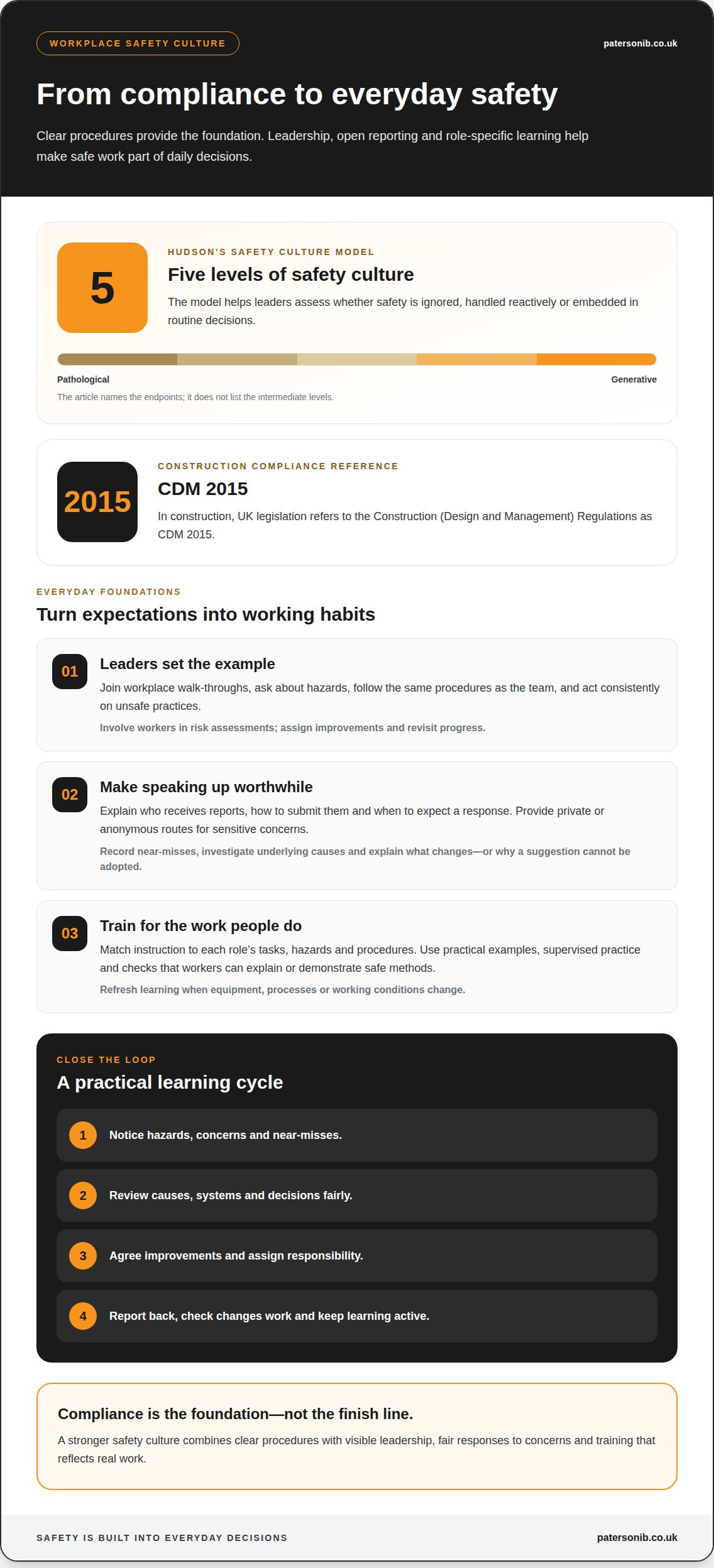
Compliance gives an organisation a shared framework of procedures, responsibilities and standards. Rules alone, however, can encourage box-ticking instead of sound decisions. To build a culture of safety, not just compliance, explain the purpose behind each control. Showing how a machine guard reduces exposure to moving parts, for example, connects a required step to the risk it addresses.
A strong safety culture turns shared values into everyday choices. Before an unfamiliar task, workers and managers can discuss likely hazards and whether existing controls suit the conditions. If a written procedure proves impractical, use that feedback to improve the process while keeping essential protections in place. This makes procedures more workable in real conditions.
Measure preventive activity alongside incidents. Training completion and hazard reports can indicate whether prevention is happening; injury rates show outcomes after harm occurs. Review the measures together. If reports repeatedly identify a blocked walkway, track whether the obstruction is removed and stays clear, rather than relying only on whether anyone is injured.
Policies need to keep pace with changing work. A revised layout may alter how materials move, making an existing procedure less useful. Update the instructions, explain the change and involve affected workers in reviewing how it works. Connecting rules to actual tasks helps teams apply them thoughtfully instead of treating them as paperwork.
Recognition can reinforce good practice. Thank workers who identify hazards, share useful feedback or help complete corrective actions. Avoid judging performance only by the absence of reported injuries, as this can discourage reporting near-misses. Instead, review prevention and follow-through, including whether agreed changes have addressed the original concern.
To consider how procedures and preventive controls fit your operations, discuss workplace risk management with Paterson Insurance Brokers.
Paterson Insurance Brokers helps businesses consider how insurance fits their operational risks and wider approach to safety. When reviewing procedures, reporting routes or workplace controls, consider whether your business cover reflects the work and risks involved.
As an independent broker, Paterson arranges tailored insurance solutions for businesses across the UK, including those in construction, agriculture, retail and manufacturing. The right cover depends on the business’s activities and circumstances, so insurance should complement practical prevention, not replace safe systems of work or role-specific training.
If you’re reviewing your business risks and insurance alongside your safety approach, make an enquiry with Paterson Insurance Brokers to discuss your circumstances.
Making safety part of everyday work takes steady attention, not a one-off initiative. Set a practical priority for the next stage, such as reviewing how a recent change affects daily tasks, then make time to learn from the results. Consistency helps shared expectations shape how people make decisions.
Building a culture of safety, not just compliance, also means considering how financial protection fits alongside prevention. Insurance can support wider risk planning, but it doesn’t replace safe procedures, competent workers or effective leadership. Paterson Insurance Brokers offers Construction Insurance, Agriculture Insurance, and Retail & Wholesale Insurance for businesses reviewing their cover alongside operational risks.
If you’re considering how your insurance fits your business and its risks, contact Paterson Insurance Brokers to discuss your circumstances. Take the next step at a pace that suits your organisation, and keep building a safer way of working together.
Safety culture is the pattern of shared expectations that influences how people handle risk during everyday work. It shows in small decisions: whether a worker checks a changing condition before continuing, or whether a supervisor makes time to discuss a concern. These signals reveal more than a policy document alone because they show how safety is understood and practised across an organisation.
Compliance is the documented side: policies, assigned responsibilities and records showing that procedures are in place. Culture is how people apply those procedures, including whether they notice and raise concerns. A team may have a reporting form, for example, but a strong culture is evident when staff use it promptly and leaders respond thoughtfully instead of dismissing the issue.
Compliance-led health and safety focuses on meeting formal requirements and following documented controls. A safety culture adds shared ownership: workers understand why precautions matter and consider risk even when a task falls outside a routine checklist. If an unusual delivery blocks a usual access route, for instance, a safety-minded team pauses to assess the changed conditions instead of assuming the standard plan still applies.
Leaders can show their commitment by joining workplace safety discussions, asking specific questions and acting on what they hear. During a site visit, a manager might ask how a recent process change affects safe access, then report back on agreed actions. They should also follow the same procedures as employees. Consistency helps staff judge whether safety remains a genuine priority under operational pressure.
Explain what to report, provide a clear reporting route and tell workers how reports will be handled. A simple example could ask staff to describe where a hazard occurred, what they observed and whether work was affected. Managers should thank the reporter, focus reviews on causes and share resulting actions. Confidential reporting options can also help people raise sensitive concerns more comfortably.
Combine measures to understand both activity and employee experience. Track hazard reports, training completion, follow-up actions and how promptly recurring issues are addressed. Add anonymous perception surveys, interviews or focus groups to learn whether workers feel able to speak up and understand procedures. Review patterns over time: rising reports may signal greater openness, so consider them alongside feedback and actions taken.
Let us know your needs and we’ll be in touch shortly.