Make an enquiry
Let us know your needs and we’ll be in touch shortly.


Check out all the latest updates, insights and advice from our expert team.
A cyber incident can put customer trust at risk long after systems are restored. Protecting brand reputation after a cyber incident means communicating clearly, addressing the security weakness and showing through practical action how the business is putting things right.
It’s understandable to focus first on getting operations back on track. Customers and business partners also need honest updates, a clear account of any disruption and useful guidance if their information may be affected. Silence or vague communication can leave people unsure about what happened and what to do next.
This article explains how a cyber incident can affect a brand, why the response matters and how prevention can support confidence over time. You’ll learn how transparent communication, a considered incident plan and stronger security measures can help rebuild trust. It also covers how brand protection in cybersecurity extends beyond restoring systems to addressing impersonation, phishing and other threats that misuse a business’s name.
Proactive cybersecurity can help protect customer confidence and maintain trusted relationships. Protecting brand reputation after a cyber incident also depends on how the organisation communicates and supports people while addressing the disruption.
A cyber incident can affect income by disrupting sales and making prospective customers hesitate. In its 2024 global study, Hiscox found that 47% of businesses hit by a cyber attack struggled to attract new customers, while 43% lost existing customers. Hiscox also reported that 21% lost business partners. These effects can reach beyond immediate recovery, influencing future sales, repeat business and commercial relationships.
Trust reflects customers’ confidence that a business will protect their information and act responsibly. A data breach can weaken that confidence, prompting cancellations, reduced engagement and churn. Customers may also share their experiences through conversation or social media, influencing others’ views. Hiscox found that 38% of attacked businesses experienced damaging media publicity. For many organisations, protecting brand reputation after a cyber incident means addressing customer concerns consistently, not only restoring services.
Prompt, transparent communication helps customers understand what happened and what action is underway. Contact affected people directly, acknowledge the disruption and distinguish confirmed facts from details still being investigated. If personal or financial information may be exposed, offer practical guidance, such as changing passwords or monitoring bank accounts. Keep messages consistent across direct communications and social media, and update them as the investigation develops. This helps customers make informed decisions.
Reputation recovery is the gradual rebuilding of customer confidence and business relationships after a breach. Track cancellations, repeat purchases, new enquiries and partner retention against the business’s own pre-incident patterns. Review customer feedback, complaint themes and social media mentions for changes in sentiment. Note recurring questions and whether concerns ease after updates. These indicators can show where confidence is returning and where clearer information or further action may be needed.
Restoring systems is only part of recovery. The business also needs to close the route used in the attack. A documented incident response should bring together technical fixes, staff awareness and clear communication with affected people.
A UK organisation must report a personal data breach to the Information Commissioner’s Office (ICO) when it is likely to pose a risk to people’s rights and freedoms. Assess what information was exposed, who may be affected and the possible consequences, then make the reporting decision promptly.
After containing an incident, investigate how the attacker gained access and which systems or accounts they reached. Remove unauthorised access, secure compromised accounts and address the underlying weakness before restoring affected services. Record decisions and findings throughout the response. This record supports transparent communication with customers and helps explain what has changed.
Regular security audits can identify weaknesses before another attack. Firewalls, encryption, intrusion detection and multi-factor authentication can add protective layers. Match each measure to the systems and information it protects. Review access permissions, software updates and backups as part of the wider security assessment. Understand the legal, contractual, industry and regulatory requirements that apply to the personal, commercial and confidential information the business handles.
People need practical guidance, not a policy they rarely revisit. Train staff to recognise phishing, follow strong password practices and report suspicious activity through a clear internal process. After an incident, review whether the training and response plan prepared employees for the situation. Use investigation findings to update procedures, test response roles and explain preventive measures to affected customers. Consistent action shows the business is addressing the cause, not just the immediate disruption.
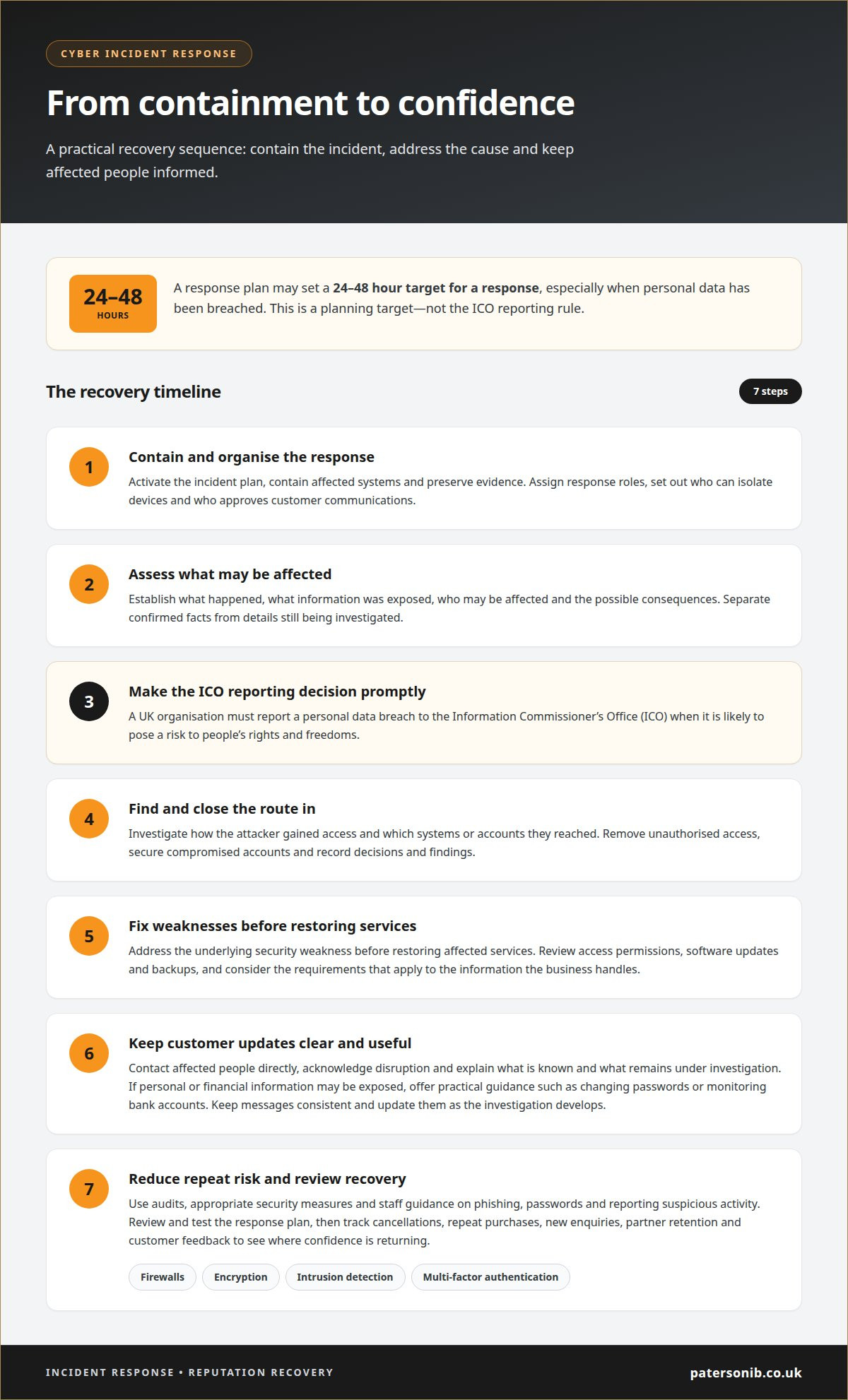
Start by containing affected systems, preserving evidence and activating the incident response plan. Assign response roles, assess what happened and prepare clear updates for customers using confirmed facts.
Ransomware payments can raise reputational questions about the business’s decisions and whether customer information remains at risk. Payment alone does not reveal what data was accessed or demonstrate that the security weakness has been fixed.
A cyber incident response plan sets out who acts, how systems are contained and how recovery is managed. It helps teams coordinate their response when operations and customer confidence are under pressure.
Set out how staff escalate alerts, who can isolate affected devices and who approves customer communications. Detection practices should combine technical alerts with human review, helping teams assess suspicious activity rather than treating every alert as a confirmed attack. A plan may set a 24-48 hour target for a response, especially when personal data has been breached.
After recovery, review the plan against what happened. Identify delays, unclear responsibilities and missed signals, then update procedures and test them with relevant staff. A 2024 study found that 78% of industry professionals ranked reputational damage as their top concern following cyberattacks, making clear ownership and timely decisions central to preparedness.
Paying a ransomware demand can leave customers questioning whether the business protected their information and acted responsibly. The decision does not, by itself, establish what was taken, whether systems are secure or what will prevent another incident. A considered response plan should involve legal and public relations teams alongside technical specialists, so communications remain accurate and consistent.
Reputation risks can extend beyond the affected network to misuse of the brand. Monitor for phishing sites and impersonating accounts, then prioritise removal requests by severity. Legal expertise can help address infringement while security teams focus on containment and recovery. Clearly explain the actions taken to give customers and partners a factual account and reduce the space for inaccurate claims to spread.
Cybersecurity protects more than networks; it can also help guard the identity customers recognise and trust. Protecting brand reputation after a cyber incident means considering how criminals might misuse the organisation’s name, not just how they breached its systems.
Impersonation can take several forms: a phishing site copying a login page, a social account posing as the business, or a counterfeit listing using its branding. Data leaks can expose sensitive information and give fraudsters material for convincing messages. Monitor company names, key executives, customer-facing accounts and common variations, as well as signs that leaked data is being used.
Prepare a response process before a crisis. Assign responsibility for assessing reports, preserving evidence and deciding which threats need immediate action. A fake payment request sent to customers, for example, may need faster attention than a misleading post with limited reach. Prioritise threats by potential harm, the number of people affected and whether the activity is ongoing.
Effective action may include warning customers through trusted channels, reporting impersonating accounts, requesting the removal of phishing sites and addressing counterfeit listings. Keep records of reports, decisions and follow-up. Brand safeguards can also include registering trade marks and designs, alongside policies for managing internal and external reputation risks.
Protecting brand reputation after a cyber incident works best when brand safeguards and technical security support each other. Technical teams can investigate the breach while communications and legal colleagues address misuse of the brand and customer questions. For advice on preparing for cyber-related business risks, review your cyber risk planning.
Paterson Insurance Brokers offers Cyber Insurance for businesses assessing how to manage cyber-related risks. It can form part of wider risk planning alongside the incident response, security and communication measures discussed above. Insurance does not replace these measures, but it can help businesses consider their financial exposure when reviewing cyber risks.
Consider discussing Cyber Insurance when assessing how a cyber incident could affect your operations, information and reputation. A useful conversation starts with your business’s circumstances and the risks it needs to address, rather than assumptions about what a policy covers. For an advice-based discussion about Cyber Insurance and your business needs, contact Paterson Insurance Brokers.
Protecting brand reputation after a cyber incident is not only a response task; it can shape how a business prepares for future change. As operations, suppliers and customer expectations evolve, revisit whether your risk planning still reflects how the organisation works. Consider how disruption could affect income, key relationships and the confidence people place in the business.
Paterson Insurance Brokers offers Cyber Insurance, Construction Insurance, Agriculture Insurance and Retail & Wholesale Insurance. These options support businesses in different sectors as they review their wider insurance needs. A conversation can help put cyber risks in the context of your organisation’s operations and existing protections.
Contact Paterson Insurance Brokers to discuss your business’s cyber insurance needs. A considered next step can help you prepare with greater confidence.
A cybersecurity breach can make customers question whether a business handles information responsibly. That doubt may affect contract renewals, referrals and prospective customers’ willingness to share sensitive details. Suppliers may also reassess a relationship if they depend on the affected systems. Beyond direct losses, inconsistent explanations can leave different audiences with conflicting impressions of the business’s reliability and judgement.
Reputation management is the ongoing work of understanding and shaping how customers, employees, suppliers and the public perceive an organisation. After a cyber incident, this includes tracking concerns, correcting inaccurate claims and ensuring public statements reflect the actions being taken. For example, a business can log recurring customer questions and use them to improve its explanations instead of responding inconsistently to each concern.
Customers partly trust a business because they expect it to handle their information carefully. If an account is compromised or sensitive details are exposed, people may worry about identity misuse, fraudulent messages or further access to their accounts. Security practices therefore affect customer relationships, not just technology. Clear evidence of responsible data handling can support confidence, while unexplained gaps may deepen uncertainty.
Use a consistent, factual message across customer emails, support teams and public updates. Separate confirmed information from matters still being investigated, and avoid speculation about the cause or extent. Explain what customers can do, where to direct questions and how they will receive further information. Keep a record of approved messages so staff give consistent answers on calls and online.
A UK business should inform affected individuals without undue delay when a personal data breach is likely to create a high risk to their rights and freedoms. This is separate from notifying the Information Commissioner’s Office (ICO): the ICO must be notified when a breach is likely to pose a risk to people’s rights and freedoms. Assess the information involved and the potential harm.
A holding statement should identify the organisation, acknowledge the incident and state what is known without presenting unverified details as facts. Explain the immediate action underway, tell affected people where to find practical updates and provide a contact route for urgent concerns. If the investigation is ongoing, say so plainly. Avoid promises about outcomes or recovery that the business cannot yet substantiate.
Let us know your needs and we’ll be in touch shortly.