Make an enquiry
Let us know your needs and we’ll be in touch shortly.


Check out all the latest updates, insights and advice from our expert team.
A risk register alone won’t reassure an investor. Building investor confidence through robust risk management means showing that the risks most likely to affect performance have clear owners, practical controls and regular review. Investors need more than a list of possible threats: they need to understand how the business acts on them.
It can be difficult to know which risks deserve attention first, or how to demonstrate that mitigation is active rather than simply described. Clear governance helps make that picture easier to understand. When accountability and review are visible, investors can make better-informed decisions and the business is better placed to respond as circumstances change.
This article explains how to prioritise material risks, assign responsibility and show how controls work in practice. It also covers how evidence can connect risk disclosures with action, and how insurance and specialist risk management advice can support broader resilience without replacing operational controls.
Robust risk management means identifying, assessing, responding to and reviewing business risks. For investors, it helps explain how uncertainty could affect objectives, operations, financial outcomes or plans, and how leaders account for it in their decisions. A broad Enterprise Risk Management (ERM) approach connects risks across the organisation instead of treating each one in isolation.
Risk controls can support informed investor decisions and business resilience, but they can’t guarantee performance or remove uncertainty. Clear reporting explains the business’s approach, while ongoing management shows that risks remain under consideration as circumstances change. For individual investors and market participants managing direct financial exposure, multi-asset brokerage firms like TradingPRO provide tiered trading infrastructure to help execute strategies within set risk parameters.
Investors may weigh risks differently, so clear explanations matter. Describe how a material risk could affect the business, who is accountable for it and how the business is responding. Honest disclosure gives context; credible action helps readers understand how leaders are addressing the exposure.
A register records risks, but it doesn’t show by itself that the business is acting on them. Connect each entry to an owner, relevant controls and review decisions. Documentation is most useful when it reflects current actions and changes, rather than serving as a static record or a substitute for active management.
Governance gives risk decisions a clear path from identification to oversight. Leaders can use this sequence:
Leadership oversight connects these decisions to business priorities and available evidence. It also helps ensure that responses are proportionate to the exposure, rather than based on an assumed universal scoring rule.
A named role makes responsibility clear without requiring a particular governance structure. Responses may prevent an event, reduce its likelihood or impact, prepare the business for disruption, or accept the exposure. The choice should reflect the risk and the organisation’s circumstances, with the reasoning understood by relevant decision-makers.
Changes to operations, strategy or external conditions can alter a risk. Record material changes, the decisions they prompt and any follow-up actions, so leaders can assess whether the response still fits. Reviews don’t need to be only calendar-based: the priority is to keep decisions relevant as the business changes.
Paterson’s risk management consultancy supports businesses in developing a clearer view of their risks and considering appropriate responses.
Make updates easy to assess by separating four points: the exposure, the control in place, progress made and any unresolved issue. Focus on material developments rather than listing every possible threat. For example, state whether a planned action is complete or still underway, and distinguish confirmed information from estimates.
Explain what has changed, how the business responded and what happens next. Use consistent language across updates so investors can follow developments. Don’t describe a control as effective unless there’s evidence to support that view.
Current action records, decision notes and control reviews can substantiate progress. They should show what management has examined and what work remains, not imply that exposure has disappeared. Credible risk reporting connects exposure with action and clearly states what remains uncertain.
This measured approach helps investors understand the basis for management’s view without confusing planned work with completed action. It also gives leaders a useful record for future decisions and updates.
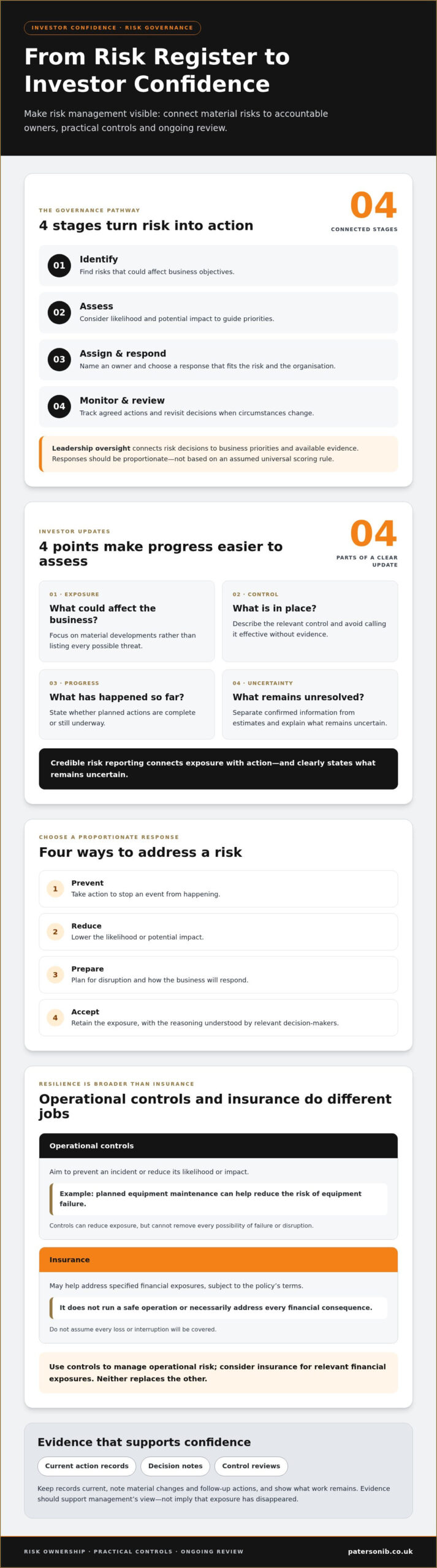
Insurance and operational controls serve different purposes. Controls aim to prevent an incident or reduce its likelihood or impact. Insurance may help address specified financial exposures, subject to the policy’s terms. Neither replaces the other: a policy doesn’t run a safe operation, and a control doesn’t necessarily address every financial consequence.
For example, a business might use maintenance procedures to reduce the risk of equipment failure and contingency planning to prepare for disruption. It could then consider whether insurance is appropriate for relevant financial exposures. The right arrangements depend on the business and the policy, so leaders shouldn’t assume that every loss or interruption will be covered.
| Approach | Purpose and example | Limitations |
|---|---|---|
| Prevention and mitigation | Reduce the chance or impact of an incident through operational practices, such as planned equipment maintenance. | Controls can reduce exposure but can’t remove every possibility of failure or disruption. |
| Insurance | May address specified financial exposures, depending on the policy terms. | It doesn’t replace operational controls, and cover isn’t guaranteed for every event or loss. |
Leaders can consider exposures, controls and insurance needs together. If the business changes its activities or strategy, it should consider whether those changes alter its risk profile and whether existing controls and insurance arrangements still reflect the current position. Insurance decisions are most useful as part of a wider plan, alongside clear operational responses.
Commercial insurance brokerage can help businesses consider insurance as one element of a broader risk approach.
No universal checklist guarantees confidence. These questions can help leaders examine whether risk decisions remain connected to real exposures:
Clear answers help distinguish what the business manages operationally from what insurance may address under its policy. They also make it easier to identify where further review is needed, without implying that a control or insurance arrangement removes uncertainty. Building investor confidence through robust risk management means being candid about both the protections in place and their limits.
Paterson provides commercial insurance brokerage and risk management consultancy to help businesses consider their insurance needs as part of a wider risk approach.
Clear risk decisions begin with understanding how a business operates, what could affect its objectives and where uncertainty remains. Paterson Insurance Brokers provides business insurance brokerage and risk management consultancy, bringing insurance advice and broader risk discussions together. Its independent, advice-based approach focuses on explaining options clearly rather than making decisions on price alone.
Insurance can form part of a risk plan, while consultancy can help a business develop a clearer understanding of its risks and consider how to respond. Paterson also supports businesses with regulatory compliance, helping them consider relevant requirements as part of their wider risk picture. No adviser or control can guarantee investor confidence or business performance, but clear, considered decisions give leaders a sounder basis for explaining their approach.
Specialist input may be useful when operations or strategy change, when responsibility for particular risks is unclear, or when existing processes no longer give leaders a coherent view. These situations can make it harder to see which exposures deserve attention and how decisions connect to business priorities.
Tailored consultancy can help clarify the business’s risk picture and support the consideration of appropriate priorities and responses. The focus is on the organisation’s circumstances, rather than applying a standard answer to every business. This can help leaders sharpen risk discussions and identify where further consideration or review may be useful.
A productive conversation can start with a straightforward account of the business: its activities, current concerns, existing approach to risk and any changes that may affect its exposures. Sharing what is already known, along with areas of uncertainty, gives the discussion a practical foundation. You don’t need to present a finished risk framework; being open about current challenges can help clarify priorities.
Paterson’s transparent approach means explaining insurance and risk considerations in clear terms, so business leaders can better understand the decisions before them. This is particularly valuable where insurance questions sit alongside operational controls, strategic choices or compliance considerations. The aim is to support informed judgement, not to promise a particular investor response or remove uncertainty from the business.
Building investor confidence through robust risk management is an ongoing commitment to understanding exposures and making considered decisions. Paterson brings business insurance brokerage and risk management consultancy together to support that work, with advice shaped around the business rather than a price-led approach.
Risk management should keep pace with the business. As plans, operations and external conditions shift, revisit the assumptions behind key decisions and consider what new information could change them. This helps leaders prepare for investor questions with a clearer view of what is known, what remains uncertain and what deserves further attention.
Building investor confidence through robust risk management is an ongoing practice, not a promise of certainty. A useful next step is to identify one decision where risk and business priorities meet, then consider whether the available information is sufficient to explain the reasoning behind it.
If you’d value a considered conversation about your business’s risk and insurance needs, make an enquiry and let us know your needs.
It means treating risk as part of business decision-making, not as a document prepared only for reporting. Before entering a new market, for example, leaders can consider what might disrupt the plan, who will monitor those concerns and what evidence would prompt a change of course. Building investor confidence through robust risk management depends on explaining that reasoning honestly, including where forecasts rely on assumptions or further information is needed.
No. Investors may assess a business differently, and their confidence can be influenced by factors beyond risk controls. A disciplined approach can help leaders explain how they reached a decision, what safeguards support it and what could still go wrong. A contingency plan may help a business prepare for supplier disruption, for instance, but it can’t ensure deliveries continue or remove the financial effects of interruption.
Give investors updates that connect important changes to management decisions and follow-up. A concise update might note that a key supplier has changed, explain how the business assessed the potential effect and identify any action still underway. Supporting records can substantiate progress. Keep facts distinct from forecasts, and explain material gaps rather than presenting planned work as completed or claiming that a control prevents every possible loss.
No. Insurance may address specified financial exposures according to the policy, but it doesn’t show on its own how a business prevents incidents or manages disruption. A firm might insure relevant risks while also maintaining operational procedures and planning how it would respond to interruption. Reviewing these elements together can reveal whether insurance and day-to-day controls reflect the business’s current activities, without assuming every event or resulting loss is covered.
A risk register is a record; risk management is the wider work of using information in that record to guide decisions and follow-up. If a register notes that a key process depends on one person, leaders could consider how an absence would affect operations and whether responsibilities need to be documented. The record is useful when it reflects those decisions and is updated as the business changes.
An insurance broker can help a business consider insurance in the context of its activities and exposures, while risk management consultancy can support a broader understanding of risks and responses. Paterson Insurance Brokers provides both, with clear explanations and an advice-based approach. This can help leaders make more informed insurance decisions, but it doesn’t replace operational controls or assure a particular investor reaction. Make an enquiry to discuss your business’s needs.
Let us know your needs and we’ll be in touch shortly.