Make an enquiry
Let us know your needs and we’ll be in touch shortly.


Check out all the latest updates, insights and advice from our expert team.
A policy can look comprehensive while a business transaction still carries overlooked liabilities. Demonstrating due diligence in insurance procurement means verifying a business’s identity and financial health, reviewing its insurance records, and assessing whether its cover fits the risks and obligations involved.
That review goes beyond collecting certificates. It can reveal gaps, unresolved claims or financial concerns that may affect a deal or supplier relationship. This article explains what insurance due diligence involves in the UK, how to assess identity, financial stability and policy suitability, and why checks should reflect the risks of the decision. Clear records and regular reviews can support better-informed choices, from selecting a supplier to completing an acquisition or renewing a contract.
Demonstrating due diligence in insurance procurement means assessing supplier risks and checking whether insurance meets the contract’s needs. The review should be proportionate to the work involved and the risks it creates.
A supplier and third-party risk review considers whether a vendor can meet its commitments and what risks its work may introduce. Buyers can assess financial health, cybersecurity, regulatory compliance, data protection, business continuity, reputation and ongoing performance. A supplier with access to sensitive information, for example, may create security and continuity risks as well as delivery concerns. Reviewing these areas helps buyers identify relevant insurance requirements and decide where further checks are warranted.
Insurer requirements are the evidence and cover conditions used to assess whether a risk can be insured. Cover should suit the contract’s value and associated risk, rather than simply meet a standard checklist. UK legal requirements depend on the organisation and procurement context. The UK Bribery Act 2010 requires organisations to provide evidence of sufficient anti-bribery measures. Under the Procurement Act 2023, NHS organisations must register on the Find a Tender Service and check supplier details against it for due diligence. These obligations concern procurement and conduct; they do not establish one universal insurance policy requirement.
Pre-quote information gives a broker the detail needed to assess a business and seek suitable terms. Provide a clear description of operations, locations, contracts, assets, workforce, existing cover and claims history. These details can uncover exposures that a brief business description might miss. Compare policies on more than premium: examine limits, exclusions, excesses, conditions and how policy definitions apply to the business. Common pitfalls include choosing on price alone, overlooking exclusions and selecting limits that do not reflect contractual responsibilities.
Checks on a broker or intermediary should establish whether they can explain cover clearly and handle the procurement requirements. Look for relevant experience, transparent explanations of policy differences and a documented reason for recommendations. Ask how exclusions, limits and excesses will be assessed against the stated risks, and how policy changes and renewals will be reviewed. Clear communication matters: incomplete business information or misunderstood wording can leave important exposures unaddressed.
Demonstrating due diligence in insurance procurement means following a robust process that turns records and responses into a documented view of risk. The process typically includes setting the scope, gathering and verifying information, assessing risk, reviewing findings and monitoring changes. Due diligence verifies information; risk assessment weighs potential threats and their impact. Keeping these tasks distinct helps decision-makers separate evidence from judgement.
Start by defining what the review must establish. Set the scope according to the proposed contract, supplier’s role and potential exposure, rather than applying identical checks to every case. A desk-based review can examine public information and material requested from the supplier. If those records leave important questions unanswered, interviews or site visits can help clarify matters. For acquisitions, the review may also cover financial records, legal documents, operations and reputation.
Verification tests whether key statements are supported by consistent evidence. Compare company details across records, examine relevant certificates and investigate discrepancies before reaching a conclusion. Financial and commercial checks may start with an initial desktop assessment, followed by final checks on a preferred supplier. These may include credit or insolvency searches, interviews, further information requests and expert advice. The depth of review should match the risk and decision.
Keep a clear record of findings. NHS organisations should log due diligence enquiries and conduct regular checks throughout supplier relationships. A sound record identifies the evidence reviewed, outstanding issues, reviewer and reason for the decision. If a concern is material, confirm the underlying facts, assess its likely effect and escalate it through the authorised decision-making process. For buyers, demonstrating due diligence in insurance procurement also means keeping factual observations separate from conclusions.
Monitoring completes the process. Revisit checks during the tender and contract term, particularly when circumstances or regulatory expectations change. A supplier’s ownership, financial position or delivery arrangements may shift after onboarding. Regular reviews help buyers recognise changes and reconsider the original risk assessment.
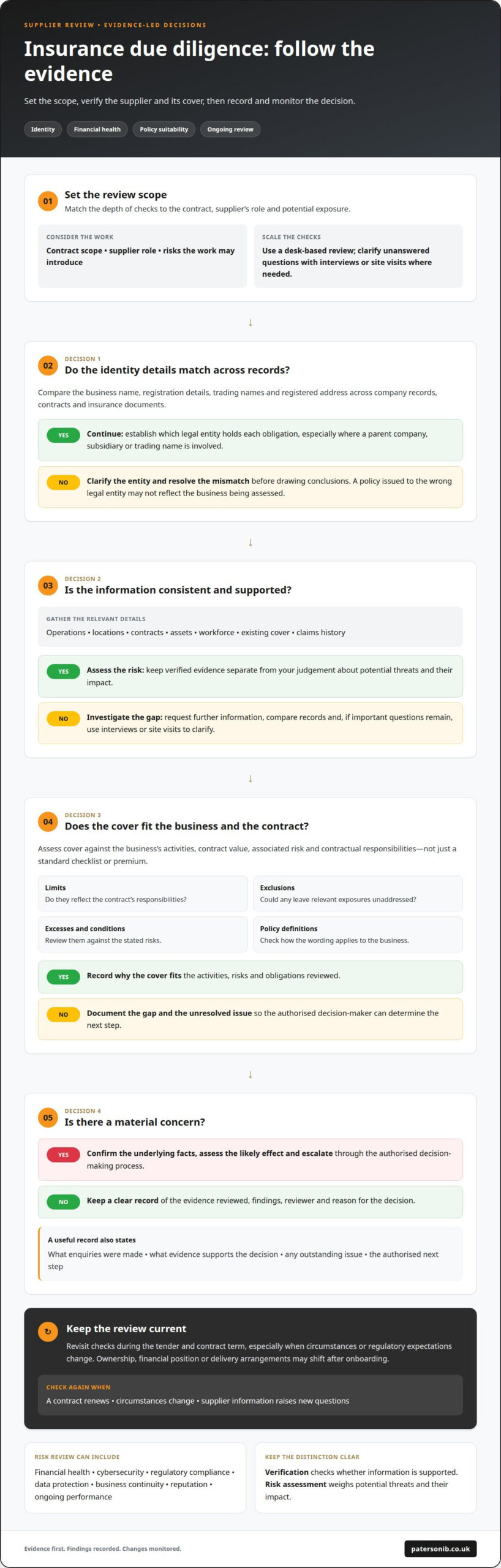
Identity checks establish which legal entity is seeking cover or entering a contract. Compare the business name, registration details, trading names and registered address across company records, contracts and insurance documents. If a parent company, subsidiary or trading name is involved, clarify which entity holds each obligation. This matters because a policy issued to the wrong legal entity may not reflect the business being assessed. Record and resolve any mismatch before drawing conclusions.
Financial checks help assess whether a supplier can meet its commitments and maintain suitable cover. Spelthorne Borough Council recommends checking a supplier’s financial health before finalising a contract when at least six months have passed since tender submission. An initial review can take place during registration of interest or shortlisting, using a desktop assessment or a more detailed examination. Match the depth of the review to the supplier’s role and the potential consequences of financial failure.
Useful evidence includes audited accounts, tax records and information about assets and liabilities. Spelthorne Borough Council’s checklist requests the supplier’s audited accounts for its last two years, if available. Tax records can indicate whether payments appear timely and whether tax obligations remain outstanding. Reviewing assets and liabilities may reveal unpaid loans or other responsibilities that could affect delivery. Consider trends across the records rather than relying on one figure in isolation. For example, falling revenue alongside growing liabilities may justify further questions.
Insurance evidence adds another layer to the review. Compare the named insured, covered activities and policy dates with the supplier’s legal identity and contractual responsibilities. Reluctance to provide insurance certificates of currency can be a financial or commercial due diligence red flag. It does not prove a problem on its own, but it warrants clarification and a documented assessment. Record what evidence was provided, which obligations it supports and whether material gaps remain before approving the contract.
In an acquisition, insurance review connects the target’s policies with the assets, liabilities and obligations transferring to the buyer. It can reveal risks that financial accounts alone may not show, including unresolved claims, gaps in cover or policy wording that does not reflect the group structure.
Reviewing claims is a practical starting point. An unresolved employment-related claim, for example, may create a future payment obligation and affect the buyer’s view of the business. Check whether key person cover exists and whether directors’ and officers’ cover will remain in place from day one. Continuity can be particularly important when ownership or management changes.
Examine policy wording closely. Check how it identifies the insured business, including subsidiaries, shareholders and the top company. Errors or omissions can complicate a claim or create uncertainty about which entity is protected. The buyer should also consider exclusions, limits and conditions in light of the business being acquired, rather than assume existing cover transfers unchanged.
Property transactions require careful timing. For UK property searches in an insured transaction, insurers require searches to be run within three months of signing the sale and purchase agreement. If the timetable does not allow for in-date searches, a “No Search” insurance policy can be obtained within a matter of days as a substitute. This option may help keep a transaction moving, while the search position remains part of the deal assessment.
Insurance analytics can help organise policy and claims information, but conclusions still require professional interpretation. Link each transaction finding to a practical decision: update cover, clarify a policy term, account for a potential liability or address continuity before completion. This makes the review useful, rather than simply a document-gathering exercise. The key is to identify what could affect the buyer after completion and reflect it in the transaction plan.
Discuss insurance risks in your business transaction when a deal raises questions about claims, cover continuity or policy wording.
Paterson Insurance Brokers helps businesses consider insurance in the context of their operations, contractual responsibilities and changing risks. If procurement or a transaction raises questions about suitable cover, the brokerage can help clarify exposures and explain how insurance options relate to them.
The cover a business needs depends on its activities and contractual responsibilities. Paterson Insurance Brokers provides insurance solutions for construction, agriculture, retail, wholesale and manufacturing businesses, including Construction Insurance, Agriculture Insurance, Retail & Wholesale Insurance and Manufacturing Insurance. Its advice-based approach helps businesses consider cover in light of their circumstances, rather than treating policy selection as a price-only decision.
If you’re assessing insurance needs as part of a procurement decision or business transaction, make an enquiry with Paterson Insurance Brokers to discuss your circumstances.
Make the review useful beyond the immediate purchase or renewal. A clear record of decisions, responsibilities and unresolved issues gives colleagues a practical reference when circumstances change. Assign responsibility for each follow-up and decide what events should trigger another review, such as a major operational change or a new contractual obligation.
This turns demonstrating due diligence in insurance procurement into an ongoing business practice, rather than a file completed once and forgotten. It also helps decision-makers explain how insurance considerations informed their choices, while recognising that documentation does not replace judgement.
If you’re considering how insurance fits your business risks or a transaction, speak with an adviser about the circumstances that matter. Contact Paterson Insurance Brokers to discuss your insurance needs. A considered next step can help you approach future decisions with greater clarity.
External advisers can provide specialist or independent input, but their involvement should match the transaction’s complexity and the expertise available internally. For example, an acquisition involving several subsidiaries may need legal, financial or insurance advice across different areas. A straightforward renewal may call for a narrower review. Consider the risks, relevant requirements and whether the business can assess them competently in-house.
Due diligence is a structured examination of information relevant to a business decision. In insurance procurement, it helps decision-makers understand how cover, policy conditions and business exposures relate before committing to an arrangement. For example, a contract involving valuable equipment may prompt closer attention to how that property is described and protected. The purpose is to base decisions on evidence, not assumptions.
Businesses should consider due diligence before entering or changing a material business arrangement. Relevant occasions include supplier onboarding, contract renewal, an acquisition, a new investment or a change in operations. Introducing a new service, for example, may alter the business’s exposure even if its existing policies remain active. Reviewing the implications at that point helps keep decisions aligned with current circumstances.
The reports needed depend on the decision, contract conditions and risks being assessed. A review may use company accounts, insurance schedules, claims information, contract documents or reports on operational risks. For example, a buyer acquiring a business with several trading entities may need information showing which entity holds each policy. Agree what evidence is needed for the decision and record any gaps.
In the UK, it means making a considered assessment of relevant information before arranging or accepting insurance for a business purpose. This can include understanding the business’s activities, contractual responsibilities and how proposed policy terms respond to its risks. For example, a procurement team may assess whether a supplier’s insurance evidence aligns with the work being commissioned. The assessment should support a reasoned decision and a clear record.
A broker can review an insurer’s published financial disclosures, including information on capital and solvency, and consider independent financial-strength assessments where available. Check the insurer’s authorisation against the relevant UK regulator’s public register, including its recorded permissions. These checks address different questions: financial information concerns the capacity to meet obligations, while register details concern regulatory status and permitted activities.
Let us know your needs and we’ll be in touch shortly.