Make an enquiry
Let us know your needs and we’ll be in touch shortly.


Check out all the latest updates, insights and advice from our expert team.
There is no single figure for insurance for businesses with a high staff turnover. Turnover also brings recruitment, onboarding and training costs, along with lost productivity while roles are vacant or new employees settle in. These operating costs vary by role, how long it takes to find a replacement and the support a new hire needs.
It is understandable to focus on the immediate cost of replacing an employee, but the impact can last well beyond recruitment. Frequent departures may also place pressure on remaining staff and disrupt day-to-day work.
This article explains how employee turnover can affect business costs at each stage, and what to consider when assessing insurance for businesses with a high staff turnover. It also separates turnover-related operating expenses from the insurance cover your business may need, helping you assess the risks and costs more clearly.
Employers’ liability insurance is the key cover to review when considering insurance obligations relating to employees. Staff turnover alone does not determine which cover applies. Start by identifying who works for the business and how each working arrangement operates. A written job title may not reflect the work someone actually does day to day.
Create an up-to-date staff record before reviewing insurance. Include permanent employees, fixed-term employees and workers whose hours vary. For each person, note who directs their work, who provides their equipment and how they are paid. These details help clarify the working relationship and identify people to consider under the policy.
Compare the staff record with the employers’ liability policy schedule and wording. Check the business activities and work locations described, and whether the policy reflects the roles people actually perform. For example, a business hiring warehouse staff for a busy period should review whether those duties match its declared operations. Staffing changes can make an older description inaccurate.
Keep recruitment and departure records with your insurance documents. Update the staff list when someone joins or leaves, and review cover when roles or working arrangements change. This makes it easier to discuss your current workforce and avoid relying on an outdated headcount or job description.
Employers’ liability is not a substitute for every type of business insurance. Public liability, property and professional indemnity cover address different exposures, depending on the work and risks involved. A shop, for example, may need to consider risks to customers separately from employee-related claims. Map workers to their duties, then review the relevant policy wording alongside the business activities.
A worker’s label alone does not determine how cover applies. Temporary describes the expected length of an engagement; seasonal describes when the work takes place; and zero-hours describes variable hours. Agency work may involve both the business receiving the worker and the agency arranging the placement. The working arrangement and policy wording are what matter.
A seasonal employee hired directly by a farm or retailer may work alongside permanent staff, even if the role lasts only for a busy period. The short duration alone does not determine the policy position. Consider the relationship between the business and worker, as well as the duties they perform.
Agency placements need careful consideration because responsibilities may be shared or divided between the agency and the organisation where the work takes place. For example, an agency may arrange a warehouse placement while the host business directs daily tasks. Neither the word “agency” nor the placement agreement alone determines how each organisation’s insurance responds.
With zero-hours staff, varying shifts do not automatically determine whether someone falls within a policy’s definition of an employee. A person may work intermittently but still perform regular duties under the business’s direction. Likewise, a fixed end date alone does not determine a temporary worker’s status. The actual working arrangement matters more than the label.
For each category, the useful question is whether the policy’s wording matches the real working relationship and the activities involved. This distinction helps avoid treating every non-permanent worker as identical. A business discussing insurance considerations for its workforce can use these categories to frame a more focused conversation about cover.
Workforce planning can add context when reviewing these arrangements. Annual employee turnover is 33.6% in the UK retail industry, 14.8% in UK health and social care, and 12.8% in the UK financial and insurance industry; a generally accepted annual employee turnover benchmark is around 10-15%.
Pay, working conditions, management, limited career opportunities and work-life balance can all contribute to dissatisfaction and turnover. Businesses can investigate patterns across teams, roles, demographics and performance, as well as when resignations occur. These checks can help explain staffing changes alongside a review of policy wording.
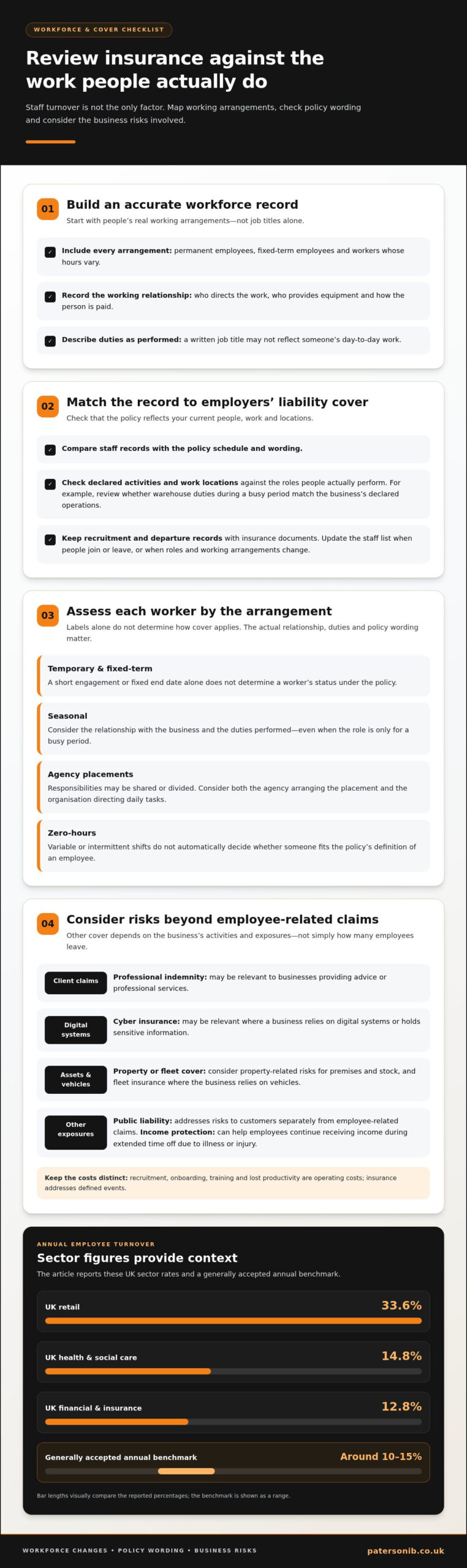
Other cover depends on the business’s risks, not the number of employees who leave. Insurance can address defined events, while recruitment, onboarding and training remain operating costs. Start by considering exposure to client claims, cyber incidents, property damage and disruption involving vehicles.
Professional indemnity insurance may be relevant to firms providing advice or professional services. For example, a consultancy could consider how a claim alleging an error in its work might affect the business. This cover addresses a different exposure from the cost of replacing a departing consultant.
Cyber insurance may be relevant to businesses that rely on digital systems or hold sensitive information. A cyber incident can disrupt operations whether or not staff turnover contributed to it. Separately, income protection can help employees in the UK continue receiving an income during extended time off work due to illness or injury. Employers may consider it as part of their employee benefits approach.
Property and fleet risks depend on what the business owns and how it operates. A retailer with premises and stock may consider property-related cover, while a business that relies on vehicles may review fleet insurance. These policies address risks to business assets and vehicles, not costs directly caused by staff departures.
Match each significant exposure to the relevant policy type, then consider how a claim could affect operations. A manufacturer may prioritise protecting its property and delivery vehicles, while a professional firm may focus more on advice-related claims and digital systems. This keeps insurance decisions centred on actual business risks, while staff retention measures address recruitment and continuity.
Employee turnover rate is the number of employees who leave a company, voluntarily or involuntarily, divided by its total number of employees, expressed as a percentage. Calculate annual turnover by dividing yearly leavers by the average number of employees that year, then multiplying by 100. In the example, 100 employees at the start of the year and 20 departures during the year give a 20% annual turnover rate.
An average of 16.8% of employees in the UK leave their jobs each year, while the annual employee turnover rate in hospitality is 37.6%. Small businesses with employee retention rates below 85% - 90% are probably spending considerable time and money recruiting new talent. These measures can inform workforce planning alongside insurance decisions, but turnover figures do not themselves identify which policy a business needs.
High turnover does not automatically mean higher business insurance premiums. Insurers assess the risks associated with the cover requested, including the nature of the business, its claims experience, and the likelihood and potential impact of insured events. Staffing changes matter when they alter those underlying risks, not simply because employees leave.
For example, frequent changes in a role involving machinery could affect how consistently safety procedures are followed, which may be relevant to an insurer’s assessment of workplace risk. Departures in a role with little effect on insured activities may have less bearing. The impact depends on how staffing changes relate to the risks covered.
Premiums are also affected by the type and extent of cover, the business’s operations and its claims record. A construction business and a professional services firm face different exposures, even if both experience staff turnover. Insurers consider the overall risk profile, not one workforce measure in isolation.
At renewal, explain any significant change affecting insured activities or risk controls. A clear account helps the insurer assess the business as it operates now, rather than relying on outdated assumptions. If turnover has not changed the work or its associated risks, say so plainly. A departure count alone does not give a complete picture of exposure.
There is no universal premium adjustment for staff turnover. The effect depends on how the changes influence the risks, claims history and cover being assessed. For a business-specific discussion, speak with Paterson Insurance Brokers about your insurance needs and how staffing changes relate to your operations.
Paterson Insurance Brokers helps businesses review their insurance needs as staffing patterns and workplace risks change. For construction firms, Construction Insurance can be part of a wider review of site activities, roles and operational exposures. Start with how your business works, including where staff operate and the responsibilities they carry.
Paterson Insurance Brokers also works with businesses in agriculture, retail and wholesale, and manufacturing. If turnover has changed how your team works, include those changes in your insurance review. Clear information about activities, staff duties and risk controls helps make the discussion about cover relevant to your business.
Contact Paterson Insurance Brokers to discuss your business’s insurance needs.
Treat a staffing change as a prompt to review how work is organised, not simply as a rise or fall in headcount. New responsibilities, changes in supervision and altered workflows can all affect the risks your business needs to manage. Keeping an up-to-date picture of these changes gives you a more useful starting point for discussing insurance for businesses with a high staff turnover.
Before your next review, note what has changed in your operations, which roles have shifted and how you manage the resulting risks. This keeps the discussion focused on your business today, rather than assumptions based on an earlier workforce or working pattern.
For a considered discussion about your business insurance needs, contact Paterson Insurance Brokers. A clear understanding of your operations can help you take the next step with confidence.
Let us know your needs and we’ll be in touch shortly.