Make an enquiry
Let us know your needs and we’ll be in touch shortly.


Check out all the latest updates, insights and advice from our expert team.
Before a subcontractor starts work, check that their insurance is current, covers the specific tasks and remains in force throughout their involvement. The dangers of not checking your subcontractor's insurance include uninsured costs after an incident and potential problems if your own policy requires you to verify their cover.
A certificate alone may not show the full picture: limits, exclusions and policy terms matter too. The dangers of not checking your subcontractor's insurance include gaps between the work being done and the activities covered by the policy. For bona fide subcontractors, compare their liability cover with your policy and contract requirements, including any requirement for an Indemnity to Principal clause.
You need clear evidence that the work is protected, without getting lost in policy wording. This article explains how to review subcontractor policies, check relevant indemnity provisions, compare limits with your own cover and confirm that the work falls within the policy. It also explains how the distinction between labour-only and bona fide subcontractors affects what to check.
Yes. A UK main contractor could be held responsible for injury or property damage caused by a subcontractor. Check the subcontractor’s current policy documents before work starts, record the details and confirm that cover lasts for the full project.
Public liability insurance covers a subcontractor’s liability for injury to third parties or damage to their property. For example, a tool dropped at a worksite could damage a visitor’s vehicle, making the policy’s scope relevant to both parties.
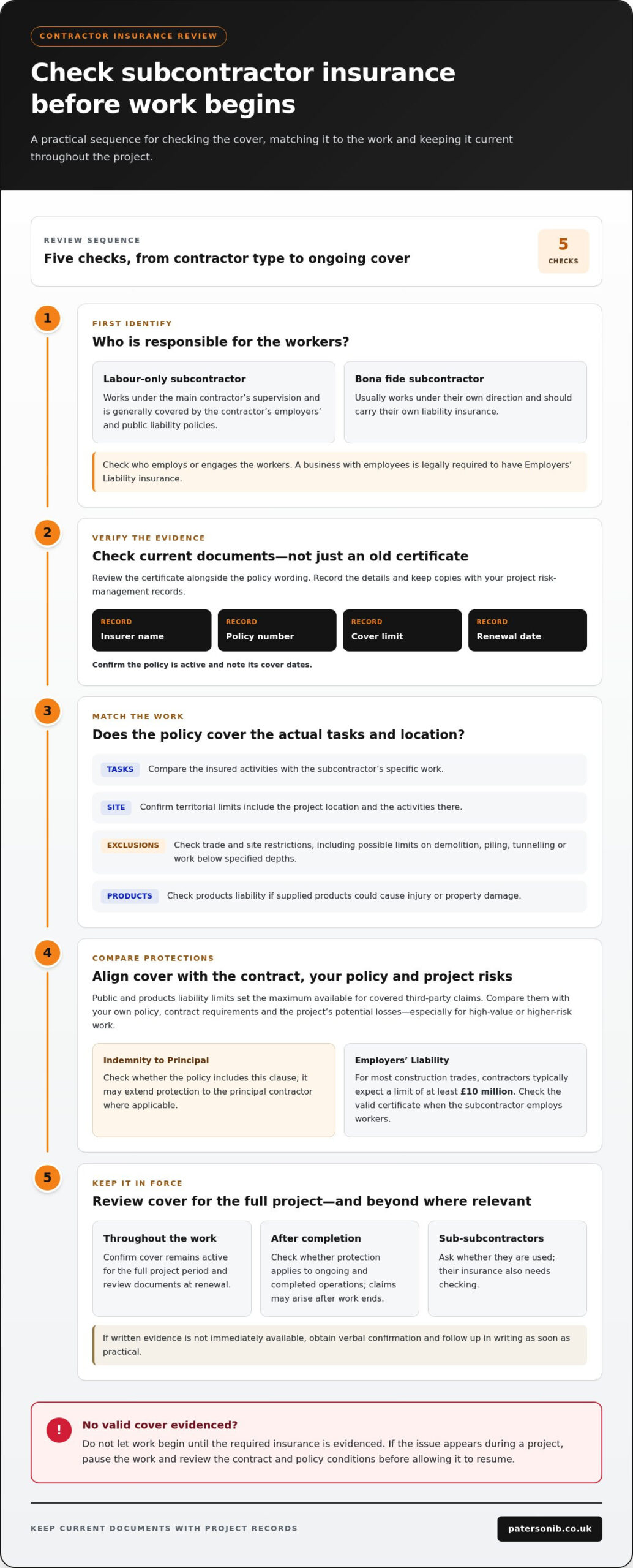
Check the certificate and policy wording, not just an old document. Record the insurer’s name, policy number, limit and renewal date, then verify that cover remains in force. Compare the insured activities with the subcontractor’s actual tasks and keep copies for your risk management records. Check whether the policy includes an Indemnity to Principal clause, which may extend protection to the principal contractor where applicable.
Labour-only subcontractors work under the main contractor’s supervision, so they are generally covered by the contractor’s employers’ and public liability policies. Bona fide subcontractors usually work under their own direction and should carry their own liability insurance.
In the UK, a business with employees is legally required to have Employers’ Liability insurance. Check who employs or engages the workers, and ensure the policy is in that employer’s name and remains active throughout the project. For most construction trades, contractors typically expect an Employers’ Liability limit of at least £10 million. If the subcontractor employs workers, inspect its valid certificate and retain the supporting documents.
Public and products liability limits set the maximum cover available for covered third-party claims, while exclusions define what the policy does not cover. A low limit can leave a shortfall after substantial injury or damage, so compare it with your own policy and the project’s potential losses.
Check that products liability applies if supplied products could cause injury or property damage. Read the exclusions for the specific trade and site conditions: policies may restrict hazardous work such as demolition, piling or tunnelling, or work below specified depths. Confirm that the subcontractor’s cover matches the contract’s insurance clause, the work period and any required minimum limits. Keep the policy documents with your project records.
A UK main contractor may face a claim for injury or damage caused by an uninsured subcontractor. Missing required insurance checks could also affect the contractor’s policy, although premium changes are not automatic.
If a subcontractor has no valid cover, do not let work begin until the required insurance is evidenced. If the issue arises during a project, pause the work and review the contract and policy conditions before allowing it to resume.
Insufficient, unsuitable or expired cover can leave a gap between a loss and the insurance available to respond. A subcontractor’s general liability policy may not cover costs arising from their performance, and the main contractor’s policy may not cover the subcontractor’s tools, possessions, equipment or hired machinery.
Check whether the subcontractor’s policy includes an Indemnity to Principal clause. This may allow the subcontractor’s insurer to indemnify both the subcontractor and principal contractor. Also check whether protection applies to ongoing and completed operations, since a claim may arise after the work ends. Without suitable wording, responsibility and claims may fall back on the main contractor’s own cover.
The client’s contract is with the business that hired the subcontractor, so the client may hold that business responsible for faulty or unsatisfactory work. An insurer may pursue the subcontractor’s insurer through subrogation, but this does not remove the need to check cover before work starts.
Territorial limits define where a policy applies. Confirm they include the project location and the subcontractor’s activities there. Check the policy wording alongside the certificate, noting the insurer, policy number, cover dates and relevant exclusions.
Keep current documents on file and review them at renewal, rather than relying on an earlier certificate. Confirm that cover remains in force throughout the project and ask whether the subcontractor uses sub-subcontractors, whose insurance also needs checking. If written evidence is not immediately available, obtain verbal confirmation and follow up in writing as soon as practical.
Clear insurance conditions in contracts and a consistent review process can strengthen construction risk management. Construction risk management support can help you assess how subcontractor risks fit within your wider cover.
UK law requires businesses with employees to hold Employers’ Liability insurance. Other subcontractor cover requirements may come from policy conditions and contract terms. At tender, compare each bona fide subcontractor’s insurance with the planned work.
Matching means aligning a subcontractor’s limits and policy types with your own cover, contract requirements and the actual trade. On high-value projects, contractors commonly require public liability limits similar to their own when one incident could cause a large loss.
For subcontracted professional services, check that professional indemnity cover is at least equal to your own. A broad trade label may not include specialist tasks: a builder’s policy, for example, may exclude roofing or demolition. Confirm the insured activities match the scope, and check for an Indemnity to Principal clause where required.
Contract requirements specify the cover a subcontractor must maintain for the agreed work. Before awarding the work, review the main contract and subcontract terms for required insurance types, minimum limits, endorsements and cover periods.
Insurance requirements can vary, so check the contract and policy terms to confirm what liability cover the subcontractor needs. Put those requirements into standard engagement terms, then compare tender documents against them. This helps identify gaps before the contractor commits to a scope or start date.
Insurance needs also depend on the project’s exposures. Consider whether Contract Works cover is relevant to physical work in progress, and whether Cyber and Data cover addresses risks from subcontracted access to business systems or information. These covers serve different purposes from public liability, so assess them separately against the contract and work involved.
During tendering, collect policy evidence and compare the insured name, activities, limits and relevant clauses with the proposed tasks. Repeat the review when the contract is awarded and record any conditions the subcontractor must meet before starting. This gives you a clear basis for checking cover against both the project and your own insurance.
A policy responds only within its stated business description, cover terms and conditions. Compare those details with each subcontractor’s actual tasks before work begins.
Check that the main contractor’s policy allows subcontracted work and that the subcontractor’s activities fit the insured business description. A builder undertaking specialist demolition, for example, may be doing work outside the activities insured under their policy.
For construction projects, check policy conditions for bona fide subcontractors, including any requirement to confirm and record their insurance. Public liability may cover office-based clerical tasks, while insurers are more likely to require specific insurance for heavier manual work. If subcontracted design work is involved, check whether your professional indemnity policy covers it and whether the subcontractor’s retroactive date is no later than the start of the design services.
Compare policy limits and endorsements with the requirements in your own policy and subcontract terms. A lower limit can leave a shortfall, while a missing Indemnity to Principal clause may mean claims fall solely on the main contractor’s insurance, even when the subcontractor was at fault.
Check the insured activities, exclusions and required insurance types, including employers’, public and products liability. Where professional services are subcontracted, include professional indemnity in the review. If your policy requires bona fide subcontractors to carry cover at a specified level, failing to meet that condition could affect the insurer’s response to your claim.
A certificate summarises key insurance details; the policy schedule and wording show the specific cover and conditions. Compare the certificate with the schedule, checking the policyholder’s legal name, insurer, policy number, limits and dates.
Make sure the named policyholder is the subcontractor employing or engaging the workers, and that the cover remains active throughout their project involvement. Record the checks and retain copies of relevant documents. At renewal, review updated evidence rather than relying on an expired certificate. Review your business insurance arrangements to assess how policy conditions and subcontracted work align.
Paterson Insurance Brokers provides Construction Insurance for businesses reviewing how subcontractor risks fit into their wider insurance arrangements. Its Risk Management Consultancy can help construction firms assess operational exposures, policy conditions and the cover needed for their work.
Consider speaking with the team when subcontracted activities change, contract requirements are unclear or you’re reviewing your business insurance. A clear assessment can help you understand how construction risks relate to your cover, including where subcontractor work is involved. Paterson also provides insurance for agriculture, retail and wholesale, and manufacturing businesses.
For a considered conversation about your construction insurance needs, contact Paterson Insurance Brokers or visit patersonib.co.uk.
Make insurance oversight part of how your business brings subcontractors onto a project, rather than paperwork to revisit only after an incident. Assign responsibility for keeping records current and reviewing them when a subcontractor’s role changes. This helps your team respond as project requirements evolve.
The dangers of not checking your subcontractor's insurance can extend beyond an individual claim, affecting how confidently you manage project responsibilities. Building regular reviews into your process helps reduce the chance that overlooked cover details become a problem later.
Paterson Insurance Brokers offers Construction Insurance, alongside Agriculture Insurance and Retail & Wholesale Insurance. If you’re considering how your business cover fits its work and subcontracting arrangements, the dangers of not checking your subcontractor's insurance are a good reason to review your approach. Start a conversation with Paterson Insurance Brokers about your insurance needs and approach future projects with greater clarity.
Check that the named business, workers, tasks and project period align across the subcontract and insurance documents. For example, if the subcontract changes from general building work to roofing, compare the revised scope with the policy’s insured activities before authorising the change. Also establish whether the subcontractor will pass work to another firm, so your approval process accounts for every business working on site.
The appropriate cover depends on the subcontractor’s role and work. A subcontractor employing workers needs Employers’ Liability insurance; bona fide subcontractors should carry their own liability cover. Public liability addresses injury or damage to third parties, while products liability may matter if the subcontractor supplies goods. For subcontracted design or other professional services, consider professional indemnity. The work description, contract requirements and policy conditions determine which covers are relevant.
If an uninsured subcontractor causes injury or damages someone else’s property, the business that hired them may face costs and a claim from its customer. For instance, damage to a neighbouring property during site work could lead to a dispute over responsibility and repair costs. A claimant may pursue the company they can identify, so relying on the subcontractor to resolve matters can leave the hiring business exposed.
Compare the certificate with the policy schedule and subcontract, checking that the insured name matches the business doing the work. Review the insurer, policy number, dates, limits and insured activities, then check any endorsements or exclusions relevant to the job. Keep the documents and record the review date. At renewal, obtain updated evidence; if a policy is cancelled or replaced, update the project file before further work proceeds.
There is no single public liability limit that fits every construction contract. Contractors commonly require bona fide subcontractors’ public liability limits to match their own, especially on high-value projects where one incident could cause a substantial loss. For most construction trades, the expected minimum Employers’ Liability indemnity limit is £10 million. Contract terms, project exposure and the main contractor’s policy conditions should guide the required limits.
Let us know your needs and we’ll be in touch shortly.