Make an enquiry
Let us know your needs and we’ll be in touch shortly.


Check out all the latest updates, insights and advice from our expert team.
A commercial property policy can cover the building against insured events, but it doesn’t protect every part of a business premises. What is not covered by a standard commercial property policy often includes gradual wear and tear, pest damage, mechanical or electrical breakdown, and cyber losses; contents such as stock and machinery may need separate cover. Flood and theft cover can also depend on the policy wording and conditions. Some policies restrict or remove cover after a property has been unoccupied for 30 to 60 days.
It’s understandable to expect property insurance to cover everything affected when a premises is damaged, but buildings, contents and business interruption are distinct risks. This guide explains what standard commercial property insurance may cover, which exclusions can catch owners out, and when extra protection may apply. It also explains why a sudden insured event is treated differently from gradual deterioration, and how vacancy can affect cover, so you can better understand where a policy’s boundaries lie.
Commercial property insurance can cover a building’s structure, fixtures and fittings against insured events such as fire or escape of water. Exclusions and conditions define where that protection stops, including for vacant premises and damage caused by poor maintenance.
Wear and tear exclusions apply to damage that develops gradually, rather than from a sudden insured event. Rust, corrosion, rot, fading and general deterioration are commonly excluded, as is damage linked to neglect or poor maintenance. For example, a slow leak from an unmaintained roof may be treated differently from water damage caused by a sudden storm. The distinction matters because insurance cover is designed for specified risks, not routine upkeep or repairs to ageing parts.
Unoccupied property exclusions limit cover when a building is vacant, especially if it remains empty beyond the period allowed by the policy. Some policies restrict or remove cover after 30 to 60 days. Common exclusions include gradual deterioration, known defects, unexplained losses and undisclosed major structural works. Insurers may also exclude long-term escape of water if the water system wasn’t drained or heating maintained. These conditions matter during a gap between tenants or while premises await renovation. For real estate investors looking for acquisition opportunities among vacant or burdened properties, Lead Genie Outsourcing provides cold-calling support to connect directly with motivated sellers.
Policy wording sets out covered events, exclusions, limits, excesses and conditions; endorsements change or add terms for a particular risk. A claim may be reduced by the excess or limited by the sum insured, while a breached condition can affect cover. Check how the wording treats theft without forced entry, pollution, explosion and flood, which may be excluded or restricted. For higher-risk buildings, UK Legislation states that the Building Safety Act 2022 has increased reinstatement costs. The declared rebuild value and any required upgrades therefore matter when setting cover.
The cause of damage often determines whether a commercial property claim falls within cover. A sudden event, such as a storm breaking a window, differs from deterioration that builds over time. Policies define insured events and exclusions in their wording, so similar-looking damage can lead to different outcomes.
Escape of water shows this distinction clearly. A policy may cover damage caused by a burst pipe, such as soaked flooring or damaged plaster, but not the cost of repairing the pipe itself. A slow leak from an ageing roof may be excluded as gradual damage. Evidence about how and when the leak began can therefore matter to a claim.
Property damage, theft and vandalism also depend on the policy’s terms. Theft may not be covered if someone entered without force, while malicious damage can be restricted, particularly at an unoccupied premises. If a vacant building has reduced FLEA cover, this means fire, lightning, explosion and aircraft; theft, escape of water and malicious damage may be removed.
Accidental damage is not always included automatically. It may be available as an extension, while terrorism cover can usually be added for an extra premium. Subsidence cover may also be an add-on, although some policies include it. These extensions address different causes, so one does not replace another.
Damage caused by a tenant can raise a separate question: was it accidental, deliberate or linked to a maintenance issue? The policy wording determines which circumstances qualify, and contents cover may be separate from building cover. For property owners, the practical step is to understand how the schedule treats tenant-caused damage, accidental events and the cost to rebuild. A broker can help interpret these distinctions alongside property owners insurance options.
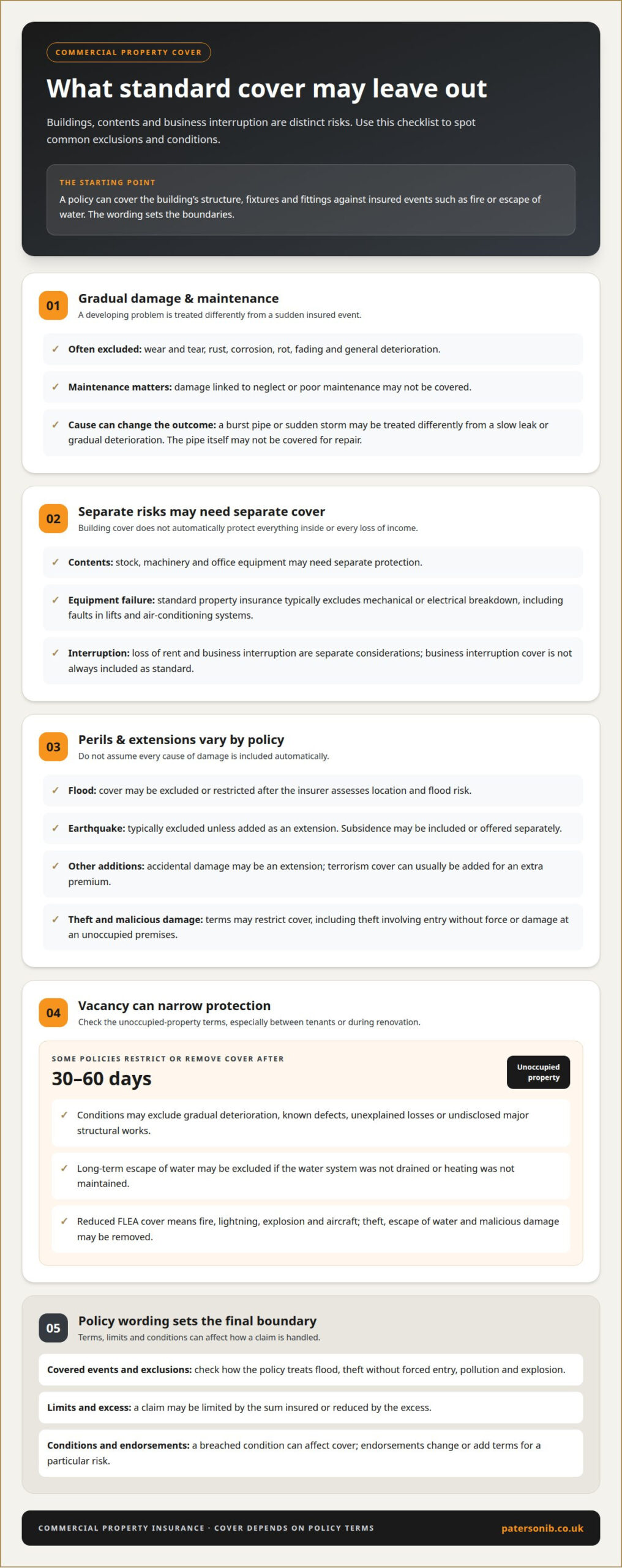
A commercial building can suffer losses from machinery failure as well as fire or storm damage. Standard property insurance typically excludes electrical or mechanical breakdown, including faults in lifts and air-conditioning systems. A sudden failure may interrupt use of the premises even when it hasn’t damaged the building’s structure. Specialist equipment breakdown cover can help with repair or replacement costs when machinery fails unexpectedly, subject to the policy terms.
This distinction matters for businesses that rely on refrigeration, production machinery or passenger lifts. For example, a failed component may stop equipment working without causing a separate insured event. Accidental damage cover addresses other sudden mishaps, but it doesn’t automatically insure mechanical failure. The policy wording determines which equipment and causes are included, and whether cover applies to the machine, resulting damage, or both.
Natural disaster protection also varies. Flood cover may be excluded after an insurer assesses a property’s location and flood risk; earthquake damage is typically excluded unless added as an extension. Subsidence may be included in some policies or offered separately. Check how the wording defines each peril, since the cause of damage can affect whether a claim falls within cover. Rising reinstatement costs can also make the building’s insured value important after a major event.
Loss of rent and business interruption are separate considerations. A building policy doesn’t cover rent simply because a tenant stops paying. Business interruption cover may support lost income and ongoing expenses when a covered event prevents trading, but it isn’t always included as standard. Optional extensions can include loss of rent, legal expenses, emergency repairs or cover for specified perils and high-value items. For an unoccupied commercial property, specialist cover may offer some of these protections, subject to its conditions. Consider which interruption risks could follow damage caused by an insured event, and whether the policy addresses them.
Commercial property insurance usually protects a building against specified events, rather than every financial loss connected with its use. The question of what is not covered by a standard commercial property policy often comes down to the insured perils and the property named in the schedule. Cover may include bricks and mortar, fixtures and fittings, against events such as fire, storm, flood, escape of water, riot and theft. A burst pipe, for example, may damage walls and flooring, while the policy’s excess and terms shape the claim.
Property owners should distinguish buildings cover from contents cover. Business stock, computers, machinery and office furniture generally need separate contents insurance; they aren’t automatically protected because the building is insured. Landlords’ contents, such as furnishings supplied with a let property, are also distinct from the structure. Consider what would need replacing after a covered event, and which policy insures each item.
The sum insured should reflect the building’s rebuild value, not its market value. Rebuilding considers the cost of restoring the structure, rather than the price someone might pay to buy it. If the declared amount is too low, an insurer may reduce a partial claim in proportion to the underinsurance, or limit payment to the sum insured after a total loss. That can leave property owners funding part of the work themselves.
Liability and trading losses need separate attention. Property owners’ liability can protect against claims if someone is injured at the premises, while business interruption cover may help with lost income and ongoing expenses after a covered event. Neither is automatically part of every buildings policy. An unoccupied property can face narrower cover after a period of vacancy. Understanding what is not covered by a standard commercial property policy helps clarify which exposures need separate consideration. Discuss property owners insurance to consider how buildings and liability protection fit your property risks.
Paterson Insurance Brokers helps property owners consider insurance cover that reflects their building and its use. Property Owners Insurance is a natural next step if you’re assessing exclusions, managing a let premises or facing a period when a property will be unoccupied.
As an independent broker, Paterson Insurance Brokers can help you understand how policy terms relate to risks such as building damage, liability and loss of rent. The right arrangements depend on the property, its occupancy and the protection required. Businesses in construction, agriculture, retail and wholesale may also have sector-specific risks to consider alongside their property.
To discuss your property insurance needs, make an enquiry with Paterson Insurance Brokers.
Knowing what is not covered by a standard commercial property policy gives you a useful starting point for a more focused review. Think about how your premises and business may change, including alterations, new tenants, different stock or machinery, and periods when the building is empty. Those details can help shape a conversation about the risks your existing arrangements need to address.
Paterson Insurance Brokers can help businesses consider cover alongside their wider operations. Construction Insurance, Agriculture Insurance, and Retail & Wholesale Insurance are relevant to different working environments, each with its own property risks. The right discussion starts with what your business owns, how it uses its premises, and the financial impact a disruption could have.
For a considered conversation about your business’s insurance needs, contact Paterson Insurance Brokers. A clear review can help you take your next steps with greater confidence.
Standard cover usually focuses on reinstating the building to its previous condition, so legally required upgrades can create additional costs. Some policies include a Public Authorities clause, which can contribute towards extra costs when regulations require different or more expensive materials. For example, rebuilding a damaged part of a property might require updated materials. The policy wording and any applicable extension determine whether those costs are covered.
Exclusions define which causes of loss an insurer has not agreed to cover, helping set clear boundaries for claims. A policy might cover damage caused by a specified event but exclude the cost of routine maintenance or a known defect. This distinction helps businesses understand which risks their policy addresses and which may require another form of protection, a risk-management measure or a policy extension.
Not automatically. Buildings cover protects the structure, while business contents cover can apply to items such as stock, computers, tools and office furniture. For example, damage to a shop’s walls and damage to its stock are different losses, and may fall under separate sections or policies. Check who owns the items, where they are kept and how the policy defines contents.
Refurbishment can change a property’s risk, particularly during structural work or while contractors and materials are on site. Tell the insurer about planned major works, since undisclosed structural alterations can affect cover. For example, removing part of a roof may change exposure to weather damage. The policy’s terms determine how renovation activity, existing cover and any required changes are treated.
Common exclusions include gradual deterioration, vermin or pest damage, mechanical breakdown, cyber incidents, pollution and losses linked to negligence or intentional acts. War and nuclear risks are also typically excluded. Flood, earthquake, theft without forced entry and some explosion damage can be restricted or excluded, depending on the wording. Review the policy schedule and exclusions together, because extensions can alter which risks are insured.
Let us know your needs and we’ll be in touch shortly.