Make an enquiry
Let us know your needs and we’ll be in touch shortly.


Check out all the latest updates, insights and advice from our expert team.
A fatality alone does not make an organisation guilty of corporate manslaughter. Under Section 1 of the Corporate Manslaughter and Corporate Homicide Act 2007, which the National Archives identifies as creating the offence, organisational liability depends on a gross breach of duty linked to how senior management organised or managed activities.
It’s understandable to want clarity about where an organisation’s responsibility ends and directors’ individual exposure begins. The distinction matters: the corporate offence applies to the organisation, while senior individuals may face separate proceedings.
This article explains corporate manslaughter in the UK, how an organisation’s turnover and the seriousness of an offence can affect fines, and why senior management involvement is central to liability. It also explains what insurance may cover, where its limits lie, and how business insurance and risk management can help organisations assess their exposures.
The Corporate Manslaughter and Corporate Homicide Act 2007 came into force on 6 April 2008. It provides for an organisation to be prosecuted when a death results from a gross breach of a relevant duty of care. The offence concerns organisational failings, rather than treating every workplace fatality as corporate manslaughter. In Scotland, it is called corporate homicide; elsewhere in the UK, it is corporate manslaughter.
Defence work can start during an investigation, before a trial. It may involve preparing an organisation’s representatives for interviews under caution, managing evidence and disclosure, and representing interested persons at an inquest. Police, regulators and coroners may each examine different aspects of a fatal incident, so these stages can require coordinated legal advice.
Directors and senior managers are not charged with the corporate offence itself. They may, however, face separate proceedings, including investigations into gross negligence manslaughter or health and safety offences. Directors’ and Officers’ Liability is designed to protect management against claims relating to duties and alleged wrongdoing. The policy wording determines how it treats individual defence costs.
How much does corporate manslaughter insurance cost in the UK? There is no single price: the cost depends on the organisation and the cover required. An insurer determines the premium based on the circumstances and selected cover.
Do employers’ liability or public liability policies cover these claims? Some general liability policies include legal protection under a “Defence of Legal Rights” provision or similar wording. This wording does not automatically mean that every criminal defence cost is covered.
What exclusions apply? Exclusions and conditions vary by policy. Review how the wording treats defence costs, investigations and insured persons.
What steps can UK businesses take to reduce risk and insurance costs? Review health and safety procedures, apply risk controls consistently, and act on issues identified through incidents or investigations. These steps can address operational failings, but they do not guarantee lower premiums, which depend on the organisation’s circumstances and selected cover.
The legal threshold is more demanding than a preventable accident or an isolated mistake. Under Section 1(4)(b) of the Corporate Manslaughter and Corporate Homicide Act 2007, a gross breach falls far below what can reasonably be expected of the organisation in the circumstances. The question is how serious the organisation’s failure was, viewed in context.
Senior management involvement connects the legal threshold to an organisation’s wider arrangements. Investigators may examine how managers organised or managed the activities linked to the death. For example, the way work was structured may be more relevant to organisational liability than one employee’s error, particularly if the failure arose from management of those activities.
This explains why the offence is not simply a judgment on whether safety procedures existed. The key question is whether a gross breach arose from the organisation’s management of its activities. The work and the related management decisions shape that assessment; “gross” means a serious departure from reasonable expectations.
The organisation and individuals face different legal questions. A company may be investigated for corporate manslaughter, while a director or manager may separately be investigated for gross negligence manslaughter or health and safety offences. These are distinct proceedings, even when they follow the same fatal incident. Corporate liability concerns organisational management; individual proceedings concern a person’s own alleged conduct.
For businesses, the practical value of understanding this threshold is to assess how management decisions connect with operational risks. A risk management consultancy can help examine how responsibilities and risk controls are organised across business activities.
That framework makes the connection among the death, the duty of care and senior management’s role essential: an organisation may be guilty where a death results from a gross breach of duty of care arising from the way senior management organised or managed activities. A corporate manslaughter conviction requires a gross breach of a relevant duty of care. These requirements concern the organisation’s management of activities, rather than simply the presence of risk or an individual’s error.
The judicial direction quoted on gross breach cites R. v. Misra [2004] EWCA Crim 2375.
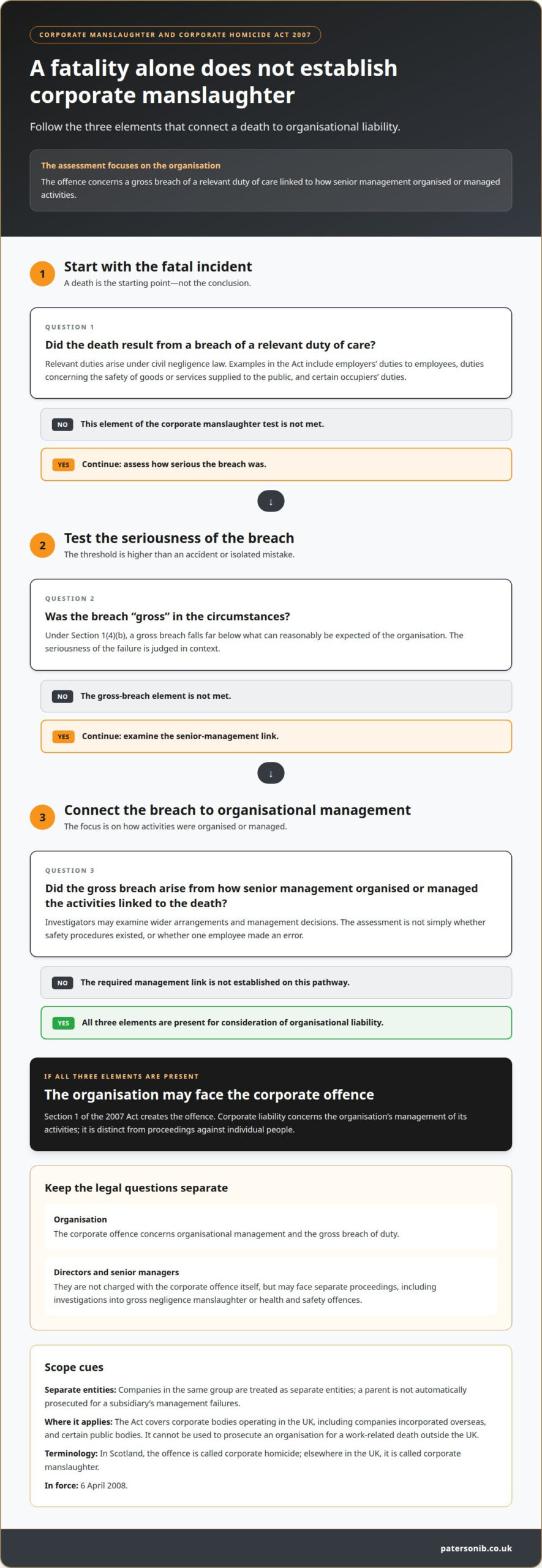
Section 1 of the Corporate Manslaughter and Corporate Homicide Act 2007 creates the offence, according to The National Archives. The legislation applies to corporate bodies operating in the UK, including companies incorporated overseas, and certain public bodies. It cannot be used to prosecute an organisation for a work-related death outside the UK. The relevant organisation’s legal identity therefore matters when considering liability.
Companies in the same group are treated as separate entities under the Act. If management failures occur within a subsidiary, the parent company is not automatically prosecuted for them. Liability is considered in relation to the organisation whose activities and management are at issue. This makes the group structure relevant when investigators identify the entity connected to a fatal incident.
The Act does not create new duties of care. Relevant duties arise under the civil law of negligence and include employers’ duties to employees and duties concerning the safety of goods or services supplied to the public. The legislation also includes certain occupiers’ duties. These boundaries help distinguish the corporate offence from separate health and safety offences.
In England and Wales, if the existence of a duty of care is disputed, the judge decides that legal question, including any necessary findings of fact. The organisation’s breach need not be the sole or main cause of death, but it must be a substantial cause. These rules help determine which organisational conduct can be considered in a prosecution.
The Act also covers deaths in specified forms of custody, including prison, police and immigration detention. It provides exceptions from liability for certain actions by public bodies. Organisational status, the setting of the death and the duty involved all help determine whether the offence applies.
Yes. UK organisations can obtain affirmative cover for corporate manslaughter defence costs. This contributes towards specified legal costs; it does not protect against every financial consequence of a fatal incident. The policy wording sets out the scope, limits and conditions.
Defence may involve several connected processes, not just a court hearing. Police may interview representatives under caution, while an inquest examines the circumstances of a death. Legal work may include preparing evidence, managing disclosure and representing interested persons. Consider these possible stages when reviewing what a policy covers.
Protection for individuals is a separate consideration. The corporate offence is brought against the organisation, while directors and senior managers may face separate proceedings. Directors’ and Officers’ Liability is designed to protect management against claims relating to duties and alleged wrongdoing. Its wording determines which investigations or proceedings involving insured persons fall within cover.
General liability policies may also contain a “Defence of Legal Rights” provision or similar wording. This may provide legal protection, but it is not automatically equivalent to affirmative corporate manslaughter cover. Employers’ or public liability insurance may respond to compensation claims following death or serious injury, while criminal defence costs raise a separate policy question.
Read the relevant policy sections together: insured parties, covered proceedings, defence-cost limits, notification requirements, exclusions and consent provisions can all affect how protection works. Compare cover for the organisation with cover for directors, as one policy may not address both exposures. Also distinguish defence expenses from fines or other consequences of conviction. Insurance does not automatically cover every cost.
For a clearer view of how your existing business insurance addresses organisational and management risks, request an insurance review.
For death or serious injury in England and Wales, compensation assessment will usually be complex and will ordinarily be covered by insurance; some companies questioned insuring liabilities under the Corporate Manslaughter and Corporate Homicide Act 2007.
Paterson Insurance Brokers helps businesses consider how their insurance and risk management arrangements relate to organisational risks, including the consequences of a fatal incident. For companies in construction, agriculture, retail and wholesale, or manufacturing, the nature of work and safety exposures can shape the wider insurance review.
An independent broker can help clarify how your business policies fit together, what risks they address and which terms need careful attention. The review should reflect your organisation’s circumstances and consider tailored solutions, rather than assume one policy covers every legal cost or consequence.
For a clear, advice-based conversation about your business insurance and risk management needs, contact Paterson Insurance Brokers.
Use your next insurance review to connect risk controls with the realities of your work. Consider whether responsibilities are clear, safety procedures are followed and your policies reflect activities that could bring scrutiny after a serious incident. Corporate manslaughter insurance cover is only one part of the picture; it is also important to understand how insurance fits alongside day-to-day risk management.
Paterson Insurance Brokers helps businesses consider tailored protection, including Construction Insurance, Agriculture Insurance, and Retail & Wholesale Insurance. A review can focus on your organisation’s circumstances and the risks arising from its operations, rather than treating policies as interchangeable. This provides a practical starting point for assessing your arrangements and identifying areas for further consideration.
Contact Paterson Insurance Brokers to discuss your business insurance needs and take a measured next step with confidence.
Depending on the policy wording and applicable limit, cover may contribute to an organisation’s legal defence costs. For example, a business facing a police investigation may need legal advice before making formal statements, while separate proceedings may require further representation. Review how the policy treats these stages, who qualifies as an insured party and whether approval is required before legal costs are incurred.
Paterson Insurance Brokers provides business insurance brokerage and risk management consultancy to organisations seeking suitable protection. It arranges commercial policies rather than underwriting them directly. An advice-based discussion can consider how Directors’ and Officers’ Liability and other relevant arrangements relate to your organisation’s circumstances. The insurer’s policy wording determines the specific protection.
In England and Wales, corporate manslaughter carries an unlimited fine, with guideline fines ranging from £180,000 to £20 million depending on the organisation’s turnover and the seriousness of the offence. A convicted organisation may also be ordered to publicise its conviction or remedy the cause of the fatal injury.
Let us know your needs and we’ll be in touch shortly.