Make an enquiry
Let us know your needs and we’ll be in touch shortly.


Check out all the latest updates, insights and advice from our expert team.
What happens when a manufacturer is ready to produce but a key supplier cannot deliver? Contingent business interruption insurance in the UK may help protect income when disruption at a covered supplier, customer or service provider affects a business’s ability to trade. The cover depends on the policy wording and the events it includes.
For manufacturers, disruption can ripple through the supply chain: a missing component may halt production, delay orders and reduce revenue. But a policy will not necessarily respond. Exclusions, named-provider requirements and cover limits can all affect whether a loss is insured.
This article explains how contingent business interruption cover works, which exclusions and provider rules may apply, and how evidence can affect a manufacturer’s claim. It also covers the need to link the disruption to lost income and map key dependencies when arranging protection, so the cover reflects how your business relies on suppliers, customers and essential services.
Contingent business interruption insurance in the UK may protect a business’s income when an insured disruption at a dependent supplier, customer or utility affects its ability to trade. For example, a manufacturer may be unable to obtain a critical component.
Supply-chain concentration means relying heavily on a small number of suppliers, customers or service providers. A broker can map key inputs and sales relationships, then assess how each failure could affect production or income. They will consider whether alternatives exist and how quickly operations could adapt. The cost of contingent business interruption insurance in the UK depends on factors such as dependencies, cover levels, employees, uninsured working expenses and claims history.
Supplier disruption occurs when a business your operations depend on has problems. Insolvency can remove a critical source of materials, while shipping disruption can delay goods and interrupt production. Pandemics may also affect supply chains, but these events are not automatically covered. Supplier bankruptcy and general supply-chain delays are commonly excluded unless additional cover applies. Pandemic exclusions also appear in many policy wordings, so the cause and policy trigger matter.
Any business that depends on outside goods or services may face interruption if a key provider cannot deliver. A missing component can stop a manufacturer’s production; retailers and wholesalers may lose sales if stock cannot arrive. Businesses relying on an external utility or service provider can also be affected. A broker can assess critical dependencies, concentration and whether alternatives could limit lost income.
Cover may respond to disruption at a supplier’s or customer’s premises, but the policy must include the relevant dependent property and event. Some policies cover only named suppliers, manufacturers or customers; others define covered locations narrowly. Cover added to a commercial property policy is generally limited to its listed perils. Premises are not automatically covered: the wording, named relationships and trigger determine whether an interruption qualifies.
Contingent business interruption cover often depends on physical damage to a dependent property caused by an insured event. If the cover is part of a commercial property policy, it is generally limited to that policy’s named perils. A supplier closure caused by an event outside those perils may therefore lead to actual losses without triggering insurance cover.
Provider definitions can narrow cover further. Some wordings cover only named suppliers, manufacturers or customers; others define dependent properties in ways that exclude particular facilities. Cyber incidents, labour strikes, pandemics and insolvency may also be excluded. A policy may cover damage at a direct supplier but not disruption at that supplier’s own provider. Overseas locations may fall outside cover if the policy’s territorial wording does not include them.
Policy forms also differ. Standard insurer forms, proprietary wordings and bespoke manuscript policies can define triggers, providers and exclusions differently. The 9/11 attacks in 2001 and the Icelandic ash cloud in 2010 showed how narrowly drawn triggers can leave losses uncovered when businesses lose access to airspace. A global supply chain makes territorial scope especially relevant: the location of the damaged property and the stated trigger both matter.
Limits and indemnity periods shape how much a claim can recover and for how long. Business interruption placements commonly use indemnity periods of 12-24 months, based on realistic recovery modelling. Contingent cover may also have a sublimit below the main business interruption limit, so the available amount can be lower than expected losses. These figures and definitions sit in the policy schedule and wording.
For a claim, the business must show that a covered event affected the specified provider and caused its interruption losses. Prompt notification is important: a delay, or action taken before notifying the insurer, may reduce or prevent cover. Accurate records of the interruption, lost income and recovery costs help show the actual impact and link it to the policy trigger.
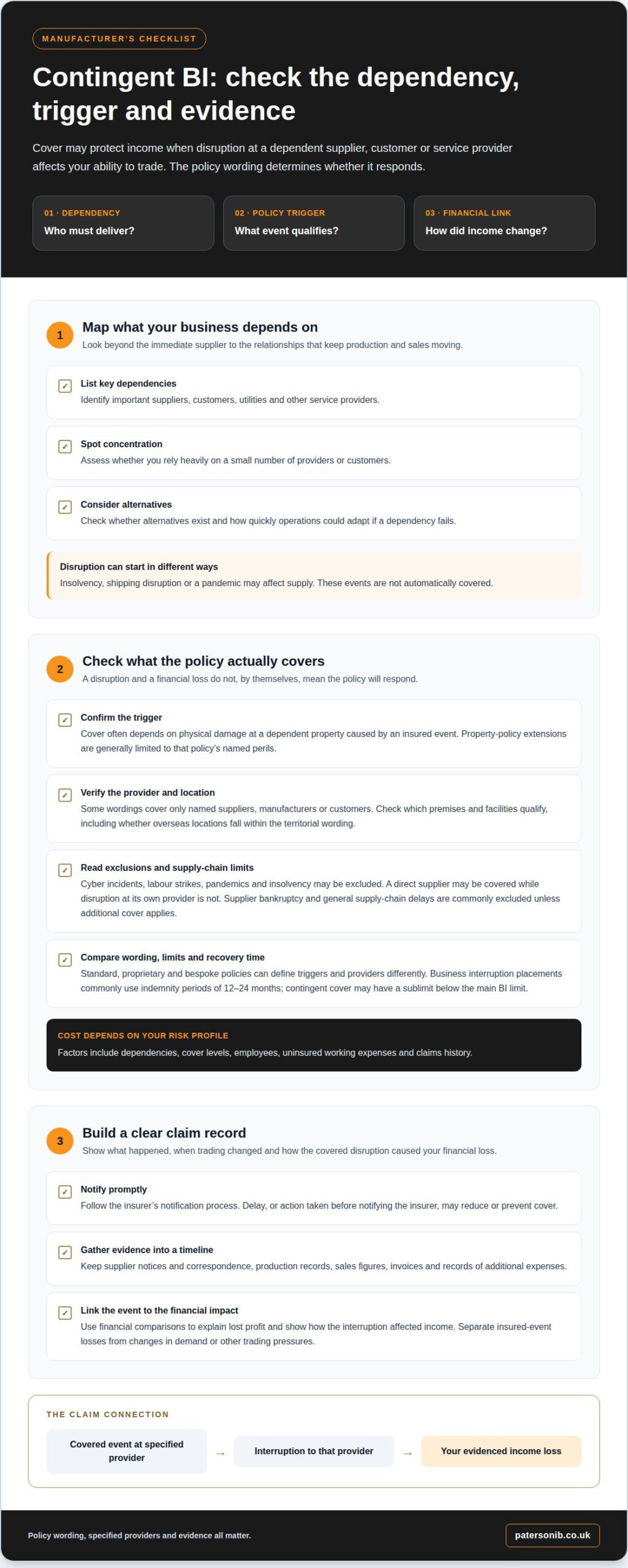
A contingent business interruption claim connects disruption at another business to your own financial loss. Showing that connection, and distinguishing it from other causes, is central to demonstrating how the interruption affected your trading.
A broker helps organise the claim, explain the policy requirements and present how the disruption caused the loss. They can help identify the relevant insurer notification process, gather financial information and distinguish insured losses from wider trading changes. Legal expenses insurance within a commercial policy could help fund potential claims and may cover an adverse costs order if a claim fails. Legal expenses claims normally need prospects of success of at least 51%.
Claim evidence should show what happened at the dependent business, when normal trading changed and how the disruption affected income. A broker can help organise supplier notices, correspondence, production records, sales figures and additional expenses into a clear timeline. Financial comparisons can help explain lost profit, while invoices support costs incurred to reduce disruption. Strong records also help distinguish losses caused by the insured event from changes in demand or other trading pressures.
A food producer lost about £140,000 in sales after a supermarket regional distribution centre it relied on flooded and closed for a month. The example shows why a claim needs evidence connecting a specific interruption to lost sales. Aggregating related losses helps insurers and reinsurers assess the total exposure across affected dependencies and claims.
Manufacturers can lose production when a key supplier fails to deliver a component, even if their own premises remain undamaged. Reliance on international suppliers, tight production tolerances and geopolitical uncertainty can make one missing input difficult to replace. A car illustrates the dependency: Swiss Re gives an automobile as an example of a product that may contain approximately 28,000 parts.
Assessing exposure means tracing how disruption could affect each product line, site and revenue stream. A broker can identify critical suppliers, the materials or services they provide, and whether another source could keep production running. Swiss Re suggests that selected high-volume product lines in a supplier-risk study should cover at least 80% of total turnover. It also suggests focusing on product lines with sales exceeding EUR 10 million.
Tiered supply chains complicate the picture. A policy may cover a direct supplier but not that supplier’s own provider, while a manufacturer may depend on several vendors for one finished product. Swiss Re suggests that limits for named suppliers’ suppliers could be capped at a maximum of 10% of the limits for direct suppliers. The insurance policy’s definitions, triggers and sublimits determine whether losses incurred further down the chain fall within business interruption cover.
Other pressures can compound a supplier failure. Sharp demand increases, labour shortages and government-mandated closures can affect output or make it harder to distinguish insured losses from wider trading changes. The 2025 Jaguar Land Rover cyber incident put around 120,000 UK supply-chain jobs at risk, according to the Cyber Monitoring Centre. That example underlines why manufacturers need to consider cyber disruption alongside physical damage and supplier continuity.
A broker can help connect the supply-chain assessment to the policy wording, including named dependencies and appropriate limits. To discuss manufacturing insurance and supply-chain risks, speak with Paterson Insurance Brokers.
Paterson Insurance Brokers helps businesses consider how supply-chain dependencies fit within their wider insurance and risk management needs. As an independent brokerage, it can assess your business’s circumstances and explain how policy wording, covered events and limits relate to potential interruptions. This can be useful when reviewing existing protection, planning around a critical supplier or considering how manufacturing, agriculture, construction, retail or wholesale operations may be affected by disruption.
Use your next insurance review to consider how your business may change, not just how it operates today. New products, changes to sourcing or expansion into different markets can shift which relationships are essential to your trading. Reviewing these changes alongside your wider risks can help identify where your insurance arrangements need a fresh look.
For businesses considering contingent business interruption insurance in the UK, an independent broker can bring these questions into a broader conversation about commercial protection. Paterson Insurance Brokers also arranges Construction Insurance, Agriculture Insurance and Retail & Wholesale Insurance, helping businesses consider cover in the context of their operations.
Contact Paterson Insurance Brokers to discuss your business’s insurance needs and take a considered next step.
Standard business interruption cover generally responds to insured damage at your own premises, not every interruption elsewhere. If a fire damages a supplier’s plant while your site remains intact, the event may not meet your policy’s trigger. Contingent cover addresses certain losses arising from dependent businesses, but the supplier, damage and interruption must all fit the policy terms.
Not automatically. Pandemic-related interruption is widely excluded from business interruption cover, while general supply-chain delays are commonly excluded unless additional cover applies. A delayed shipment differs from physical damage to a named supplier’s premises, and the policy may treat each cause differently. The defined events, covered relationships and exclusions determine whether resulting losses qualify.
Consider it if disruption at an external business could prevent you from fulfilling orders, supplying customers or earning income. For example, a food manufacturer relying on one specialist ingredient may face a sharper interruption than a business able to switch inputs quickly. The key considerations are dependency, likely financial impact and practical alternatives, not simply the number of suppliers.
A broker can organise a clear picture of important suppliers, customers, inputs and the effect their interruption could have on trading. Insurers may ask which relationships account for more than 20-30% of turnover or inputs. Showing these dependencies alongside locations, product lines and alternatives helps explain where disruption could create concentrated exposure.
The calculation focuses on financial loss linked to the covered interruption, not every fall in sales during the same period. Some policies assess lost profit using the business’s profits in preceding months. Records of turnover, orders, operating expenses and interruption-related extra costs can help distinguish the event’s impact from unrelated changes, such as weaker customer demand.
No. Business interruption insurance is not a legal requirement in the UK, according to NFP. A business may still choose it to protect against income loss, but the decision depends on its financial resilience and exposure to interruption. Consider whether the business could meet continuing expenses if trading stopped and whether a separate contract requires particular insurance protection.
Let us know your needs and we’ll be in touch shortly.