Make an enquiry
Let us know your needs and we’ll be in touch shortly.


Check out all the latest updates, insights and advice from our expert team.
Calling someone a freelancer does not, by itself, determine who bears the risk. Assessing the risk of vicarious liability from freelance contractors means examining the real working relationship and whether the alleged wrongdoing is sufficiently connected to the work. A business is not automatically liable for a genuinely independent contractor, but the position can be less clear when the arrangement resembles employment.
That distinction matters when you bring specialist help into your business. A written agreement can set expectations, but how the work is managed in practice matters too. Clear responsibilities, suitable indemnities and appropriate insurance can all form part of a considered approach to risk.
This article explains when a contractor may be treated as working in an employment-like relationship, what courts consider, and how contract terms and insurance can help manage exposure. It also explains the limits of these measures, giving you a clearer view of your responsibilities.
Courts assess the real relationship between the parties, not simply the title in an agreement. In Barclays Bank plc v Various Claimants [2020] UKSC 13, the Supreme Court distinguished a true independent contractor from an employment-like relationship.
An employee works under a contract of employment, while a genuinely independent contractor conducts a business on his own account. Section 230(3)(a) of the Employment Rights Act 1996 describes a person working under a contract of employment as a worker. Its separate worker definition, in section 230(3)(b), does not decide vicarious liability. The distinction matters because a business may be liable for an employee’s civil wrong, but isn’t automatically liable for a truly independent contractor’s act.
No. Calling someone a freelancer in a contract does not prevent vicarious liability in the UK. Courts examine how the arrangement works in practice, so the written label cannot settle the issue alone. In Barclays Bank, the Supreme Court found Dr Bates was in business on his own account, so the bank was not vicariously liable for his alleged assaults. The decision shows why the substance of the relationship matters to both parties.
The Supreme Court’s approach has two stages: a qualifying relationship, then a sufficient connection between that relationship and the wrongful act or omission. In Cox v Ministry of Justice [2016] UKSC 10, the Court considered whether a tortfeasor’s activities were attributable to an independent business. The case also found the prison service could be vicariously liable for a prisoner’s negligence while working in a prison kitchen.
A single label or factor does not settle whether a relationship is employment-like. The Supreme Court said its five relationship factors can help in doubtful cases, but need not be considered when the person who committed the tort clearly runs an independent business. Integration into operations and the degree of control may inform arguments, particularly when contractor personnel are managed like employees.
A qualifying relationship alone is insufficient. In WM Morrisons Supermarkets plc v Various Claimants [2020] UKSC 12, the Supreme Court addressed the separate connection requirement.
Vicarious liability is secondary legal responsibility for another person’s civil wrong. In the UK, a business is generally not liable for a tort committed by a genuinely independent contractor carrying out an engagement.
Key cases include Barclays Bank plc v Various Claimants [2020] UKSC 13, which confirmed the rule for a contractor in business on his own account. D&F Estates Limited v Church Commissioners for England sets out the general principle for contractor negligence. Woodland v Swimming Teachers Association [2014] AC 537 also states that vicarious liability has not extended to truly independent contractors.
An independent contractor typically runs a separate business rather than working as part of the defendant’s organisation. The practical question is who directs and takes responsibility for the work. For example, a contractor who organises their own work and delivers a defined service may be acting as an independent business. The contract matters, but the actual arrangement matters too.
The independent contractor rule does not remove the contractor’s own responsibility. A contractor can be liable for their own tort, including copyright infringement. That is distinct from making the business that engaged them vicariously liable. Claimants may therefore need to consider who committed the wrong and whether another legal basis connects the defendant to the loss.
A non-delegable duty is a separate issue. In Woodland v Essex County Council [2013] UKSC 66, the Supreme Court considered when a defendant owes a duty that cannot be avoided by appointing a contractor. In Hughes v Rattan, a dental practice owner owed patients such a duty despite using self-employed dentists. This shows that outsourcing alone doesn’t settle responsibility.
For a business, the useful distinction is between liability for a contractor’s tort and responsibility for a duty the business itself owes. Business risk planning can help frame those exposures alongside contractor arrangements.
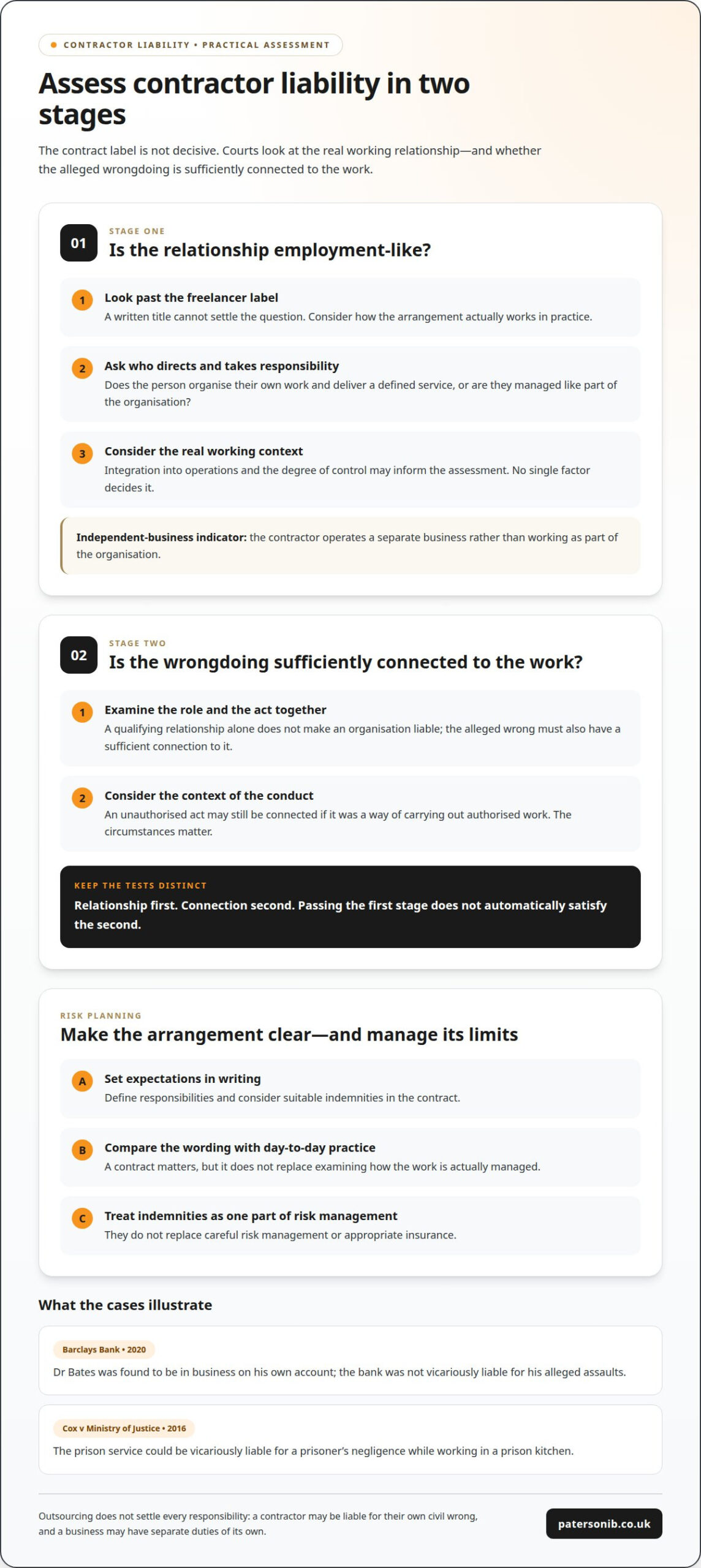
Vicarious liability can make an organisation liable for a worker’s civil wrong. Courts apply two stages: first, they consider the relationship; then they assess whether the wrongdoing is sufficiently connected to it.
The close connection test asks whether the employee’s role is sufficiently connected to the wrongful act. It matters because a qualifying employment relationship alone doesn’t make an organisation liable. In Lister v Hesley Hall Ltd [2001] UKHL 22, the House of Lords established this approach. An employee’s unauthorised act may still be connected if it was a way of carrying out authorised work.
In Mohamud v WM Morrison Supermarkets plc [2016] UKSC 11, the Supreme Court held the employer liable for an employee’s assault on a customer. By contrast, WM Morrisons Supermarkets plc v Various Claimants [2020] UKSC 12 concerned the second stage and found no sufficient connection for the employee’s conduct. Together, these decisions show why the court examines the position and context, not simply whether wrongdoing happened at work.
The relationship test asks whether the connection between the organisation and the person who committed the tort is employment or sufficiently akin to it. The Supreme Court says five employment relationship factors can help in doubtful cases, but are not needed when the person clearly runs an independent business. This distinction helps parties assess the relationship before considering the alleged act.
Both stages matter. A business may face a vicarious liability claim only if the relationship qualifies and the act is sufficiently connected to the work. In Barclays Bank plc v Various Claimants [2020] UKSC 13, the Supreme Court found no qualifying relationship with a self-employed doctor in business on his own account. The appeal succeeded at the first stage, so the connection test did not make the bank liable.
An employee’s motive does not determine vicarious liability, although intention may affect whether the conduct creates liability in the first place. For an organisation, separating the two legal questions clarifies its position: identify the relationship, then assess the link between the role and the alleged wrong.
Clear controls can clarify responsibility and support a considered response if a claim arises. After an injury or financial loss, record the facts, notify relevant insurers and assess the contractor’s conduct and working relationship. These steps help manage the risk of vicarious liability from freelance contractors.
Contractor risk management means setting responsibilities while keeping the contractor’s management structure separate. Courts assess the practical relationship, not just the contract wording. The contractor should retain responsibility for recruitment, training, supervision, performance management and discipline. A careful selection process can help identify competent people before work begins. Define the work and reporting arrangements clearly, without managing contractor personnel as employees.
An indemnity allocates responsibility between contracting parties, while insurance may help meet covered losses. Neither automatically prevents a claimant from bringing a claim against the business. Set out responsibilities in the agreement and consider how any indemnity relates to the work and potential losses. Obtain annual insurance certificates, then review renewals, indemnity limits and financial standing. This can reveal gaps before a claim tests the arrangement.
A measured response preserves evidence and helps establish the facts. Record the incident, timing, people involved and reported loss. Preserve relevant correspondence, work records and contract documents. Notify the relevant insurer and follow the policy’s claims process. Then assess whether the contractor operated independently, whether the relationship was akin to employment, and how the conduct related to the work. A contracting party remains responsible for a breach of contract, regardless of who caused it.
Reviewing controls and insurance can help your business manage the risk of vicarious liability from freelance contractors. Risk management consultancy can support a structured review of your exposures.
Paterson Insurance Brokers can help businesses consider Directors & Officers Liability alongside the governance decisions involved in managing contractor relationships. This cover relates to directors’ and officers’ responsibilities, so it should not be treated as a substitute for assessing contractor liability or arranging appropriate cover for operational risks.
When contractor arrangements form part of a wider risk picture, Risk Management Consultancy can support a structured review of responsibilities and controls. Businesses in construction or agriculture can also consider sector-relevant insurance as part of their broader protection. The right focus depends on the work, the relationship and the risks the organisation carries.
For advice on your business’s insurance and risk management needs, make an enquiry with Paterson Insurance Brokers.
Managing the risk of vicarious liability from freelance contractors is an ongoing part of running a business, not just a contract-drafting exercise. As projects, working arrangements and responsibilities change, include contractor relationships in your regular risk review. Consider whether your insurance arrangements reflect the work your organisation undertakes and the sector in which it operates.
Paterson Insurance Brokers offers Construction Insurance, Agriculture Insurance and Retail & Wholesale Insurance. These sector-specific options can form part of a broader review of business protection, alongside clear agreements and sound contractor management. The appropriate cover depends on your organisation’s circumstances and should be considered in the context of its wider risks.
For a practical discussion about your business’s insurance needs, contact Paterson Insurance Brokers. A measured review can help you plan confidently as your work and contractor arrangements evolve.
Protect your business by mapping contractor activities to the people, property and decisions they may affect. For example, a freelancer working on a client site creates different exposures from one providing remote advice. Assign an internal owner to oversee each engagement, agree how concerns should be escalated, and review the arrangement when the scope changes. This gives your organisation a clearer view of emerging risks.
Yes, a UK business can be vicariously liable in some circumstances, but hiring a freelancer does not automatically create liability. The key distinction is whether the relationship is genuinely independent or sufficiently akin to employment, followed by whether the wrongful act connects to that relationship. A freelancer running an independent business is generally outside the rule, although other duties or legal claims may still apply.
UK courts look at the substance of the working relationship, rather than relying solely on the contract’s label. They may consider how the work is organised in practice, including control and integration into the organisation. Employment status under section 230 of the Employment Rights Act 1996 doesn’t, by itself, determine vicarious liability. The legal question concerns the relationship relevant to the alleged civil wrong.
A business may face direct liability if its own failure caused or contributed to the loss, or if it owed a duty that could not be delegated. For example, an organisation’s unsafe instructions could raise a different issue from a contractor’s independent mistake. Direct liability focuses on the business’s conduct or responsibility; vicarious liability concerns responsibility for another person’s wrong.
Build a consistent process around the engagement: define the work and decision-making boundaries, assign an appropriate internal contact, and record material changes to the scope. For example, if a freelance technician begins directing a team, revisit who controls and manages the work. Keep the working arrangement aligned with the written terms, so operational practice and the agreement do not point in different directions.
Businesses and freelancers should consider insurance relevant to the work and the liabilities they could face. Professional indemnity may be relevant when a freelancer provides professional advice or services; businesses may also need cover suited to their operations and sector. Policy wording, exclusions and limits determine what responds to a claim, so review these against actual activities rather than relying on a policy name alone.
Let us know your needs and we’ll be in touch shortly.