Make an enquiry
Let us know your needs and we’ll be in touch shortly.


Check out all the latest updates, insights and advice from our expert team.
What happens if a supplier has inadequate insurance and an incident affects your business? You could face unrecovered costs, disruption or a dispute, but responsibility depends on the circumstances, your contracts and the cover in place. A certificate alone may not show whether the policy limits and terms match the supplier’s work.
It’s reasonable to expect a supplier’s insurance to respond to problems arising from its work. But gaps in cover can make losses harder to recover and disrupt a project or service. Not every supplier needs the same cover: the right checks depend on the work, the contract and the potential impact on your business.
This article explains the financial, contractual and operational risks to consider, what to review in insurance documents and how to record your checks. It also sets out practical controls to put in place before work begins, as part of a wider approach to supplier risk management.
Inadequate insurance is cover that may not match a supplier’s work, contractual obligations or the losses an incident could cause. A gap doesn’t automatically make your business liable. The consequences depend on what happened, the contract and the relevant policy wording. You could face unrecovered costs, interrupted work or a dispute over responsibility, so don’t assume the supplier’s policy will meet every loss.
Your policy and the supplier’s policy are separate. Your own cover responds according to its terms, not simply because the supplier is underinsured.
If a loss exceeds the available cover, recovering the shortfall may be difficult. An incident can also delay a project or service if the supplier has to stop work or arrange repairs. A dispute may develop over what caused the loss, what each party agreed to do or what evidence is available. Keep relevant instructions, correspondence and incident records together to help establish what happened.
The key question is whether the supplier’s cover fits its actual work and the losses that work could cause. A construction contractor, professional adviser and goods supplier have different exposures, so there’s no universal set of policies or limits. Assess the supplier’s activities, the contract and how your business could be affected if something goes wrong.
When considering what happens if a supplier has inadequate insurance, look for mismatches between the work and the cover shown. Exclusions, sub-limits and the activities described in policy documents can all affect the protection available.
Public liability may be relevant if a supplier’s activities could cause injury or property damage. Site access, machinery, deliveries and contact with your staff can all affect the exposure. Employers’ liability relates to the supplier’s employees, so consider the workforce involved and how the work is carried out. A policy label alone doesn’t establish whether the cover is suitable for the work.
Professional indemnity may be relevant when a supplier provides advice, design or other professional services that your business relies on. For supplied goods, consider their intended use and the consequences if they fail. Cover varies, so compare the policy wording and exclusions with the agreed work and the role the goods or services play in your business.
Use the supplier’s role to guide your review:
Check that the activities shown in the insurance evidence align with the contract, and note any restrictions that could apply. If the implications are unclear, commercial risk management advice can help you assess the supplier’s cover in the context of your business exposure.
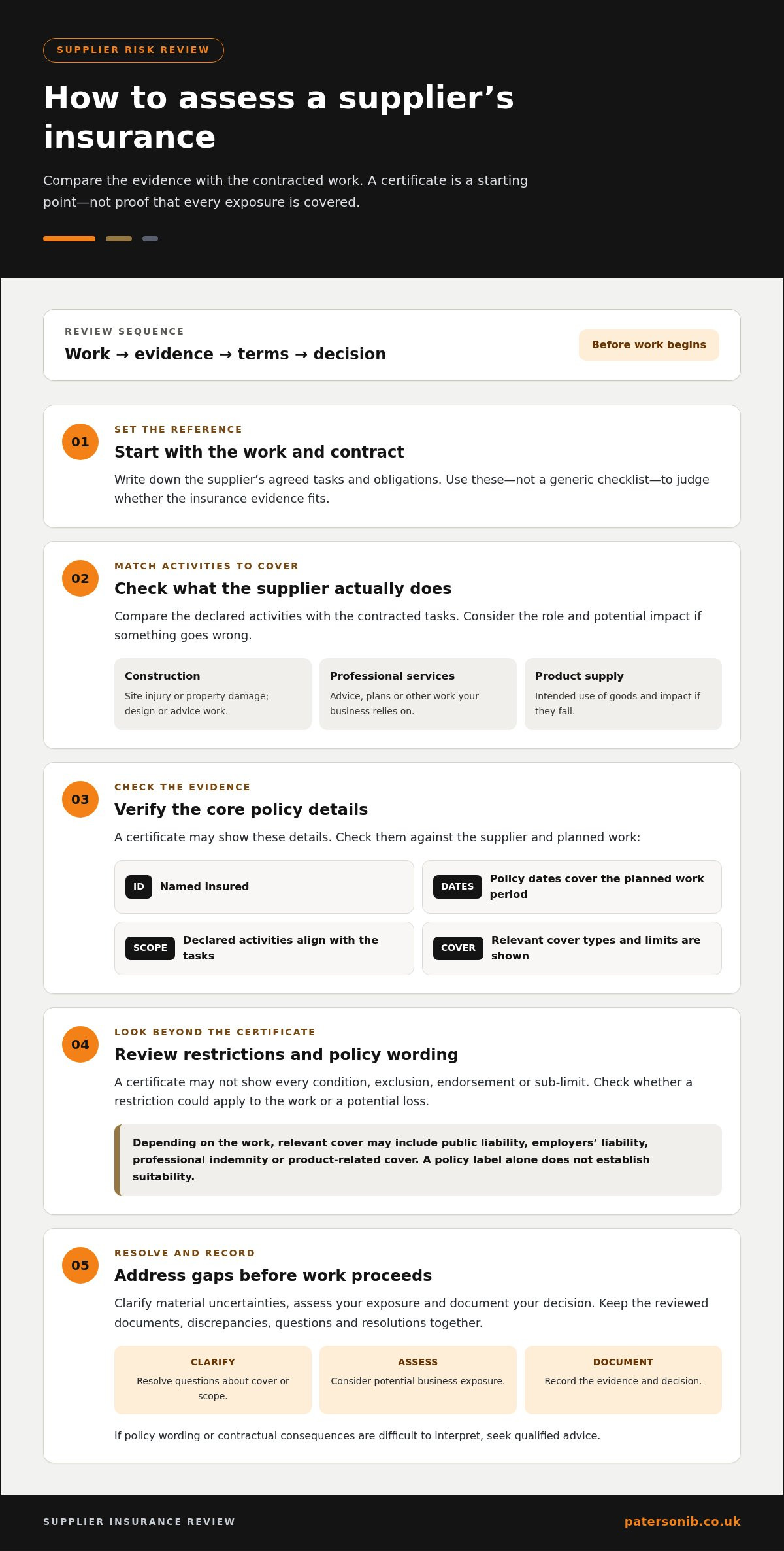
Assess the insurance evidence against the supplier’s contracted work. A certificate can show useful policy details, but it isn’t a full review of the policy or proof that every contractual exposure is covered. If the work or documents raise questions, review the relevant policy wording and seek qualified advice when interpretation could affect an important decision.
A certificate may show the named insured, policy dates, cover types and limits. It may not set out every condition, exclusion, endorsement or sub-limit. Treat it as a starting point, then check whether the policy details and described activities fit the work the supplier will do.
Use the contract and agreed work description as your reference. Record discrepancies between those documents and the insurance evidence, along with any questions and how they were resolved. Clarify material uncertainties before work starts. If policy wording or contractual consequences are difficult to interpret, seek qualified advice.
Use this table to record the main checks:
| Review item | Question to ask | Why it matters |
|---|---|---|
| Named insured | Is the supplier responsible for the work named? | Differences in names may need clarification. |
| Policy dates | Do they cover the planned work period? | Out-of-date evidence may not reflect current cover. |
| Declared activities | Do they align with the contracted tasks? | A mismatch may raise questions about scope. |
| Cover types and limits | Are relevant types and limits shown? | These details help frame further review. |
| Exclusions and sub-limits | Could a restriction apply to the work or loss? | Terms may narrow the cover available. |
Keep the documents reviewed and your decisions together. Revisit them if the supplier’s work changes, so your record reflects the arrangement in place.
Respond in proportion to the gap and the work involved. A missing or delayed certificate may be an administrative issue if the supplier can provide the relevant evidence. A policy that doesn’t appear to cover the agreed activities is a more substantive concern. Establish what’s missing before making assumptions. If you’re unsure what happens if a supplier has inadequate insurance, start with the work, your potential exposure and the practical steps available to manage it.
Set out the agreed tasks and compare them with the insurance evidence. If a document is outstanding, record what’s needed and by when. If the stated activities, cover or policy period don’t appear to fit the work, clarify the discrepancy and assess its practical effect. A paperwork delay and a possible coverage mismatch are different issues and should be handled accordingly.
Agree next steps in writing. Depending on the circumstances, these might include providing updated evidence, revising the work scope or adjusting the planned start. If a material concern remains, consider whether access or particular activities should wait while you assess the exposure. Check the contract before changing arrangements, and record the reasons for your decision.
If work is already under way, review the situation promptly. Consider whether any activity should pause or change while you clarify the position. Preserve the contract, relevant correspondence and insurance documents, and keep a factual record of events. If an incident has occurred, gather related reports, photographs and communications in line with your organisation’s usual record-handling procedures.
Notify relevant parties in accordance with the processes set out in applicable policies and contracts. Avoid admitting liability or promising who will pay before the circumstances and relevant cover have been assessed. If responsibility is disputed, an incident is serious or the potential loss could materially affect your business, seek timely advice from appropriately qualified professionals, such as business law firm Matthew Fornaro, P.A..
Organise your response into four steps:
Use the outcome to decide whether contract controls or the planned work need to change. For example, a revised scope may warrant another review of the insurance evidence and the controls agreed with the supplier. Keep your response proportionate, but don’t leave a material mismatch unresolved without recording a clear rationale. Paterson Insurance Brokers’ supplier-risk management advice can help you understand how insurance checks fit into your business’s wider risk picture.
Supplier insurance checks are most useful as part of a broader risk-management process. Insurance may respond to certain losses under its terms, but it doesn’t prevent accidents, protect a project from every delay or guarantee that a supplier can keep working. Pair document reviews with suitable contract controls, practical safeguards and contingency plans for important goods or services.
A proportionate approach focuses attention where an interruption or incident could have the greatest effect. A supplier whose work is closely tied to a critical project may warrant more detailed review than one providing a readily replaceable service. Consider each supplier’s role, the work involved and the likely business impact if that work is interrupted.
Set review points that reflect the supplier’s role and potential impact. Record the documents received, concerns raised, who reviewed them and the decision made. This creates a useful history if the agreed work or insurance evidence changes. Keep the process clear enough for the people managing supplier relationships to follow consistently.
Revisit the review when the supplier takes on different tasks, the contract scope changes or your business’s exposure shifts. For example, a supplier engaged for off-site advice may present a different risk if later asked to attend your premises or take on additional responsibilities. The change is a reason to reconsider the arrangements, not proof that the existing cover is inadequate.
Insurance should complement prevention and continuity planning. Depending on the work, operational controls might include agreed site procedures, clear responsibilities or checks on supplied goods. Contingency planning can help you decide how to maintain operations if a key supplier cannot deliver. These measures address different parts of the risk, and none is an automatic substitute for another.
A broker can help you review your own insurance and risk position alongside supplier arrangements. This can be useful when the potential impact is material, the work is changing or you’re unsure how an identified gap relates to your wider exposures. Advice can support a considered assessment, but it doesn’t guarantee that a particular policy will respond to a future claim.
Understanding what happens if a supplier has inadequate insurance is one part of a considered approach to supplier risk. Paterson Insurance Brokers is an independent UK brokerage with over 25 years of experience, providing tailored commercial insurance and risk-management advice across construction, agriculture, retail and other sectors. Discuss your business risks with Paterson to review how supplier checks fit within your wider risk-management plan.
Supplier risk is easier to manage when you consider it before a relationship or project becomes business-critical. When planning, ask which services would be difficult to replace, who owns the supplier relationship and what alternatives could keep essential work moving. These questions make insurance review part of a practical business decision, not an isolated document check.
Agree who should review concerns and when they need to be escalated. Clear ownership helps your team respond consistently as supplier arrangements evolve. The answer to what happens if a supplier has inadequate insurance depends on the circumstances, but preparation can help your business make better-informed decisions.
For advice tailored to your organisation’s exposures, talk with Paterson about your business risks. A considered plan can help your team work with suppliers and adapt as needs change.
Possibly, but a supplier’s insurance gap alone doesn’t make your business liable. Responsibility depends on what happened, each party’s actions and responsibilities, and the relevant contract and law. Your business may face separate questions if its own decisions or conduct contributed to an incident. If a claim is made or contractual responsibility is disputed, get appropriate legal and insurance advice before responding on liability.
If a covered claim exceeds the amount available under the relevant policy, the policy may not meet the full loss. Whether you can recover any shortfall from the supplier depends on the circumstances, the supplier’s ability to pay and the agreements between you. Don’t assume a stated limit applies to every event, as policy terms can affect how it operates. Consider the potential shortfall when assessing your reliance on the supplier.
No. A certificate summarises stated insurance details, but it doesn’t prove that every activity, contractual obligation or possible claim is covered. If a supplier is taking on a new or changed task, compare the evidence with the actual scope instead of relying on a familiar policy label. Keep the version reviewed and note unresolved questions so your decision reflects the information available at the time.
Not automatically in every situation, but don’t ignore an expired date. Establish whether the supplier has renewed the policy and whether the evidence relates to the work under way. Consider the contract, the activity’s potential impact and any immediate exposure. If work could create material risk while the position is unclear, consider pausing or restricting that activity until you’ve assessed the situation and documented your decision.
It may respond to some losses, but only if the event falls within your own policy’s terms. An uninsured supplier doesn’t automatically trigger cover under your insurance, and exclusions, conditions or limits may affect the outcome. Damage to your property and losses caused by interrupted supply, for example, may be treated differently. Review your policy with your broker before relying on it as a back-up for supplier failure.
Set review points according to the supplier’s role and the possible impact of an incident or disruption. Check the evidence before work begins, then review it at renewal or when the supplier’s tasks, contract scope or your exposure changes. A calendar reminder can help prevent a renewal from passing unnoticed. For critical suppliers, make review ownership and escalation steps clear so missing evidence is addressed.
Let us know your needs and we’ll be in touch shortly.