Make an enquiry
Let us know your needs and we’ll be in touch shortly.


Check out all the latest updates, insights and advice from our expert team.
Insurance can turn construction uncertainty into risks investors can assess. Building investor confidence with a robust insurance programme means matching cover to project risks, from damage during construction to property losses, liability claims and business interruption. This protection can help maintain continuity when unexpected events threaten a project’s plans or finances.
Investors need more than ambitious plans. They also need a clear view of how a project will manage setbacks. A considered insurance programme cannot remove every risk, but it can show that key exposures have been identified and addressed.
This article explains how builder’s risk, construction and infrastructure insurance, and property and liability cover can contribute to project resilience and wider economic stability. You’ll see how these forms of protection work together, why involving risk expertise early can matter, and what to consider when shaping cover around a UK construction project.
Insurance can help businesses manage shocks, protect jobs and keep projects moving. For investors, a documented approach to risk makes potential disruption easier to assess.
For a practical guide to construction risk management, watch this video:
The ABI report includes case studies of commercial insurers supporting UK businesses, jobs and investment. Commercial cover can help protect supply chains and business continuity when events damage premises, injure employees or interrupt operations. Across the country, commercial insurance supports thousands of local jobs linked to sustainability projects. These examples show how risk transfer can contribute to economic activity beyond an individual policyholder.
When comparing brokers, policies and insurers in the UK, assess the scope of cover, exclusions, limits, claims support and insurer strength. Compare how each programme addresses the same project risks rather than relying on premium alone.
Legally required insurance depends on a company’s workforce and activities. Not every commercial policy is compulsory for every business. Distinguish legal duties from additional cover chosen to protect property, liability exposures or business interruption.
A risk assessment records events that could affect a company’s assets, operations, people and contractual commitments. Investors can use it to understand how management has identified exposures and matched them to insurance or other controls.
For each project, document the risk, its possible business impact, the control in place and the relevant policy response. Include examples such as damage to works, a supplier interruption or a liability claim, and record significant exclusions or uninsured exposures.
A programme review tests whether cover still reflects the company’s assets, contracts, operations and risk profile. Review it at renewal and whenever a material change occurs, such as a new project, site, major contract or shift in supply arrangements.
Compare policy limits with current project values and potential loss scenarios, not just last year’s figures. Record why limits remain suitable or what has changed. This gives investors a clear rationale for decisions without suggesting that cover removes every risk.
A company can demonstrate insurance adequacy through a concise, controlled summary of its coverage and review process. Paterson Insurance Brokers can help outline insured risk categories, policy periods, limits and the governance steps used to assess gaps.
Share relevant evidence, such as a certificate or redacted schedule, while withholding sensitive operational details and contract terms. A named internal owner and dated review record also show investors how insurance decisions are monitored and updated.
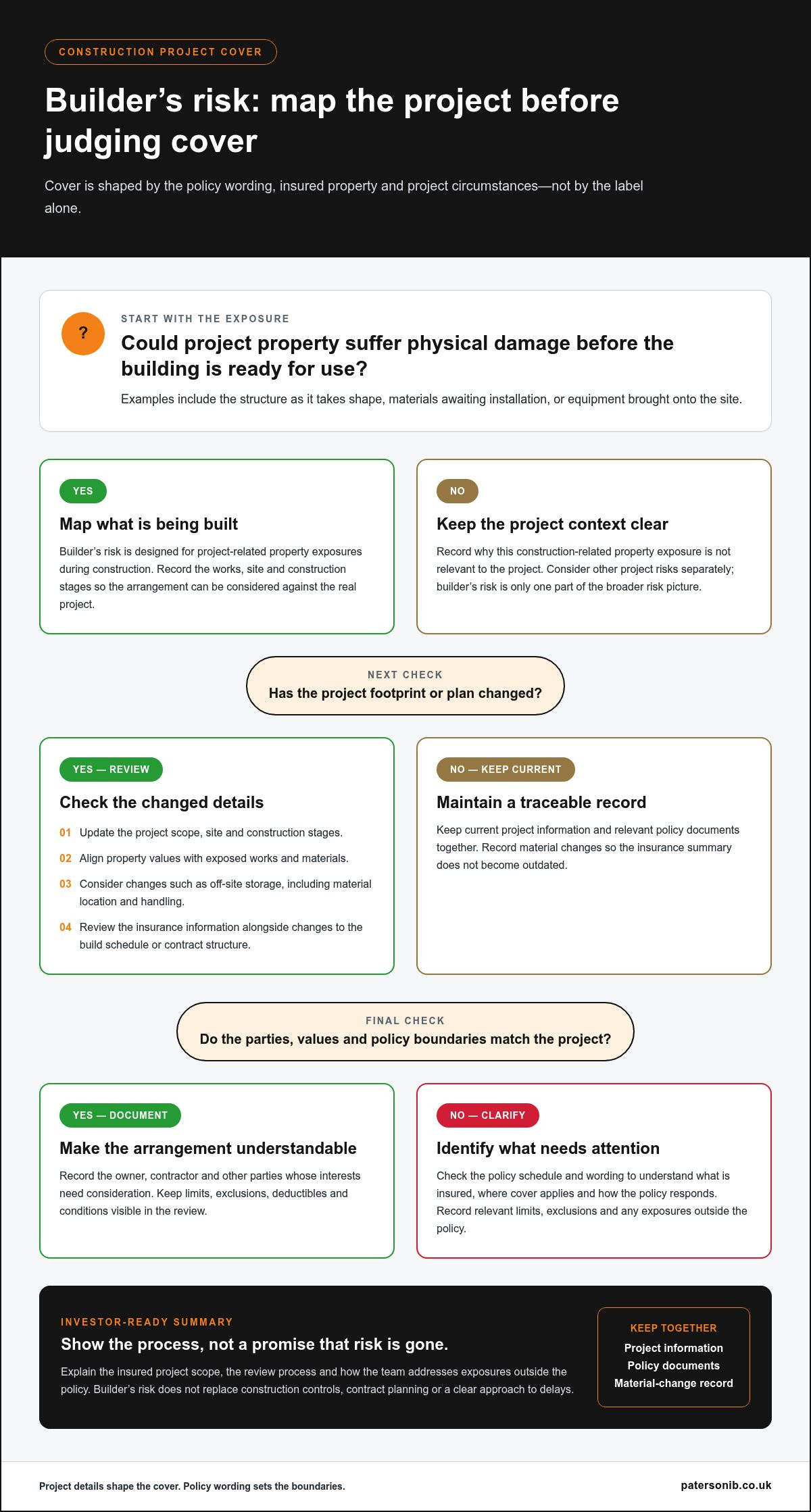
A construction project can suffer physical damage before a building is ready for use. Builder’s risk insurance is designed for project-related property exposures during construction, with protection shaped by the policy wording, insured property and project circumstances. Damage to materials on site, for example, could affect both the build schedule and the capital committed to the project. Investors can assess the exposure more clearly when the project team explains what protection applies and where limits or exclusions matter.
Start by mapping the construction period and the property involved. A new commercial building, for instance, may involve the structure as it takes shape, materials awaiting installation and equipment brought onto the site. The policy schedule and wording determine what is insured, where cover applies and how the policy responds. The term “builder’s risk” is not a complete description of cover. The actual terms are what matter.
Useful project details to organise include:
These details help connect the policy to the project’s actual risk profile. If a project expands from a single-site build to include off-site storage, for example, the location and handling of materials become relevant to the insurance review. Recording the change gives the team a basis for considering whether the existing arrangement still reflects the work being done.
Builder’s risk cover can also help investors understand how physical damage could affect project delivery. It does not replace sound construction controls, contract planning or a clear approach to delays. Instead, it is one part of a broader risk picture. A useful investor update can explain the insured project scope, the review process and how the team addresses exposures outside the policy.
Keep the evidence practical: retain current project information, relevant policy documents and a record of material changes. If the build schedule, contract structure or property values change, review the insurance information alongside them. This creates a traceable link between project decisions and insurance arrangements, rather than relying on an outdated summary.
For projects where construction exposures are changing, project-specific construction risk planning can help bring the policy discussion into line with the work and its stakeholders.
Infrastructure assets often function as connected systems, not isolated buildings. A rail station, for example, depends on access, utilities and links to the wider network. Building investor confidence with a robust insurance programme means showing how project cover relates to these interfaces, not just the main structure. This helps investors understand where a loss could affect connected assets or services.
Project teams can examine how insurance arrangements fit the boundary between new works and existing infrastructure. A contractor upgrading a live facility may work alongside assets that remain in use. Project documents should make clear which property belongs to the works, which remains operational and how responsibilities are divided. This gives investors a more useful picture of exposure than a single project description.
Coverage discussions also need to account for the transitions between construction, testing and handover. Equipment, for example, may be installed before the completed facility enters normal operation. Recording these stages helps the team align the project schedule, contractual responsibilities and insurance arrangements. It also gives investors a clearer basis for understanding how oversight changes as the asset moves towards service.
For a major infrastructure scheme, consider four practical interfaces:
These details help investors follow how the project is organised. If a transport upgrade affects a station that stays open, for instance, project records can explain the boundary between construction activity and ongoing operations. Clear documentation can also support consistent decisions if the schedule, asset ownership or contractual roles change.
Project governance should assign teams responsibility for maintaining records and communicating material changes. A design revision, altered handover date or change in contractor can affect how the project’s insurance arrangements fit its current structure. Keeping a decision log gives stakeholders a traceable account of who assessed the change and how the programme was considered.
For investors, this governance provides context for the insurance documents themselves. Building investor confidence with a robust insurance programme also means explaining how project interfaces, handover stages and changing responsibilities are monitored. This makes the project’s risk oversight easier to follow as infrastructure moves from plans to a working asset.
These project records can support early discussions with commercial insurers, helping teams explain interfaces, responsibilities and changes as plans develop. Commercial insurers have helped make major infrastructure projects possible, supported business recovery from unexpected losses, enabled the net-zero transition, and protected landmarks and events in the UK. The ABI recommends involving commercial insurers earlier in major UK infrastructure development so their risk-management expertise can help build resilience into projects. Bringing that expertise into discussions about project boundaries and transitions can help teams consider resilience alongside delivery planning and keep investors informed about risk management.
Property and liability policies address different losses, so investors need a clear view of each. Damage to premises, an injured employee and a public liability claim represent distinct exposures.
An investor-ready programme matches policies to the company’s assets, activities and contractual responsibilities. Commercial insurance can protect against employee injuries, public liability lawsuits, damage to stock or premises, and business interruption.
A manufacturer, for example, may need to consider damage to its premises and stock alongside production disruption. A contractor may focus on liability exposures linked to work at a project site. Cyber threats and credit risk can also affect businesses, so consider less visible exposures alongside physical property.
Set out what each policy is intended to address, then show how the combined programme relates to the company’s operations. This helps investors understand the purpose of each type of cover without treating a policy list as proof that every exposure is insured.
There is no single insurance bundle for every UK business or investment. During due diligence, present cover relevant to the company’s activities, property, workforce, contracts and continuity risks.
A clear pack can summarise policy types, insured activities, limits, exclusions and renewal dates. A company with valuable stock, for example, can explain how property protection relates to that exposure, while a service business can outline relevant liability cover. Investors can then compare the stated protection with the risks described in the business plan.
Keep policy documents and the summary consistent. If a contract creates a specific insurance requirement, show how the company’s arrangements address it and record any difference that needs management attention.
The right amount of business insurance depends on the potential scale of loss and the company’s assets, operations and obligations. A premises policy should reflect the property exposure, while liability limits should be considered against the claims the business could face.
Use current asset values, contract terms and credible loss scenarios to support decisions. A retailer with significant stock, for example, should consider how a major loss could affect replacement needs and trading continuity. Record the assumptions behind each limit so investors can see the reasoning, rather than relying on an unexplained figure.
An exclusion defines circumstances or losses a policy does not cover. A gap arises when an exposure lacks a suitable response across the programme. Either can weaken investor confidence if the business presents broad protection without explaining its boundaries.
Review exclusions against actual operations. A policy, for example, may not address a particular activity, location or cause of loss relevant to the company. Compare the policy wording with contracts, property records and operational risks, then document how any uncovered exposure is managed. This gives investors a more accurate picture than simply listing policy names.
Consider property damage, liability and interruption cover together, but assess them separately. A fire affecting stock, for instance, may raise property and continuity concerns, while an injury claim involves liability. Mapping each scenario to the relevant policy, limits and exclusions helps the business explain its protection clearly during investor review.
An investor-ready programme reflects how a UK business earns revenue, uses assets and depends on people, suppliers and systems. A warehouse operator, for example, may face property, stock, employee injury and trading interruption exposures. Start by matching each material risk to a policy or another recorded control, then explain any remaining exposure.
Commercial insurance can address employee injuries, public liability lawsuits, damage to stock or premises, and business interruption. The right combination depends on the company’s activities and risk profile. Treat these policy categories as a framework, not a standard package for every business:
Not every organisation needs every category. A manufacturer with specialist equipment may prioritise asset and interruption risks, while a consultancy may focus more closely on professional services and cyber exposures. Contract terms, operating locations, supplier dependencies and the value of business assets also shape the programme.
Build the insurance schedule around the company’s risk register and explain why each policy is relevant. Record the insured activity, principal limits, exclusions and renewal dates, then identify exposures managed through contracts or operational controls instead. This gives investors a clearer way to compare declared risks with the protection arranged.
Review the programme whenever the business changes materially. A new site, service line, major customer or reliance on an online platform can alter the risk picture. Adding online sales, for example, may make technology disruption more central to continuity planning. Document the change and its effect on the company’s insurance decisions.
Through Paterson Insurance Brokers, businesses can evaluate niche and emerging risks such as credit risk and cyber threats alongside the controls supporting them. Commercial insurance can cover these specialized exposures. For an investor-ready programme, show how those risks relate to the business’s revenue, assets and operations, and clarify whether the response is insurance, a contractual arrangement or an operational control. Keep the rationale consistent with the risk register so the programme presents a coherent view of exposures, not a collection of policy names. This helps investors assess how declared risks are addressed and where exposure remains.
Paterson Insurance Brokers helps construction businesses consider insurance in light of their project risks and operational needs. Its Construction Insurance offering is relevant when a company is reviewing cover for planned works, changing contracts or preparing information for investors. A discussion can connect the project’s activities with the risks recorded in its insurance programme, helping the business assess how its arrangements fit its circumstances.
Bring together key project details, existing policy information and any changes affecting the work. This gives the conversation a practical starting point, whether you’re planning a development or reviewing cover for an active construction business.
For a considered discussion about Construction Insurance, contact Paterson Insurance Brokers.
Use your next renewal or project planning discussion to connect insurance decisions with the business’s direction. As projects, contracts and operations evolve, a clear record of changing risks can help keep the programme relevant and make decisions easier to explain to investors.
Building investor confidence with a robust insurance programme is an ongoing discipline, not a one-off exercise. Paterson Insurance Brokers offers Construction Insurance, Agriculture Insurance and Retail & Wholesale Insurance, helping businesses in these sectors consider cover in relation to their risks.
If you’re reviewing construction risks or planning a new project, contact Paterson Insurance Brokers to discuss your insurance needs. A thoughtful review can help you take the next step with greater clarity and confidence.
A robust insurance programme helps investors judge whether a business can absorb disruption while meeting its financial commitments. During due diligence, consistent policy records and clear ownership of insurance decisions make oversight easier to assess. An investor reviewing a project company, for example, can compare the entity named in its documents with the entity receiving investment. This clarity supports informed decisions and shows how management treats risk as part of responsible governance.
Let us know your needs and we’ll be in touch shortly.