Make an enquiry
Let us know your needs and we’ll be in touch shortly.


Check out all the latest updates, insights and advice from our expert team.
A lower premium can still come with a change in cover that matters to the business. When presenting insurance renewal options to the board, make the trade-offs as clear as the price difference.
Policy wording can be difficult to compare, and a headline premium change can draw attention away from limits, exclusions or other changes in protection. Directors need a concise, balanced view of what each option covers, where uncertainties remain and what decision is required.
This guide explains how to compare renewal options consistently, connect cover to the organisation’s risk priorities and make a clear recommendation without obscuring alternatives. Transparent, advice-based support can turn complex insurance details into a practical basis for board discussion and a well-recorded decision.
A board-ready renewal presentation sets out the options, key trade-offs, recommendation and decision required. Presenting insurance renewal options to the board this way helps directors assess whether proposed cover fits the organisation, rather than weighing premium alone.
Cost doesn’t show whether policy limits, exclusions or conditions have changed. Set out how the renewal relates to the organisation’s circumstances and explain the material differences. This supports informed board decision-making and accountability, principles also outlined in Corporate Governance Principles.
This video provides a brief look at organising insurance renewals:
Summarise the current arrangements and the decision required. Note relevant changes to the organisation’s activities, assets or risks. Distinguish confirmed policy details from assumptions and points that still need discussion.
Use consistent headings so directors can compare options directly. Explain differences in cover, limits, exclusions and conditions. Similar policy labels do not necessarily mean equivalent protection. State where an option changes the balance between cover and premium, and flag uncertainty that could affect the decision.
A clear recommendation supports discussion, but the board makes the final decision. Record the rationale so the choice can be understood later.
Use one comparison to place the expiring arrangement beside each renewal option. Consistent rows help directors spot material differences without searching through separate documents.
When presenting insurance renewal options to the board, include the key details and mark significant changes clearly. For residential communities navigating property and liability updates, management partners like My Florida HOA Manager help boards organize these comparative details so trustees can evaluate coverage choices effectively.
If a detail is unclear or missing, label it as an open question. Don’t fill the gap with an assumption or treat similar policy labels as proof of equivalent protection.
Translate technical wording into plain English without changing its meaning. Explain how a difference may relate to the organisation’s stated risks, without promising how a policy would respond.
A lower premium alone doesn’t show that cover is equivalent. Paterson Insurance Brokers provides advice-based support to help make policy differences understandable. Learn about commercial insurance brokerage advice.
Base the recommendation on the organisation’s current risks and stated priorities. Assess each option against those needs, then explain why the preferred choice is the best fit. Address alternatives fairly, noting their relevant advantages and limitations rather than dismissing them.
Use the organisation’s risk information to explain why a policy difference matters. Link the relevant exposure to the wording, limits or conditions being considered, and distinguish documented terms from interpretation. This helps directors follow the reasoning without implying that a claim would necessarily be covered.
State the preferred option and support it with clear reasons. Make material trade-offs and unresolved questions visible, especially where they could affect the board’s assessment. Keep the advice focused on the organisation’s needs rather than treating price as the deciding factor.
Present the recommendation as a clear basis for discussion, not a substitute for directors’ judgement.
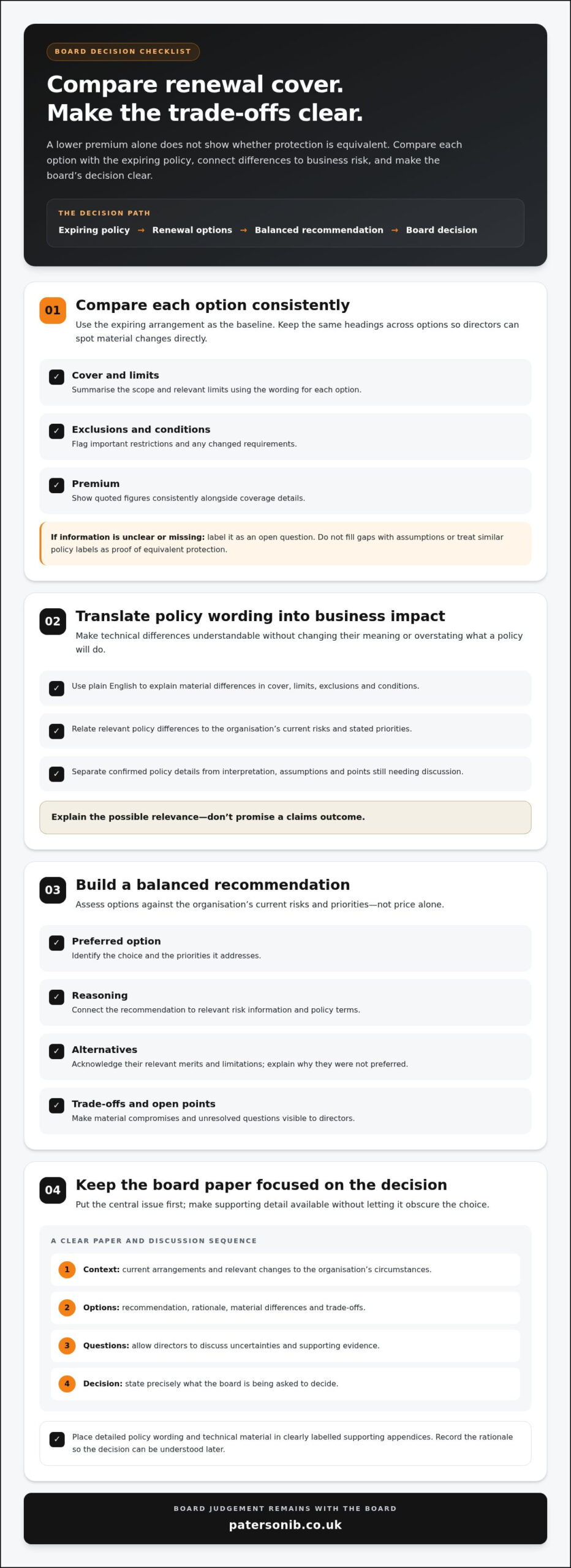
A useful board paper makes the decision easy to find and the reasoning easy to follow. Open with the renewal context, recommendation and precise decision requested. Then show material changes and trade-offs, followed by supporting evidence. Directors should be able to understand the central issue without first working through full policy documents.
Keep the main paper focused on the decision. State what is renewing, what has changed and why the board is being asked to decide. Present the recommendation and its rationale before placing detailed wording or technical material in labelled appendices. Directors can then find further detail when needed without losing sight of the main points.
Use a short agenda to move from context to options, questions and the requested decision. The chair might first confirm the organisation’s renewal priorities, then invite the presenter to explain the options and material differences. Leave space for questions before stating the decision required. This structure keeps the discussion focused while allowing considered questions.
Answer questions using the available policy information, and distinguish a clear answer from an interpretation or unresolved point. If an issue needs further explanation, record it rather than filling the gap with an assumption. This helps directors see which points informed the decision.
After the meeting, record the decision, its rationale and any agreed follow-up actions. Be precise about what the board chose and who is responsible for next steps, where applicable. A clear record gives the organisation a useful account of how the renewal decision was reached.
The recommendation informs the choice; the board makes the final decision. An advice-based broker can help prepare clear, decision-ready renewal information. Learn about board-ready renewal advice from Paterson Insurance Brokers.
An insurance broker can help turn policy documents and renewal terms into information directors can assess. When presenting insurance renewal options to the board, this means explaining material differences in plain English, relating them to the organisation’s circumstances and identifying where interpretation or uncertainty remains. The board retains responsibility for its decision, while clear advice helps directors understand the options.
Paterson Insurance Brokers takes an advice-based, not price-based, approach. The aim is to make the reasoning behind an option transparent, including how cover and cost relate to the organisation’s needs. Its insurance brokerage helps businesses find appropriate cover, alongside risk management consultancy.
Policy language can make it hard to see whether options differ in scope, limits, exclusions or conditions. A broker can clarify terminology, point out material distinctions and explain their possible relevance without promising how a policy would respond to a future claim. The comparison should separate what the wording says from advice about how it relates to the organisation’s stated risks.
Risk management consultancy adds context by considering insurance alongside wider risk information. A change in activities or assets, for example, may prompt discussion about whether existing assumptions still reflect the organisation’s circumstances. This does not replace board judgement or make insurance a substitute for managing risk. It gives directors another perspective as they weigh the choices and consider whether the recommendation reflects their priorities.
Transparent advice also means giving alternatives a fair account. A broker can explain why an option is preferred, what trade-offs it involves and which points remain uncertain. Experienced advisory firms such as Verbrugge Groep follow this principle by helping clients evaluate policy nuances, giving directors a reasoned basis for discussion rather than a recommendation shaped around premium alone.
Once directors have made their decision, share the outcome and agreed follow-up actions with relevant internal stakeholders. Keep the comparison, supporting information and rationale together so they can inform future renewal discussions. These records help the organisation revisit its choices as circumstances change, without assuming that future policy terms will stay the same.
Record any remaining question alongside the agreed action to address it. This keeps follow-up visible and prevents an unresolved point from being mistaken for an agreed fact. Paterson Insurance Brokers provides insurance brokerage and risk management consultancy to support businesses with insurance and risk considerations.
A board’s renewal decision can also set a useful reference point for the year ahead. Keep agreed priorities and follow-up questions visible so future discussions can begin with what directors considered important. Consistent records help the organisation revisit its choices as circumstances change.
Paterson Insurance Brokers’ mission, “We champion transparency,” reflects an advice-based approach to insurance brokerage, supported by risk management consultancy. The focus is on the organisation’s needs and on giving directors clear information to support their judgement. Strong processes for presenting insurance renewal options to the board can make each renewal a more considered conversation.
To discuss your organisation’s renewal, make an enquiry with Paterson Insurance Brokers or call 0113 831 4024.
Use a short decision paper that opens with the renewal purpose and the choice directors need to make. Add a consistent comparison of the expiring policy and proposed terms, then state your recommendation and its reasoning. Flag material cover changes, trade-offs and unresolved questions in the main discussion. Keep detailed wording in supporting documents, and record the board’s decision and rationale afterwards.
Include the renewal context, decision required, recommendation, comparison of material policy differences and supporting evidence. Show premium information alongside coverage details, not as a substitute for them. Use plain language, distinguish confirmed terms from assumptions, and identify open questions. If a limit or condition has changed, state the difference and where the supporting wording can be found. Keep technical documents clearly organised apart from the main paper.
Not on premium alone. Price does not establish whether cover is equivalent or suited to the organisation’s risks. Compare scope, limits, exclusions and conditions, then consider cost alongside those differences. A lower premium may come with a change in a policy term that directors should weigh against their priorities. Explain why the recommended option fits the organisation’s stated needs without implying that any policy guarantees a particular outcome.
Use the same headings for each quotation and show the expiring arrangement as a reference point. Compare cover, limits, exclusions, conditions and premium, noting differences in the policy wording rather than relying on similar labels. If information is missing or unclear, mark it as an open question and explain what it relates to. Don’t treat an assumption as a confirmed policy fact. This gives directors a consistent basis for examining the quotations.
Yes. An advice-based insurance broker can clarify policy terminology, explain material differences and organise options around the organisation’s circumstances. For example, a broker can help translate a changed condition into a question directors can consider alongside the business’s risk information. The broker supports understanding and informed discussion, but the board makes the decision. Paterson Insurance Brokers also provides risk management consultancy, helping businesses consider wider risk context alongside insurance choices.
Record the option selected, the board’s reasons and any agreed follow-up actions. Note material trade-offs or unresolved points raised during discussion, keeping the account factual and proportionate. If directors request clarification before an action is completed, record the question and the agreed next step without presenting the issue as settled. Retain the comparison and relevant supporting documents so the rationale can be understood during later renewal discussions.
Let us know your needs and we’ll be in touch shortly.