Make an enquiry
Let us know your needs and we’ll be in touch shortly.


Check out all the latest updates, insights and advice from our expert team.
What if the higher premium is the more cost-conscious option? When renewal costs rise, it’s understandable that a CFO will focus on the budget impact. But a clear case for how to justify a higher insurance premium to a CFO needs to show more than the new figure: it should explain what changed, what protection the business receives and what exposure remains.
That means comparing options on consistent terms, not judging them on price alone. A lower premium may come with different limits, exclusions or cover, so the decision should make those trade-offs visible. The aim isn’t to defend every increase, but to show the evidence behind the recommendation and the alternatives considered.
In this article, we’ll set out a practical way to explain renewal changes, compare premium, cover and risk, and agree next steps with finance and your insurance advisers. As an independent broker, Paterson Insurance Brokers takes an advice-led approach, helping make complex insurance decisions clearer through transparent discussion of the risks and options.
A renewal increase affects the budget, so acknowledge the cost directly. Then frame the decision around the premium, the protection offered and the risk the business would retain if it chose different terms. The increase isn’t automatically justified; the evidence should show why the proposed cover suits the business and what alternatives were considered.
A premium is the amount paid for insurance. The Insurance Premium overview offers general background, but the policy documents and adviser’s explanation are the useful sources for this renewal.
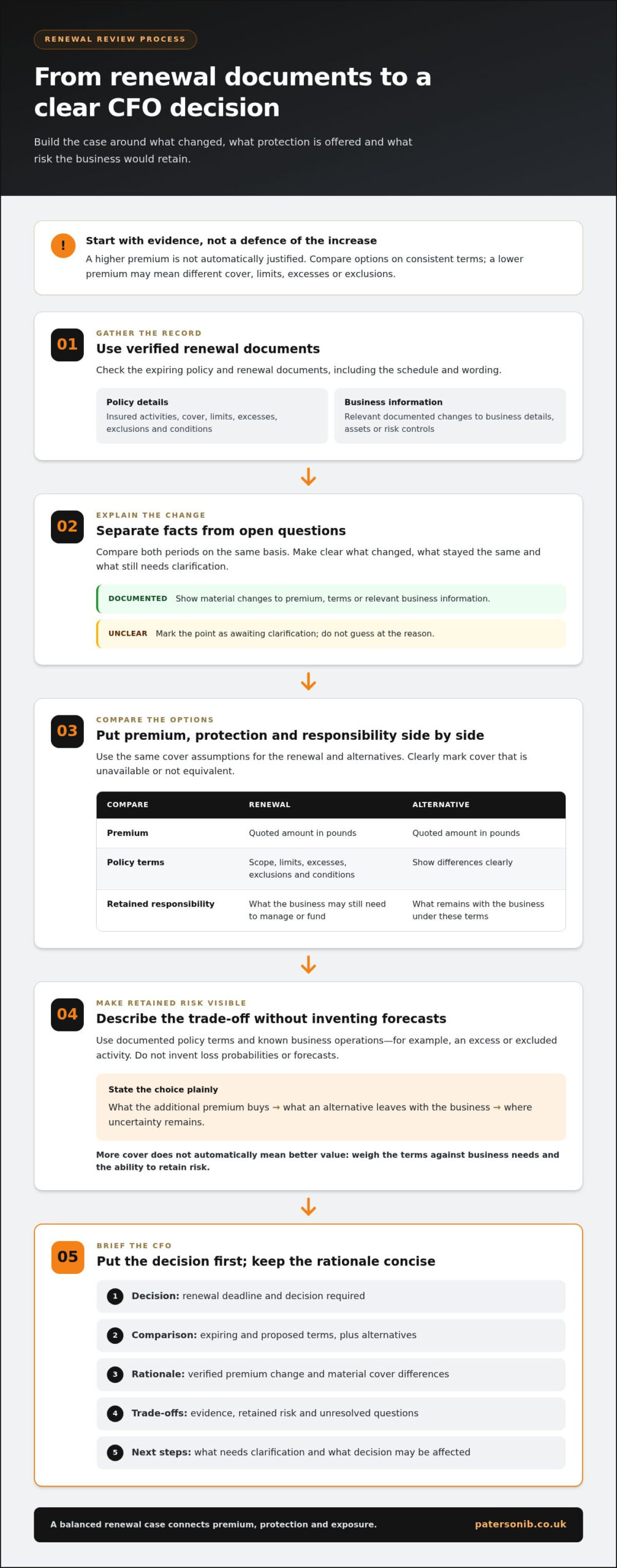
Use verified documents to state the expiring and proposed terms, the decision needed and the date it’s required. Briefly identify which cover elements changed, stayed the same or need clarification.
Policies may differ in scope, limits, excesses, exclusions and conditions. Compare those terms rather than treating the lowest premium as equivalent protection. Keep documented differences separate from assumptions about potential losses.
A sound renewal case explains the premium change, the protection provided and the alternatives considered.
Use the expiring policy and renewal documents to show what changed alongside the premium. A short, like-for-like table can make differences easier to review and keep the explanation grounded in the records.
Check the schedule and wording for insured activities, cover, limits, excesses, exclusions and conditions. Note documented changes to declared business information, assets or risk controls where relevant.
Mark unexplained points as awaiting clarification. Don’t attribute the increase to a particular exposure or underwriting factor unless the insurer or broker has provided that explanation. Share specific questions with your broker and record what remains under review.
A concise comparison might say: “These terms changed, these stayed the same, and this premium point is still being clarified.” Paterson Insurance Brokers’ advice-led commercial insurance brokerage can help make renewal details clearer.
Compare the renewal with available alternatives using the same cover assumptions. A simple options table helps show the premium alongside what each policy covers and what responsibilities remain with the business. If options aren’t equivalent, mark the differences clearly rather than presenting them as a direct match.
Where risk controls affect the review, include documented information and consider it alongside the insurance arrangements. Paterson Insurance Brokers business risk management consultancy can complement discussions about operational controls and exposures.
Use one row per material feature and one column per option. Include the renewal and alternatives, marking unavailable or non-equivalent cover clearly.
Describe retained risk using documented policy terms and known business operations, such as an excess or excluded activity. Don’t invent loss probabilities or forecasts. More cover doesn’t automatically mean better value; weigh the terms against the business’s needs and ability to retain risk.
State the trade-off plainly: what the additional premium buys, what an alternative leaves with the business, and where uncertainty remains. This gives the CFO a balanced basis for choosing without presenting assumptions as guaranteed outcomes.
A CFO briefing should make the decision clear before it explains the detail. Open with the renewal deadline, the decision required and the verified premium change in pounds. Then present the recommended option, the material cover differences and the evidence for the change. Keep the sequence logical: decision, comparison, rationale, trade-offs and next steps. This helps the discussion stay focused on the business choice rather than becoming a tour through policy wording.
A concise case isn’t a sales pitch. State what the evidence supports, identify any unresolved questions and explain what decision may be affected if they remain unanswered. A clear, advice-led commercial insurance review can help bring the policy terms, risks and available options into focus.
Use the page to make the decision and its basis easy to scan. Include the renewal deadline, expiring and proposed terms, material policy changes and a short business rationale. Add the options comparison, identify the recommended choice and state why it fits the documented exposures. Keep confirmed policy details separate from assumptions or unresolved questions, so the reader can see where the evidence ends.
Keep supporting schedules or detailed wording available for reference, but don’t let them obscure the main recommendation. The summary should be understandable on its own, with enough detail to show how the conclusion was reached.
Prepare direct answers to three questions: what changed, what does the proposed cover provide, and what alternatives were considered? If a cheaper option differs in scope, limits, excesses, exclusions or conditions, name the documented difference. Don’t imply that the higher premium guarantees a better outcome; explain the specific protection and trade-off that the terms show.
If a point remains uncertain, say so and identify who will resolve it and what information is needed. That candour strengthens the recommendation. To discuss a clear, advice-led review of your renewal, speak with Paterson Insurance Brokers.
A broker can help turn renewal documents and insurer explanations into a clearer account of what the business is being asked to approve. An advice-led review brings the policy terms, declared risk information and available options into one discussion, helping finance distinguish confirmed differences from points that still need clarification. This supports a more balanced decision than focusing on the premium alone.
Paterson Insurance Brokers takes a transparent, advice-based approach to commercial insurance. We can help explain relevant policy terms, consider options against the business’s risk profile and discuss how risk management considerations relate to insurance arrangements. This doesn’t mean that a higher premium is automatically justified. It means the decision can be made with a clearer view of the cover, trade-offs and evidence.
A broker can help interpret policy wording and identify differences that matter to the business, such as changes to scope, limits, excesses or exclusions. They can also help organise the information needed to compare options and explain which points relate to the business’s stated activities and exposures. Where risk controls are relevant, risk management consultancy can complement the insurance discussion without promising a particular premium or outcome.
This practical support can help finance understand how to justify a higher insurance premium to a CFO without overstating what the policy will do. It also gives the business a route to raise unanswered questions and agree what information is needed before settling on a recommendation.
Once the decision is made, keep a concise record of the option chosen, the business rationale, any assumptions and follow-up actions. Share the approved policy information with relevant finance and operational colleagues so they understand the agreed cover and responsibilities. Revisit the rationale if business activities, assets, controls or insurance needs change, rather than relying on an old comparison.
A clear renewal decision is a considered one, with the evidence, trade-offs and remaining questions visible to everyone involved. If you’d like to discuss your business’s insurance needs with Paterson Insurance Brokers, make an enquiry.
A CFO-ready renewal case can do more than support this year’s decision. Use it to establish a shared approach for future planning: which business changes should prompt an insurance review, who owns the relevant information, and how finance and operational teams will keep it current. That way, the next renewal discussion can begin with a clearer picture of the business, rather than relying on people to reconstruct events after the fact.
This is a practical next step in how to justify a higher insurance premium to a CFO: connect insurance decisions to the business’s evolving plans, not only its annual budget cycle. If activities, assets or risk controls change, recording that context as it happens can help inform future discussions with your advisers.
For support with your business’s insurance needs, start a conversation with Paterson Insurance Brokers. A considered discussion can help you identify the questions to address and prepare for the decisions ahead. Move forward with confidence and a clearer view of what your business needs.
Explain the increase by showing the renewal change, the reasons supported by evidence and what decision is needed. For how to justify a higher insurance premium to a CFO, prepare a short note that identifies the source of each explanation, such as a revised declaration or an insurer’s written comments. Highlight what the proposed cover means for the business, and state clearly if any part of the price movement is still unexplained.
Compare the policy’s scope, limits, excesses, exclusions and conditions, as well as the premium. Check whether the business’s activities and declared information are represented consistently across the documents. For example, note if an excess has changed and what amount the business would be responsible for under the policy. Include relevant retained risk, but distinguish documented terms from assumptions about what a future claim might involve.
No. A higher price by itself doesn’t prove that the cover is broader or better suited to the business. Check the actual wording and consider whether any change addresses a documented need, such as a limit or activity that matters to the business. If terms are unchanged, or the reason for the increase is unclear, record that distinction and seek an explanation before treating the extra cost as added protection.
A business can review its information, discuss available options and explore the policy terms with its broker. For instance, it may be useful to check that declared activities and assets are accurate and that the options being compared reflect the cover the business needs. The outcome will depend on the circumstances and available terms. A discussion may clarify choices, but it shouldn’t be treated as a promise of a lower premium.
Compare quotes against the same stated business activities and cover requirements, then mark any differences that prevent a like-for-like assessment. Check that limits, excesses, exclusions and conditions are visible alongside each premium. If one quote omits a feature or provides a different scope, label it as non-equivalent rather than assuming the gap is covered. This makes the trade-offs clearer and helps avoid choosing on headline price alone.
Separate the facts in the renewal documents from anything not yet explained, and avoid guessing at the insurer’s reasoning. Give your broker a precise question about the premium movement and any relevant changes to the business or its declared risk information. Ask for a clear explanation of how the proposed terms relate to that information. Keep the point open in your decision record until you receive a substantiated answer.
Give the CFO enough information to make and record the decision: the renewal premium, approval deadline, material policy changes, options considered and the practical trade-offs. Include the recommendation and its business rationale, then list unresolved questions or assumptions separately. For example, if a term is still being clarified, show who will follow it up. This creates a useful record for finance and operational colleagues after approval.
Let us know your needs and we’ll be in touch shortly.