Make an enquiry
Let us know your needs and we’ll be in touch shortly.


Check out all the latest updates, insights and advice from our expert team.
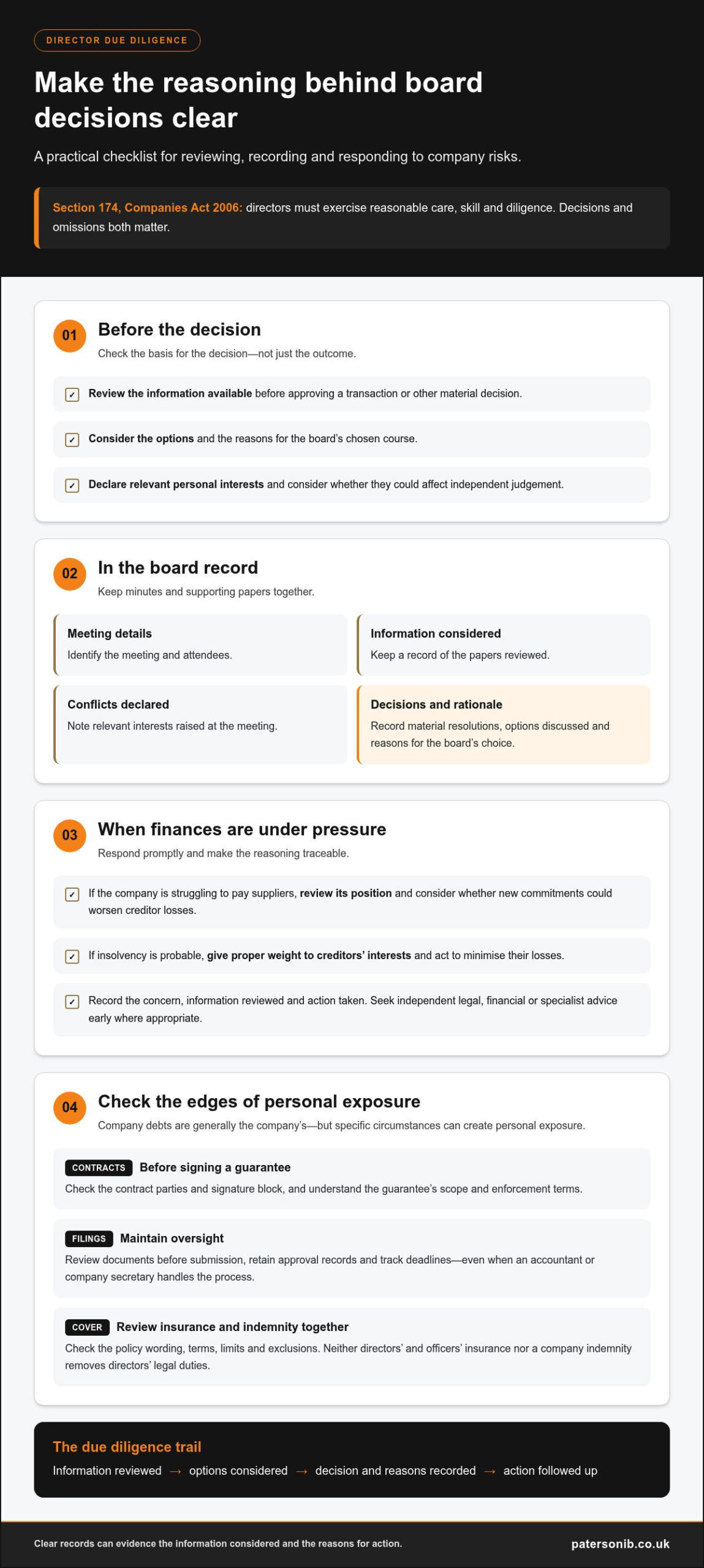
Personal liability cannot be ruled out, but demonstrating due diligence to avoid director liability can help show that you acted responsibly. Under the Companies Act 2006, section 174 requires directors to exercise reasonable care, skill and diligence, according to UK legislation. Clear records of board decisions can evidence the information considered and the reasons for action.
It’s understandable to want confidence that a difficult business decision won’t put your personal finances at risk. This article explains how fiduciary duties apply, when company debts may create personal exposure, and how careful records demonstrate due diligence. It also explains the role and limits of directors’ and officers’ liability insurance, and why it supports sound governance rather than replacing it.
A breach can lead to claims against a director, repayment obligations or disqualification, depending on the conduct. Section 174 of the Companies Act 2006 requires directors to exercise reasonable care, skill and diligence, according to UK legislation. This applies to decisions and omissions, such as approving a transaction without reviewing the information available.
The Companies Act 2006 sets out duties to act within powers, promote the company’s success, exercise independent judgement, avoid conflicts and use reasonable care. Sections 171 and 175 address proper use of powers and conflicts of interest. Directors should declare relevant personal interests and consider whether they could affect their judgement. Statutory duties give a framework to responsibilities that also developed through common law and fiduciary principles.
Directors of public and private companies share the core duties set out in the Companies Act. Directors of charitable companies also have director duties, while charity trustees may have additional responsibilities in that separate role. The company’s legal structure and each person’s role determine which obligations apply.
If insolvency is probable, directors should give proper weight to creditors’ interests and act to minimise their losses. Continuing to trade, incur debts, take deposits or prefer selected creditors when insolvency cannot reasonably be avoided can increase personal exposure. If the company is struggling to pay suppliers, directors should promptly review its position and consider whether new commitments could worsen creditor losses.
Misfeasance may involve diverting company funds for personal use or failing to take necessary steps to protect creditors. Members may also seek permission to bring a derivative claim on the company’s behalf. The Companies Act 2006 sets criteria for that process in sections 263(2) and 263(3).
Directors should also understand statutory duties addressing bribery, fraud and economic crime. Relevant legislation includes the Bribery Act 2010, Fraud Act 2006, Criminal Finances Act 2017 and Economic Crime and Corporate Transparency Act 2023. Fraudulent trading requires actual dishonesty and may be a civil and criminal offence. Proactive oversight and prompt action when concerns arise can help directors respond responsibly.
Being a public or private company does not remove the need for independent judgement, conflict management or reasonable care. Directors of charitable companies should consider their director role alongside any trustee responsibilities, rather than assuming one replaces the other.
Seek independent legal, financial or specialist advice early if insolvency becomes a concern, a conflict arises or a potential breach is identified. Advice can help directors assess their options, but responsibility for decisions remains with them. Record the concern, the information reviewed and the action taken so the reasoning is clear.
Generally, company debts belong to the company, not its directors. Personal liability can arise in specific circumstances, including personal guarantees, misconduct or certain filing failures.
The Companies Act 2006 sets statutory duties for directors, including acting within their powers and exercising reasonable care, skill and diligence. A breach can expose a director to claims, repayment obligations or disqualification. Professional advice can inform a decision, but it doesn’t transfer the director’s responsibilities.
In England and Wales, a company is a separate legal entity, so its debts are generally its own. A director may accept personal responsibility by signing a guarantee or a contract in their own capacity. Before signing, check the contract’s parties and signature block, and understand the scope and enforcement terms of any guarantee.
Directors’ and officers’ insurance may cover some liabilities connected with a director’s role, subject to the policy wording. A company indemnity is a separate arrangement, and the Companies Act 2006 restricts provisions that exempt or indemnify directors. Review the policy and indemnity together to understand their terms, limits and exclusions; neither removes directors’ legal duties.
Delegating Companies House filings does not remove directors’ responsibility to oversee them. Companies must submit documents such as annual accounts, confirmation statements and notifications of officer changes. Review filings before submission and retain records of what was approved. If an accountant or company secretary handles the process, clear responsibility and follow-up help identify missed or inaccurate filings.
Persistent filing defaults can also lead to disqualification. According to UK legislation, a director may be disqualified for up to five years following persistent Companies House filing defaults. Keep a record of deadlines and submitted documents to help spot omissions early.
HMRC may pursue directors personally for certain unpaid liabilities where fraud, neglect or other qualifying misconduct is involved. That differs from ordinary company tax debts, which generally remain the company’s obligations. If tax arrears or signs of financial difficulty arise, review the company’s position and document the decisions made. Directors’ and officers’ liability cover can form part of a broader approach to managing personal exposure.
Good governance gives directors a reliable record of how the board reached its decisions. Keep minutes and supporting papers together so the reasoning is clear if a decision is later questioned.
Minutes should identify the meeting, attendees, papers considered, conflicts declared and decisions made. For each material resolution, record the main options discussed, the reasons for the board’s choice and any conditions attached to approval. This creates a useful account of the board’s process without relying on later recollection.
Retain the papers supporting the minutes, such as financial reports, risk assessments, contract documents and relevant professional advice. Link each agreed action to a responsible person and record its status at a later meeting. If a director raises a concern or disagrees, note the issue and how the board addressed it. A concise record of reasoning is more useful than minutes that simply say “approved”.
Keep records organised and accessible, with clear links between board papers, minutes and follow-up actions. If new information changes the basis for a decision, record the update and the board’s response. This shows what directors considered at the time, rather than presenting a decision without context.
Before approving a proposal, directors should review relevant financial information, legal obligations and operational risks. Identify assumptions that could change the outcome, check whether the proposal falls within the board’s authority, and note any conflicts. If key information is missing, record what is needed and whether the decision should wait.
For a safety-related decision, retain the risk assessment, any identified control measures and records of unresolved concerns. Under section 37 of the Health and Safety at Work etc. Act 1974, a director or similar officer can be personally prosecuted when a company offence occurs with that individual’s consent, connivance or neglect, according to UK legislation. Accurate records can show which concerns reached the board and what action followed.
For complex matters or when the company faces financial difficulty, record the independent advice considered and the board’s own assessment. Advice can inform the decision, but directors remain responsible for their judgement. Minutes should explain how the advice affected the chosen course, rather than merely naming the adviser.
Review open actions at later meetings and document whether they were completed or need further work. If a control fails or circumstances change, record the issue, the board’s response and any revised decision. A focused record of decisions, supporting evidence and follow-up creates a clear governance trail without duplicating every discussion.
Directors’ and officers’ (D&O) insurance can help protect directors and officers against certain liabilities connected with their management responsibilities. It is a financial risk-management measure, not permission to ignore duties or act carelessly. For example, a claim alleging a wrongful management decision may require a response even if the director believes they acted properly. The policy wording determines how the insurer responds.
In the UK, D&O insurance may cover some potential liabilities faced by directors, while exclusions depend on the specific policy. It does not cover every claim or replace a director’s responsibilities. Before relying on protection, read the wording for covered claims, insured people, exclusions, policy limits, excesses and notification requirements.
Coverage may be relevant when a director faces a claim arising from decisions made in their role. For example, if a director is accused of failing to oversee a company process, the policy wording determines whether the allegation falls within cover and which response costs may be included. Do not assume every dispute, investigation or demand qualifies simply because it concerns company management.
Check who counts as an insured person. The policy may define how it treats current or former directors, officers or people serving in particular roles. Compare those definitions with the company’s governance arrangements, including changes in appointments. If someone’s position is unclear, rely on the policy language rather than an informal assumption about their title.
Review exclusions carefully. A policy’s wording may restrict cover for particular conduct or claims, so understand the stated exclusions rather than relying on a broad label such as “management protection”. Insurance does not remove legal duties or guarantee protection from personal liability. A director accused of deliberate wrongdoing should not assume the policy will respond.
Before renewal, compare the policy’s scope with the company’s actual decisions and exposures. If the board is dealing with a major acquisition, regulatory scrutiny or financial strain, identify those circumstances and assess whether the wording addresses relevant claims. Keep the schedule and full policy wording together, and record when directors reviewed them. This makes the protection easier to understand before a claim arises.
Understand the claims process. Identify who must notify the insurer, the notification deadline set out in the wording and what information the insurer needs. If a formal demand arrives, preserve relevant emails and board papers, note when it was received, and follow the policy’s notification instructions. Prompt action can help avoid procedural errors that complicate a claim.
Directors should also understand how D&O insurance relates to any company indemnity. An indemnity and an insurance policy are separate arrangements, with different terms and limits. Neither lets directors transfer their decision-making responsibilities or stop exercising independent judgement. Legal advice can help interpret a disputed clause or assess a serious allegation, while directors continue to meet their duties.
When demonstrating due diligence to avoid director liability, treat insurance as one part of a wider governance approach. Review the policy at renewal, revisit it when the company’s circumstances change, and ensure directors know where the wording is held. Clear records of these steps help the board understand its protection without mistaking insurance for a substitute for careful conduct.
Before approving a proposal, directors should assess its financial, legal and operational implications against the company’s current position. A documented review helps show what information the board considered and why it chose that course.
Start with the company’s finances. Review current management accounts, cash-flow forecasts, debts due and expected income before approving a major commitment. For example, compare a proposed supplier contract with forecast cash needs, not just projected sales. Record assumptions, uncertainties and the effect of delayed income. If the figures raise concerns, pause approval until directors understand the risk.
Check whether the proposal serves the company’s interests and falls within the board’s authority. Review the company’s constitution, relevant contracts and any approval requirements before committing funds. Identify conflicts of interest, disclose them through the proper process and ensure the decision is made independently. A director with a personal interest in a supplier should declare it before the board considers the contract.
Assess the practical risks of implementation. For a construction project, review the proposed timetable, responsibilities, safety arrangements and the resources needed to deliver the work. For a new digital system, consider how it will handle personal information and who will oversee access. The Data Protection Act 2018 and UK GDPR are among the obligations directors should consider when a decision involves personal data.
Test the evidence behind the recommendation. Ask whether the board has current figures, relevant specialist input and a clear explanation of alternatives. If a supplier’s forecast drives the proposal, examine its assumptions instead of relying only on the headline estimate. Seek independent professional advice early if financial difficulty or technical complexity could materially affect the company. Advice informs the decision, but directors remain accountable for their own judgement.
Before the vote, clarify what will happen after approval. Name the person responsible for each action, set a review point and identify the information that should trigger reconsideration. For example, a board approving expansion could require an updated cash-flow review before taking on further commitments. This makes oversight active rather than leaving a decision unchecked after the meeting.
Record the board’s reasoning in the minutes and retain the papers it relied on. Include material risks, alternatives, conflicts, advice received and any conditions attached to approval. If directors reject a proposal, note the key reason, such as unacceptable cash-flow pressure or unresolved safety concerns. These records help explain the decision if circumstances later change.
Review the decision when new information emerges. A revised forecast, missed milestone or data-protection concern may require directors to reassess the original approval. Record the new facts, the board’s response and any revised actions. For support in considering how directors’ and officers’ liability cover fits alongside these governance checks, speak with an insurance adviser.
Paterson Insurance Brokers provides Construction Insurance for businesses managing risks across construction work. This cover can form part of a review of how insurance supports board oversight and documented decisions. Insurance supports risk management, but it does not replace directors’ responsibilities or careful governance.
Construction businesses can also consider how changing operations affect their wider business risks. Paterson Insurance Brokers provides tailored insurance solutions shaped around each business’s circumstances. A discussion can help connect the company’s risk profile with its insurance arrangements.
For a considered conversation about Construction Insurance, contact Paterson Insurance Brokers or visit patersonib.co.uk.
Use your next board review to connect governance with the risks your business actually faces. Consider whether your insurance arrangements remain suited to changing operations, contracts and responsibilities, then record any questions that need attention. A considered review supports demonstrating due diligence to avoid director liability by keeping risk decisions connected to the company’s circumstances.
Paterson Insurance Brokers offers Construction Insurance, Agriculture Insurance, and Retail & Wholesale Insurance. These offerings can support businesses in different sectors as they consider insurance alongside wider risk management. A useful conversation starts with understanding your operations and the exposures that matter to your organisation.
Take a practical next step by discussing your business’s insurance needs with Paterson Insurance Brokers. Discuss your business insurance needs and move forward with a clearer view of the protection relevant to your work.
Personal liability cannot be avoided in every situation, but directors can reduce their exposure through careful oversight. Stay informed about the company’s finances, understand decisions before approving them, and raise concerns promptly. For example, if a forecast indicates difficulty meeting upcoming payments, review the position and record the steps considered. Insurance may respond to some claims, depending on its wording, but it does not remove directors’ legal responsibilities.
Yes, a director may face personal exposure if they sign in their own capacity or give a personal guarantee. Make the company’s role clear in the contract and sign on its behalf, rather than appearing to accept the obligation personally. Before signing a guarantee, understand which borrowing it covers and when it can be enforced. The contract’s wording and the circumstances of signing can affect responsibility.
Directors can reduce risk by staying actively involved, reviewing reliable company information and addressing warning signs early. Before approving a major commitment, check its financial impact, identify conflicts and understand the alternatives. Keep the supporting papers and a clear account of the board’s reasoning. If a specialist issue arises, seek appropriate advice and document how the board used it to reach its decision.
A director may be personally liable after giving a personal guarantee, misusing company funds or becoming involved in fraudulent trading. Personal exposure can also arise in specific tax or filing circumstances, or when a disqualified person acts as a director in England and Wales. Company debts generally belong to the company, but the circumstances and the director’s conduct matter. A company’s separate legal status does not protect every action.
The Companies Act 2006 sets out duties to act within powers, promote the company’s success, exercise independent judgement, avoid conflicts, and use reasonable care, skill and diligence. It also addresses benefits from third parties and declaring interests in proposed transactions. These duties guide decisions such as approving contracts or managing conflicts. Directors should consider the company’s constitution and the purpose of their powers when making decisions.
It means directors should take an informed, active approach to their responsibilities, rather than approve decisions without understanding them. For example, a director reviewing a major purchase should examine the financial information, question unclear assumptions and understand the risks. The Companies Act 2006 sets this duty out in section 174. A director’s role and the information available are relevant to how they should approach a decision.
Keep board minutes, meeting papers, financial reports, conflict declarations, specialist advice and records of follow-up actions. For a proposed investment, retain the forecasts and analysis considered, alongside the board’s reasons for approval or refusal. Maintain company filing records too, including copies of submitted accounts and confirmation statements. Clear, dated documents help show what information directors had and what action they took at the time.
Show the board’s process through records created at the time: financial forecasts, risk assessments, relevant contract terms and written advice. Record key assumptions, alternatives considered, questions raised and any conditions attached to approval. For instance, minutes might note that approval depended on reviewing an updated cash-flow forecast. If new facts emerge, document the board’s reassessment and any revised actions so the record reflects decisions as circumstances change.
Let us know your needs and we’ll be in touch shortly.