Make an enquiry
Let us know your needs and we’ll be in touch shortly.


Check out all the latest updates, insights and advice from our expert team.
What if a claim is accepted, but the settlement still leaves your business facing a substantial bill? That’s one answer to the question, what are the consequences of underinsuring your business premises? If the amount insured falls short of the cost to reinstate the property, the gap may affect what you receive, depending on your policy’s terms. The result can be a shortfall at the very point you need cover to help your business recover.
It’s understandable to assume that insuring a building for its market value, or renewing last year’s figure, will be enough. But market value and rebuilding cost are different, and reinstatement may involve more than the building itself. Contents and business interruption cover also need to reflect what your business would need after a loss.
This article explains how underinsurance can affect a property claim, including how an average clause may reduce a settlement when it applies. We’ll look at where valuation gaps can arise and which parts of your cover to review, from buildings and contents values to the period allowed for business interruption. With a clear picture of these details, you can approach a policy review with greater confidence and seek tailored guidance from an advice-led insurance broker.
Underinsurance means the cover declared is below the value or exposure being insured. If your premises are damaged, this gap may leave your business funding part of a covered loss. The outcome depends on the policy wording and circumstances, so underinsurance doesn’t automatically mean a claim will be rejected.
Some policies include an average condition, which may reduce a settlement proportionally when the sum insured is inadequate. It doesn’t apply to every policy or claim. The Condition of average describes this approach, but your policy wording determines whether it applies.
This video provides broader context on business insurance, though it doesn’t focus on premises valuation:
If an average condition applies, a claim settlement may be reduced in line with the declared value compared with the value required under the policy. For instance, a hypothetical shortfall could mean the settlement doesn’t cover the full cost of repairs. The exact effect depends on the policy terms and loss.
A gap in repair or replacement funding can delay recovery and put pressure on cash flow. Premises damage may also interrupt trading, but business interruption cover has separate terms and insured values; it doesn’t automatically cover every disruption.
An inadequate sum insured can leave a gap between the claim settlement and the funds needed to repair, replace and recover.
Declared values can fall behind as premises and business needs change. Figures carried over from an earlier policy may no longer reflect the building, its contents or the financial impact of disruption. Reviewing each value against current circumstances can help identify where an estimate needs attention.
Reinstatement cost is the cost of rebuilding the insured premises on the basis set out in the policy. It may include work such as demolition, site clearance, professional fees, materials and labour. Market value serves a different purpose and isn’t automatically the right buildings sum insured.
A property’s sale price may reflect its location or demand rather than what reinstatement would require. Depending on the building and policy basis, a professional valuation may help assess the appropriate figure. It should be considered alongside the policy declaration, not treated as an answer to every cover question.
Buildings, contents, stock and business interruption relate to different exposures, so one figure can’t stand in for all of them. Contents may include equipment or fit-out, while stock values reflect what the business holds. Business interruption relates to financial effects of disruption and has separate terms and declared values.
Changes that may prompt a review include:
A new fit-out may affect the contents value even if the building figure remains unchanged. Similarly, changes to operations may alter the business’s interruption needs. Reviewing these categories separately can help reveal whether recorded values still reflect the business.
Review buildings, contents, stock and business interruption as separate value categories. If you’re considering what are the consequences of underinsuring your business premises, comparing current circumstances with declared values is a useful starting point. Business insurance brokerage advice can help put those figures and policy wording into context.
Different parts of premises cover use different declared values. A suitable buildings figure doesn’t confirm that contents, stock or business interruption values are also adequate. The table shows where a shortfall may arise; the policy wording and circumstances determine any claim impact.
| Cover area | Value that may be understated | Potential claim implication |
|---|---|---|
| Buildings | The declared value for reinstating the premises under the policy basis. | A settlement may not meet the full cost of covered repairs or reinstatement. |
| Contents or stock | The value of business contents, equipment, fit-out or stock. | Available funds may not cover the full repair or replacement need. |
| Business interruption | The declared value for financial effects of interruption. | Support may fall short of the business’s needs after insured damage. |
Buildings relate to the insured premises; contents and stock relate to separate business property. Damage to one category doesn’t establish whether another is adequately valued. For example, a building claim says nothing by itself about the declared value of equipment or stock. Cover and claim outcomes depend on the wording, limits, exclusions and circumstances.
Business interruption cover relates to financial effects following insured damage and has its own terms and declared values. If the declared value is inadequate, it may contribute to a shortfall. This cover isn’t automatically included, and the policy determines its scope and limits.
Considering how premises damage could affect trading can form part of broader operational planning. Businesses looking at wider risks may find risk management consultancy useful in that process.
What are the consequences of underinsuring your business premises across these cover sections? A gap in one declared value doesn’t establish whether the others are suitable. Reviewing each category separately helps clarify where further attention may be needed.
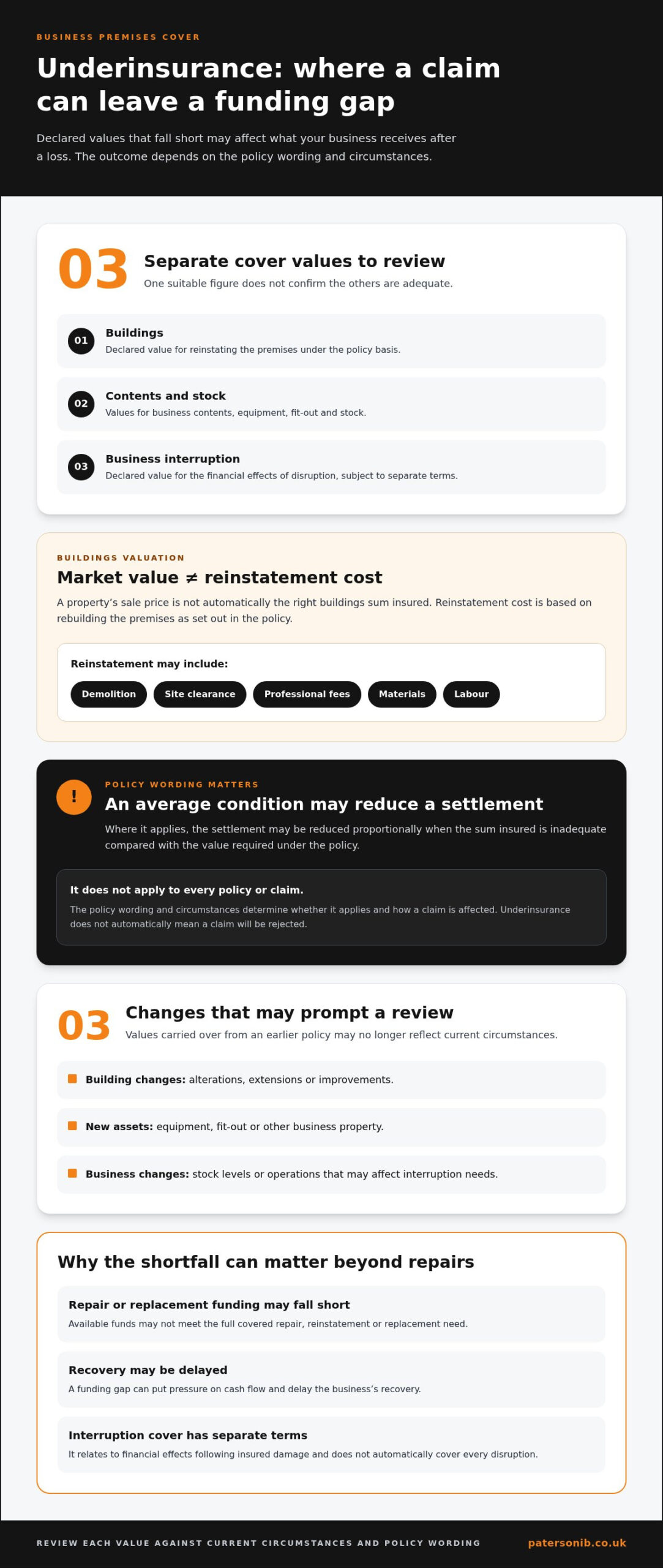
A structured review can help you spot where declared values may no longer reflect your premises or business. Start with the policy schedule and wording, then compare each figure with the relevant property or financial exposure. This is not just a buildings check: contents, stock and business interruption may each need attention.
Before changing a figure, understand what it covers and the basis used in the policy. Keep a short record of the changes you’ve identified and the information behind each value. This makes it easier to discuss any differences and avoids treating the schedule as a single figure for every type of exposure.
The question of what are the consequences of underinsuring your business premises can’t be answered from a valuation alone. The policy wording, limits, exclusions and circumstances of a loss all matter. Use the review to identify questions about how the declared values relate to those terms, rather than assuming one valuation resolves every coverage issue.
An adviser can help you consider the relationship between the schedule, the values you’ve gathered and the wording across related cover sections. Ask for relevant terms and available adjustments to be explained plainly, including how a change to one declared value may differ from a change to another. Paterson’s independent, advice-based approach is focused on clear, tailored guidance, not a promised claim result.
Commercial insurance broker support can help bring these questions together, from declared values to relevant policy wording. If you’d like help reviewing your cover, speak with our business insurance team.
A clear review can help you understand how your declared values relate to your premises and the cover set out in your policy. As an independent insurance broker, Paterson Insurance Brokers provides business insurance brokerage and risk management consultancy to businesses nationally. Our advice-based approach focuses on explaining your options and relevant wording in plain language, rather than making decisions on price alone.
Cover can involve several distinct values. A review should help you see which figures relate to the building, contents or stock, and business interruption, and how each relates to the policy terms. This matters because a suitable buildings figure doesn’t by itself confirm that other declared values reflect your business’s needs.
We can help you make sense of relevant limits, conditions and exclusions, and consider how they apply to the circumstances you describe. If you’ve made changes to the premises, acquired equipment, altered stock levels or changed how the business operates, these details can inform a discussion about whether your current declarations remain appropriate. Where you have valuation information, it can also be considered alongside the policy schedule and wording.
The question of what are the consequences of underinsuring your business premises depends on the policy and the circumstances of a loss. A broker can explain how the wording may affect a claim and discuss possible adjustments to the cover, but no review can guarantee a particular claim outcome. The aim is to give you a clearer understanding of the protection arranged and any areas that may need further consideration.
To make an enquiry useful, outline the type of premises, the cover sections you’re reviewing and any changes or concerns you’ve identified. You can also note questions about declared values or policy wording. This gives us a practical starting point for a conversation about your circumstances, whether your business operates from one premises or across a wider footprint.
Paterson Insurance Brokers’ independent advice is designed to make business insurance clearer through open, tailored discussion. If you’re considering broker support, our approach is centred on understanding your needs and explaining relevant cover without pressure. Let us know your needs and we'll be in touch shortly.
Set aside time to bring your insurance records alongside the decisions shaping your business, such as planned improvements, new assets or changes to how you trade. This makes it easier to keep your declared information connected to the premises and the way you use it, rather than treating renewal as a routine paperwork exercise.
If you’re still considering what are the consequences of underinsuring your business premises, focus on making your current position clear. A discussion about your circumstances can help you identify what needs closer attention and understand the wording that applies, without assuming in advance what a future claim would deliver. Paterson’s approach is built around clear communication and advice tailored to the business, with risk management consultancy available to support wider planning.
Take the next step at a pace that feels right for your business. Discuss your premises cover with Paterson, and move forward with a clearer basis for your decisions.
Underinsurance means a declared value falls short of the relevant insured value or exposure. It differs from having no insurance: a policy may be in place, but the amount declared may not reflect what is being insured. Buildings, contents, stock and business interruption can each have separate values. If you’re asking what are the consequences of underinsuring your business premises, the answer depends on the policy wording and the circumstances of a particular loss.
Yes, some policies include an average condition that may reduce a settlement proportionally if the sum insured is inadequate. This isn’t a rule that applies to every policy or claim, and it doesn’t mean a claim will automatically be rejected. The insurer’s wording and the facts of the loss matter. Before drawing conclusions, check the relevant policy section and ask an adviser to explain how its terms may apply.
Not necessarily. Market value and reinstatement value serve different purposes, so a property’s sale price isn’t automatically the right buildings sum insured. The relevant basis depends on the policy and the property’s circumstances. For example, a sale price may reflect location or demand rather than the amount needed to reinstate the premises. Review the declared basis with an insurance adviser, and consider whether a professional valuation would be useful.
It can. Buildings and contents are distinct categories, so an appropriate buildings value doesn’t establish that business contents or stock are adequately insured. For example, a business might update its premises but overlook newly acquired equipment, or accurately value its contents while its buildings figure needs attention. How a claim is affected depends on the policy terms, how items are categorised and the circumstances of the loss.
Yes, an inadequate declared value for business interruption may contribute to a shortfall following insured damage. This cover concerns financial effects of disruption, rather than the physical repair or replacement of property, and has its own wording, limits and values. It isn’t automatically included in every policy. Consider how the business’s income and operating needs could be affected by premises damage, then review the relevant terms with an adviser.
Start with your policy schedule and note the declared values and the cover sections they relate to. Record changes since the figures were set, such as alterations to the premises, new equipment, different stock levels or changes in business activity. Then consider buildings, contents or stock, and interruption cover separately. An insurance adviser can help you understand relevant wording and discuss possible adjustments, but no change guarantees a particular claim outcome.
Let us know your needs and we’ll be in touch shortly.