Make an enquiry
Let us know your needs and we’ll be in touch shortly.


Check out all the latest updates, insights and advice from our expert team.
Insurance paperwork alone won’t reassure investors; a programme that reflects the organisation’s actual risks can. To understand how to reassure investors with a robust insurance programme, show how risks have been assessed, which cover addresses them and how other exposures are managed. This gives investors a clearer view of your approach than a simple list of policies.
Investors want confidence that a business understands the risks that could affect its operations and prospects. A tailored programme can demonstrate that decisions about cover are connected to the organisation’s activities, assets and responsibilities, rather than based on a one-size-fits-all approach.
This article explains how risk profiling informs insurance decisions, what suitable cover can signal and how to present the programme clearly. It also explains why reviewing the fit between changing business risks and existing protection is important for maintaining investor confidence.
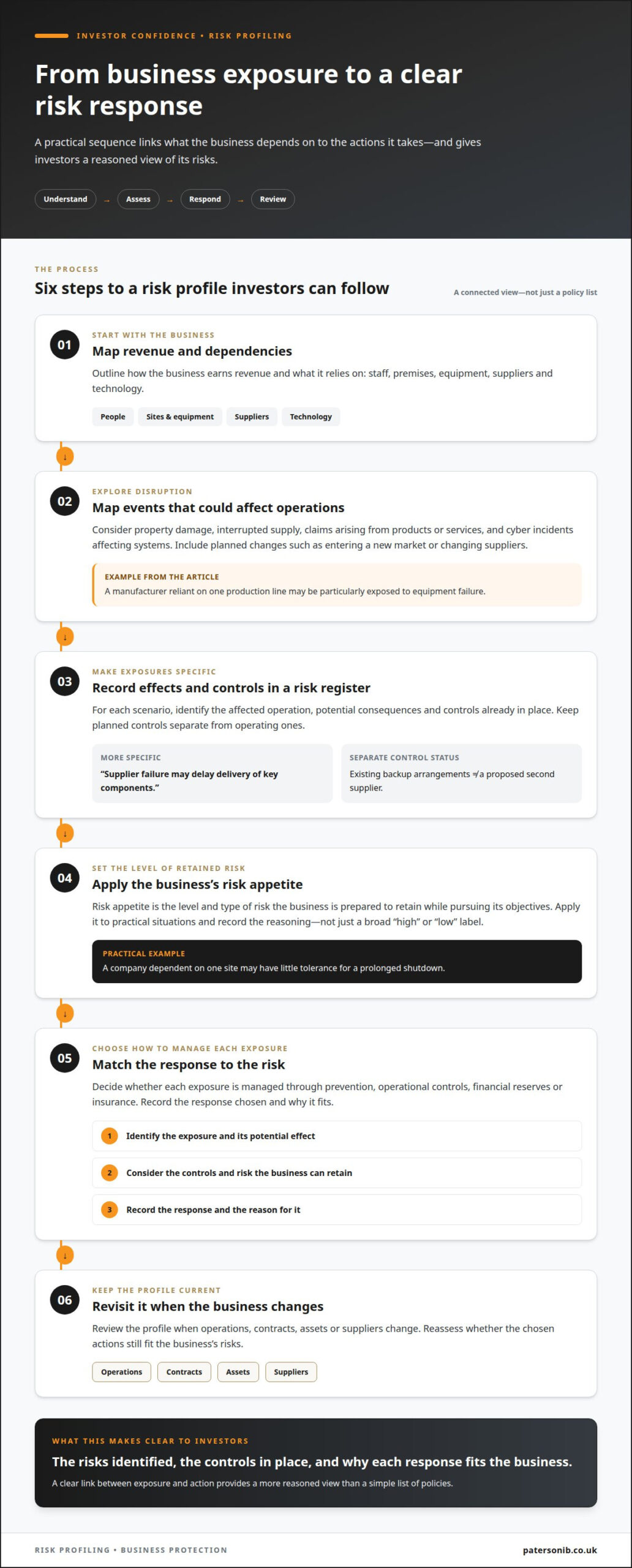
Risk profiling identifies threats to a business and assesses their potential effect on operations, assets and finances. It gives investors a reasoned view of how the organisation understands its exposure. Begin by outlining how the business earns revenue and what it depends on, including staff, premises, equipment, suppliers and technology. A manufacturer reliant on one production line, for example, may be particularly exposed to equipment failure.
Next, map events that could disrupt those activities. Consider property damage, interrupted supply, claims arising from products or services, and cyber incidents affecting business systems. Include planned changes, too. Entering a new market or changing suppliers can create risks the current profile does not capture. For each scenario, identify the affected operation and likely business consequences.
A risk register records identified exposures, their potential effects and the controls in place. Keep entries specific: “supplier failure may delay delivery of key components” is more useful than “supply-chain risk”. Note whether a control is already operating or is still planned. For example, record existing backup arrangements separately from a proposed second supplier. This makes the organisation’s response easier to explain.
Risk appetite is the level and type of risk a business is prepared to retain while pursuing its objectives. Apply it to practical decisions. A company dependent on one site may have little tolerance for a prolonged shutdown. Record the reasoning behind the assessment instead of relying on broad labels such as “high” or “low”.
Finally, decide how to manage each exposure: through prevention, operational controls, financial reserves or insurance. Record the chosen response and why it fits. Revisit the profile when operations, contracts, assets or suppliers change. This creates a clear link between identified risks and the actions taken, helping investors understand the organisation’s approach.
An insurance limit is the maximum a policy pays for a covered loss. Set it against a realistic loss scenario, including repair, replacement and business interruption costs. Check whether each limit applies per claim, per policy period or to a specific section. Those terms affect how much cover remains after a claim.
A deductible, commonly called an excess in UK policies, is the amount the business pays towards a claim. Choose an excess that available reserves can absorb without straining cash flow. A higher excess means the business retains more of each covered loss, so weigh any premium saving against that exposure.
A policy extension adds cover for a particular risk beyond the core policy terms. Select extensions that match actual operations or contract requirements. For example, a business holding customer data could consider whether its cover addresses relevant cyber incidents. Review each extension’s definitions, exclusions, conditions and sub-limits, as these may restrict its scope.
Use a consistent approach: identify a loss scenario, estimate its impact, decide what the business can retain, then set cover for the remaining exposure. Document the reasoning and revisit it after a major asset purchase, acquisition or contract change. For manufacturing operations, tailored Manufacturing Insurance can be considered in relation to relevant exposures.
Keep protection decisions distinct from investment considerations. Compare the amount of risk retained with the cover selected, and check that the final choice still fits the business’s needs and ability to absorb a loss. If a qualifying policy is also being considered as part of wider financial planning, assess that feature separately from the limits, deductibles and extensions used to address operational risks. Investment growth received from a qualifying policy is usually free from personal income tax and capital gains tax.
Before committing, confirm which policy terms apply to the exposure and record any assumptions behind the choice. If the policy’s purpose or structure is unclear, seek an explanation from the provider or a suitably qualified adviser, rather than treating an investment feature as a substitute for appropriate business cover. Reassess the arrangement when the business’s circumstances change, so its retained risk and selected protection remain aligned.
A certificate of insurance summarises current cover, including the insured business, insurer, policy period and stated limits. Investors may request certificates for relevant policies, such as employers’ liability, public liability or cyber insurance. A certificate is a snapshot, not the full contract, so it does not show every exclusion or condition.
A policy schedule sets out the cover arranged for the business. It can identify insured entities, locations, limits, excesses and extensions. For a group with subsidiaries, check that the documents show which entities are covered. The policy wording explains definitions, exclusions and claims conditions.
Disclosures should explain material gaps, exclusions, sub-limits, upcoming renewals or operational changes that affect cover. Keep explanations aligned with the policy documents. For instance, clarify if stock at a separate location is insured under different terms.
Investors may also ask for claims information, including open matters and significant incidents. A concise due diligence pack should organise certificates, schedules, relevant wording and claims summaries by policy and insured entity. This makes the scope and context of the documents easier to follow.
A financial strength rating is an external assessment of an insurer’s ability to meet policy obligations. Investors may use it as one indicator when assessing whether an insurer appears able to respond to covered claims. Explain the rating shown for each insurer and the policy it supports. If a programme uses several insurers, identify which policies each one underwrites. This gives investors a clearer picture than presenting a single rating without context.
A rating is an assessment, not a promise that every claim will be paid. Policy wording, exclusions, conditions and the circumstances of a loss still matter. For example, a financially strong insurer may not cover damage that falls outside a policy’s defined scope. Present the rating alongside the relevant schedule and wording, so it is not mistaken for evidence of comprehensive cover.
Claims records show the organisation’s reported losses and their progress or outcomes. Investors may consider the type, cause and status of claims rather than treating claim volume alone as a measure of poor risk management. Repeated equipment failure, for instance, may prompt questions about maintenance and operational controls. A well-explained record connects each event with its business impact and the response taken.
Prepare a clear account of open and settled claims, including the incident, current status and corrective action. Distinguish the insurer’s decision from the business’s own steps to prevent recurrence. For an unresolved claim, describe the known position without predicting its outcome. Keep the summary consistent with policy documents and disclose relevant changes, such as a new insurer at renewal. Investors can then assess insurer capacity, coverage terms and the organisation’s claims handling as related but separate considerations.
For a considered review of how your insurance programme addresses business risks, discuss your insurance programme.
Paterson Insurance Brokers can help businesses connect their insurance arrangements with the risks investors want to understand. As an independent broker, it provides tailored insurance solutions for organisations across sectors such as construction, agriculture, retail, wholesale and manufacturing. A review can help clarify how the programme relates to your operations, identify where policy terms need closer attention and support a more coherent explanation during investor discussions.
Consider this support when your activities have changed, you are preparing for due diligence or existing cover no longer reflects the business. A clear, considered programme can make it easier to explain your approach without suggesting that insurance removes every risk. To discuss your business’s insurance needs, contact Paterson Insurance Brokers.
Understanding how to reassure investors with a robust insurance programme starts with treating risk planning as an ongoing part of business decisions, not a document prepared only for due diligence. As your organisation changes, revisit whether its insurance arrangements still reflect its activities, assets and obligations. This gives future investor conversations a clear basis: explain what has changed, how you have responded and where insurance fits alongside operational controls.
Paterson Insurance Brokers provides insurance brokerage and risk management consultancy to businesses. Its insurance offerings include Construction Insurance, Agriculture Insurance, and Retail & Wholesale Insurance. This support can be useful when your operations evolve or you want to review how your cover aligns with your risk profile.
Contact Paterson Insurance Brokers to discuss your organisation’s insurance needs and take a considered next step.
Choose cover that reflects the business’s activities, assets and contractual responsibilities, rather than relying on a standard package. A construction business may consider Construction Insurance, while a retailer may need Retail & Wholesale Insurance. Manufacturers and agricultural businesses can assess the corresponding specialist cover. Other needs may include protection for professional advice, cyber incidents, vehicles or commercial property. The right mix depends on the organisation’s specific exposures.
Use business records to estimate the financial effect of realistic loss scenarios. For example, combine asset valuations, repair estimates and expected interruption impacts to model damage at a key site. Record the assumptions behind each estimate, who owns the response and which costs insurance may not address. Comparing scenarios helps decision-makers distinguish manageable losses from exposures that could disrupt operations or planned investment.
Give investors and lenders a concise, traceable explanation linking business exposures to insurance decisions. A coverage map can identify each risk, its accountable business lead, the policy intended to respond and the rationale for any retained exposure. Add a clear review date and note changes requiring a fresh assessment, such as a new activity or acquisition. This helps stakeholders understand the reasoning behind the programme.
Let us know your needs and we’ll be in touch shortly.