Make an enquiry
Let us know your needs and we’ll be in touch shortly.


Check out all the latest updates, insights and advice from our expert team.
Employers’ liability insurance is a legal requirement for most UK businesses with employees. The legal consequences of inadequate employers’ liability cover can include enforcement and substantial fines: the minimum cover is £5 million, and the Employers’ Liability (Compulsory Insurance) Act 1969 requires most employers to hold insurance, according to the UK Parliament. The Health and Safety Executive says employers can be fined £2,500 for every day they are not properly insured.
It’s understandable to assume that having a policy is enough, but both the level of cover and whether the legal requirement applies to your workforce matter. This article explains who must be insured, how inadequate cover can leave a business exposed to compensation and legal costs, and what corrective action or HSE enforcement may follow. It also sets out key points to consider when reviewing your cover, so you can understand your responsibilities and the risks of falling short.
UK employers need to understand the legal threshold and check whether their policy fits their workforce. The appropriate limit also depends on the risks and activities involved in the business.
The minimum cover amount is £5 million for most employers, while the policy limit sets the maximum protection available under the policy. UK Parliament states that the Employers’ Liability (Compulsory Insurance) Act 1969 requires most UK businesses that employ staff to hold employers’ liability insurance. This is a legal floor, not a universal ceiling. If cover is below £5 million, the business may not meet the requirement and could face uncovered damages and legal costs.
Insufficient cover creates a gap between the policy protection and the employer’s legal or financial exposure. If an insurer refuses a claim because the policy is inadequate or invalid, the employer may have to pay compensation and legal costs from its own funds. This can arise when a current or former employee claims for a work-related injury or illness. The policy limit is therefore an important consideration when assessing whether the business could respond to a serious claim.
To check, renew or increase cover, review the policy schedule and certificate before renewal. Confirm that the insured business, workforce and activities still match the policy, and discuss changed operations or increased exposure with the insurer or broker. If the limit is below £5 million, arrange compliant cover rather than assuming an existing policy is sufficient. Keep the updated certificate accessible to employees and available for inspection.
The requirement can apply even when a business has only one employee; there is no minimum employee threshold. Temporary staff may also count. A sole trader with no staff generally does not need this cover, while some family businesses and limited companies have specific exemptions. The legal position can depend on a worker’s status and the business structure, so assess the actual working arrangement rather than relying only on a job title.
An employer’s common-law duty is to take reasonable care to protect employees from foreseeable harm. This means assessing workplace risks and taking precautions suited to the circumstances. In Kennedy v Cordia (Services) LLP, the Supreme Court considered how a suitable and sufficient risk assessment can help identify reasonable safety precautions. For example, a business should consider whether staff need protective equipment or safer procedures before an accident causes injury.
This duty applies alongside health and safety obligations, not instead of them. A written assessment is useful only if it reflects the work actually done and leads to practical action. If a workplace inspection identifies a spill risk, the employer can arrange prompt cleaning, suitable warnings and staff instruction. Training, equipment checks and incident records can help show how identified hazards were managed. When circumstances change, such as the introduction of new machinery or tasks, reviewing the assessment helps keep precautions relevant.
Employers also have responsibilities concerning discrimination. Under section 109 of the Equality Act 2010, an employer can be responsible for discriminatory acts by employees in the course of employment. In Great Britain, this can include harassment. Employers should take reasonable steps to prevent harmful conduct, provide clear ways to report concerns and respond appropriately to complaints. Harassment by a third party can also create employer liability unless all reasonable steps were taken to prevent it.
Section 109(4) of the Equality Act 2010 provides a defence when an employer shows it took all reasonable steps to prevent an employee’s discriminatory act. It is not enough to rely on a policy that staff never see or use. Practical evidence may include clear procedures, relevant staff training, accessible reporting routes and records showing complaints were addressed. These measures should suit the workforce and the risks involved. A documented, active approach gives the employer a clearer basis for showing how it tried to prevent discrimination.
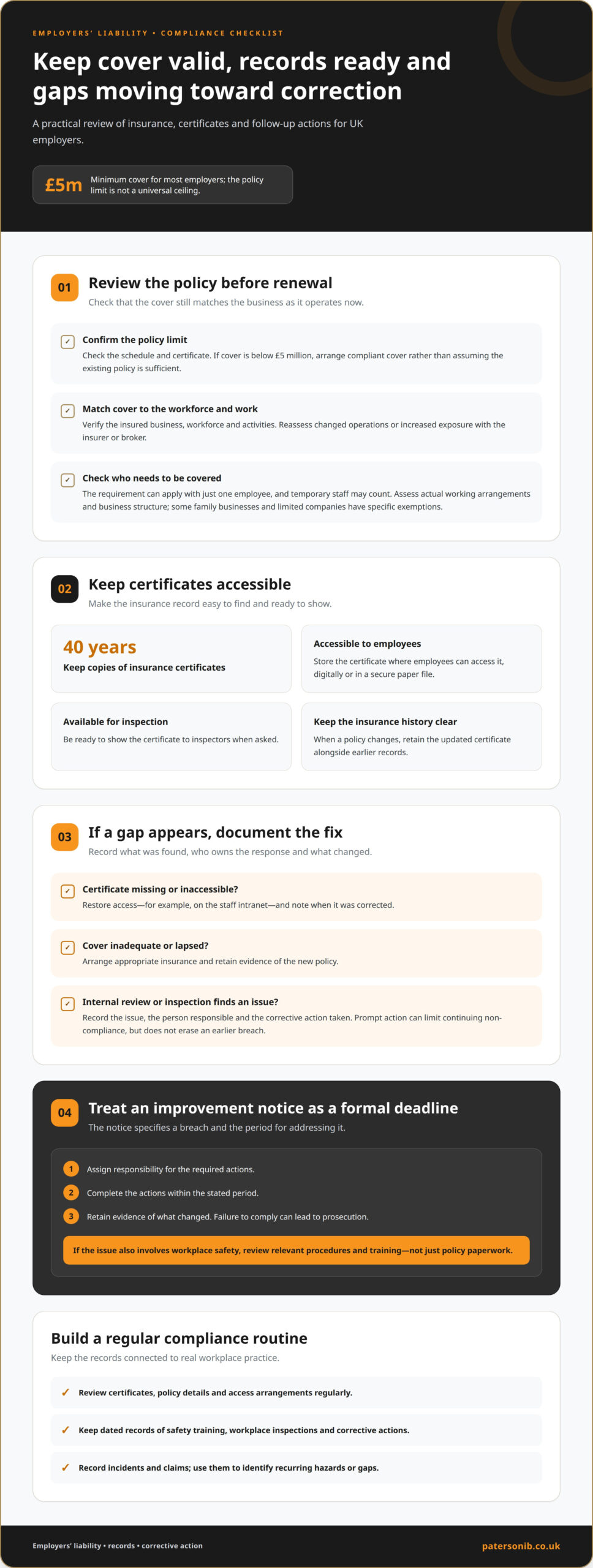
Keeping employers’ liability cover compliant means maintaining valid insurance records and acting promptly when a gap appears. Employers must keep copies of insurance certificates for 40 years, make the certificate accessible to employees and show it to inspectors when asked. A certificate should be easy to retrieve, whether stored digitally or in a secure paper file. If a policy changes, retain the updated document alongside earlier records so the insurance history remains clear.
If an inspection or internal review identifies a problem, record the issue, who is responsible and the corrective action taken. For example, if a certificate is missing from the staff intranet, restore access and document when it was corrected. If cover is inadequate or has lapsed, arrange appropriate insurance and retain evidence of the new policy. Prompt action can help limit continuing non-compliance, but it does not erase an earlier breach.
An improvement notice requires the employer to address a specified breach within the stated period. Failure to comply can lead to prosecution. Treat the notice as a formal deadline: assign responsibility, complete the required actions and retain evidence of what changed. If the issue involves workplace safety as well as insurance, review relevant procedures and training, not just the policy paperwork.
These practices help demonstrate how the business manages its obligations and supports adequate cover over time. For tailored insurance and risk management support, consider how changing staff, duties or operations affect the protection in place.
The Health and Safety at Work Act 1974 sets employers’ duties to protect workers’ health, safety and welfare. Insurance enforcement is separate from investigating an accident or unsafe conduct. The Health and Safety Executive (HSE) investigates the most serious reported work-related incidents, injuries and cases of ill health. A workplace incident may therefore lead to scrutiny of safety arrangements as well as insurance compliance.
The Health and Safety Executive states that employers can be fined £2,500 for every day they are not properly insured with employers’ liability insurance. This daily penalty makes correcting a lapse promptly important. The legal consequences of inadequate employers' liability cover can extend beyond this fine if a separate safety breach is also investigated. Keep current policy details and the certificate readily accessible so responsible staff can establish the position quickly.
Employers can also face a separate fine of £1,000 for failing to display the insurance certificate or produce it when inspectors ask. An electronic certificate may be accessible to staff, provided employees can find and use it. For example, a clearly labelled intranet document can help workers locate the certificate and help managers produce it during an inspection.
HSE enforcement may also address health and safety breaches. An improvement notice requires corrective action, and failure to comply can lead to prosecution. Breaching a prohibition notice is a criminal offence. Employers should record the required actions, assign responsibility and retain evidence that the issue was corrected. Serious safety breaches can bring further penalties, including prosecution under applicable health and safety law.
Directors or company officers may face personal actions from third parties, including co-directors or shareholders, for failing to arrange correct insurance. Understanding the legal consequences of inadequate employers' liability cover also means distinguishing those potential personal actions from an employer’s insurance fine. Limited liability does not automatically protect a director from personal liability for such actions. Review directors’ liability protection as part of considering management-related risks.
Paterson Insurance Brokers can help businesses consider Directors & Officers Liability when directors face potential personal actions connected with management decisions, including decisions about arranging insurance. This cover addresses a different risk from employers’ liability insurance. It does not replace the employer’s legal duty to hold adequate employers’ liability cover or resolve a gap in that policy.
The right conversation depends on your organisation’s responsibilities and the risks its directors manage. Paterson Insurance Brokers also provides insurance for construction, agriculture, retail and wholesale businesses, where operational risks can differ. Understanding how these protections relate can help you make informed decisions about your business’s risk arrangements.
Contact Paterson Insurance Brokers to discuss your business’s insurance needs.
Understanding the legal consequences of inadequate employers’ liability cover is a useful starting point, but keeping protection aligned with your business requires attention as work and responsibilities change. Treat insurance as part of a wider risk review: consider how your workforce, contracts and day-to-day operations affect the risks your organisation needs to manage. Clear records and timely conversations can help make compliance an ongoing business practice, rather than a task revisited only after a problem arises.
Paterson Insurance Brokers arranges insurance for businesses in construction, agriculture, retail and wholesale. If you’re considering how your insurance arrangements fit your activities and management risks, an advice-based conversation can help clarify the next steps.
Contact Paterson Insurance Brokers to discuss your business’s insurance needs and move forward with a considered approach.
Yes, most UK businesses that employ staff must hold employers’ liability insurance. The Employers’ Liability (Compulsory Insurance) Act 1969 sets this requirement. A sole trader with no staff generally does not need it, and some specific exemptions apply, including certain family businesses. The key question is the working relationship, not simply whether someone is called an employee.
A contractor may need employers’ liability cover if the business controls how, when and where they work, because the arrangement may make them an employee for insurance purposes. Cover may also be required under a supplier agreement. For example, a contractor working under the business’s direction may not be treated like an independent provider, whatever their contract calls them.
Yes, an employer can face a fine for being improperly insured even if the omission was unintentional. The Health and Safety Executive states that the fine can be £2,500 for every day without proper cover. A misunderstanding about a worker’s status does not itself establish an exemption. Review working arrangements whenever roles change, especially where supervision or control increases.
The Employers’ Liability (Compulsory Insurance) Act 1969 requires most employers to insure against liability for employees’ work-related injury or illness. The Health and Safety at Work Act 1974 separately sets employers’ duties to protect workers’ health, safety and welfare. These laws address different responsibilities: insurance provides cover for qualifying claims, while safety duties concern preventing harm at work.
An employer without required cover may face enforcement fines and could have to meet a successful employee claim from business funds. This may include compensation and legal costs for a work-related injury or illness. A supplier agreement may also require the insurance, so lacking it could put the business in breach of contract. The specific consequences depend on the circumstances.
If a current or former employee brings a claim for a work-related injury or illness, the employer may have to fund compensation and legal costs itself. The absence of insurance does not remove the underlying claim. For instance, a former worker could bring a claim relating to an illness they say developed through their work, creating financial exposure after their employment ends.
Let us know your needs and we’ll be in touch shortly.