Make an enquiry
Let us know your needs and we’ll be in touch shortly.


Check out all the latest updates, insights and advice from our expert team.
What should stakeholders see beyond a statement that an insurer follows the rules? An insurance compliance report for stakeholders should explain how the organisation identifies and meets applicable requirements, manages compliance risks and monitors its controls. It turns oversight into a clear account of responsibilities, actions and emerging issues.
Regulatory duties, internal procedures, customer data protection and anti-money laundering controls all need attention. A useful report connects these areas and shows how they support sound governance, rather than presenting them as isolated checklist items.
This article explains insurance compliance in the UK and how stakeholder reporting can make it easier to understand. It covers internal controls and investigations, data protection and financial crime risks, and the ongoing monitoring that keeps compliance programmes relevant as requirements and risks change.
A clear report links written controls to evidence, audit findings and accountable decisions. It shows stakeholders how compliance supports daily operations and where improvements are underway.
Useful management information shows which controls were tested, what the assessment found and who is responsible for follow-up. Compliance automation can bring records from separate systems together, support ongoing oversight and reduce reliance on scattered files. An audit trail should record the control, evidence reviewed, decision, responsible person and date. For example, a policy approval record can show its version, approver and implementation status.
An audit turns control testing into practical decisions. Reports should distinguish effective controls from weaknesses requiring action, then explain the potential effect on operations. A prioritised action plan names an accountable owner, corrective steps, progress and evidence of completion. Root cause analysis helps establish why a failure occurred, so the response addresses the underlying process rather than correcting only one record.
Stakeholders need a concise account of material compliance risks, breaches and remedial work. Show the issue, affected process, likely consequence, escalation route and current status, while protecting sensitive details. Written procedures for internal investigations help teams gather evidence consistently and document conclusions. Reporting should distinguish immediate containment from longer-term remediation, such as revising a procedure, retraining relevant staff or retesting a control.
Governance information should identify who oversees compliance, how responsibilities are delegated and how significant issues reach the board. Include the reporting period, key decisions, unresolved risks, action owners and any relevant control or certification status. A written compliance policy and regular staff training provide useful evidence of oversight. The board can then review progress and whether management has addressed recurring causes.
Stakeholders need to understand how customer information is handled and financial crime risks are controlled. A useful report connects these areas to staff processes, monitoring and retained evidence. It should show who owns each control, how exceptions are escalated and whether remedial actions are complete.
For data protection, report how customer information moves through the insurance process, from collection and assessment to storage and access. Identify the teams or systems involved, the purpose of each data use and the controls that limit access. For example, a report might explain how claims information is restricted to staff who need it, and how suspected inappropriate access is investigated. This gives stakeholders a practical basis for assessing privacy risks and control effectiveness.
Anti-money laundering reporting should explain how procedures identify and respond to customer risks, including politically exposed person status and sanctions. It should also describe how unusual payment activity is handled. Refundable premiums or intentional overpayments that trigger refunds may be used to launder money through insurance, so controls should record review decisions and escalation. The FCA’s 2024/35 Business Plan identifies tackling financial crime, including money laundering in the insurance sector, as a UK regulatory priority.
Consumer outcome reporting shows how processes affect customers, not just whether staff followed them. Report recurring complaints, delays or unclear communications alongside their causes, affected processes and corrective actions. This helps stakeholders assess whether customer treatment needs closer monitoring and whether changes have improved outcomes. A compliance consultant can help connect these findings with data handling and financial crime controls, keeping the assessment relevant to the organisation’s operations.
For a joined-up view of business risks and controls, explore business risk support as part of your compliance planning.
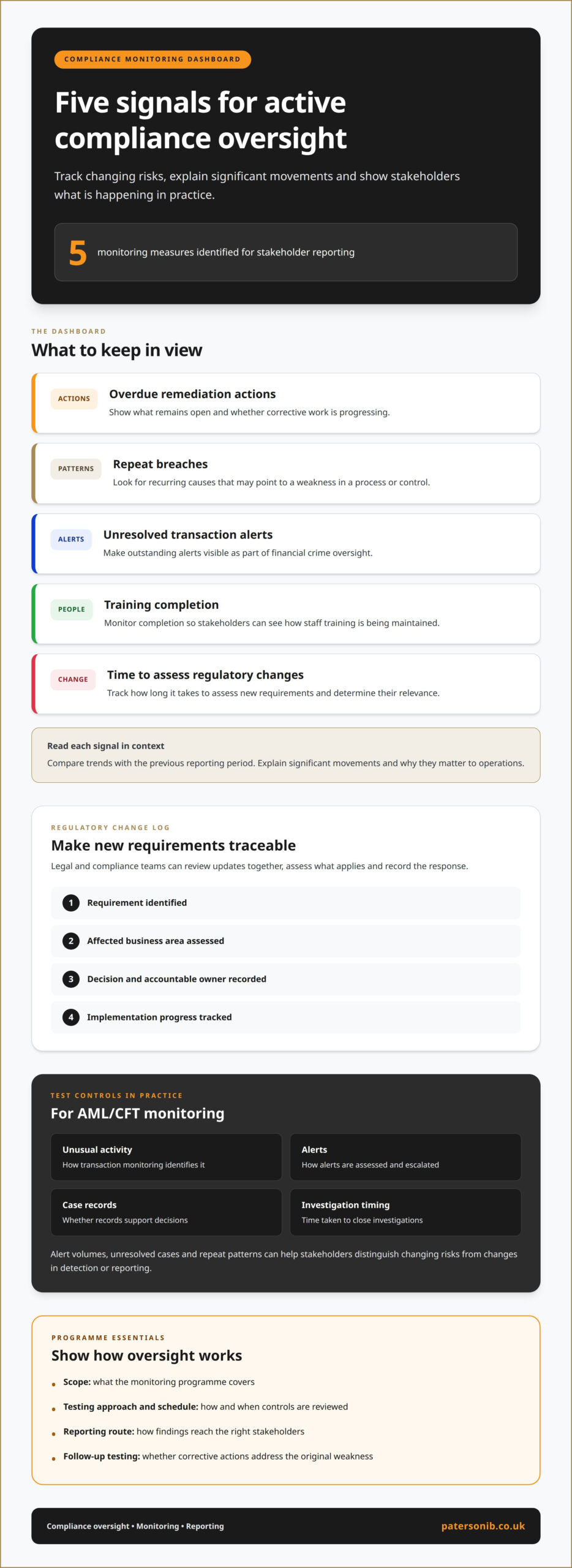
Which insurance compliance KPIs and metrics should stakeholders monitor? Track overdue remediation actions, repeat breaches, unresolved transaction alerts, training completion and the time taken to assess regulatory changes. Compare trends with the previous reporting period, then explain significant movements and their operational importance.
Compliance risks change as products, processes and external requirements develop. Legal and compliance teams can jointly review regulatory updates, assess which apply to the organisation and record the resulting obligations. A change log should capture the requirement, affected business area, decision, accountable owner and implementation progress. This gives governance teams a clear view of how regulatory developments affect current controls.
Monitoring should also test whether controls work in practice. For AML/CFT, review how transaction monitoring identifies unusual activity, how alerts are assessed and escalated, and whether case records support decisions. Useful measures include alert volumes, unresolved cases, repeat patterns and the time taken to close investigations. These indicators help stakeholders distinguish changing risks from changes in detection or reporting processes.
A compliance monitoring programme should set out its scope, testing approach, schedule and reporting route. Internal gap analyses can compare existing controls with applicable requirements, while follow-up testing checks whether corrective actions addressed the original weakness. Record the assessment method and evidence so stakeholders can distinguish completed actions from those still open. Training completion and recurring control failures can also point to areas where staff need guidance.
Review the programme as a continuous cycle, not a one-off exercise. When introducing a new product or process, assess its compliance implications before implementation, then monitor its performance after launch. Use findings, incidents and regulatory developments to refine controls and training. Stakeholders can then see how standards are maintained, where exposure is changing and which decisions support ongoing programme development.
A useful report gives stakeholders a consistent account of each compliance issue and the response. Start with the reporting period, affected business area and a plain-language description of the risk or breach. Explain the possible impact on customers, operations or regulatory obligations, then identify existing controls and any remaining exposure. This format helps board members distinguish an emerging concern from a confirmed breach.
For each issue, record its status, escalation route, accountable owner and supporting evidence. Separate immediate containment from longer-term remediation. For example, restricting access to a misused customer record may contain an incident, while reviewing permissions addresses the underlying weakness. Internal investigation procedures and root cause analysis help explain what happened, why controls failed and how the risk of recurrence will be reduced.
Action tracking should show the agreed corrective step, owner, progress and evidence needed for closure. If work is delayed, state the reason, interim control and decision-maker responsible for oversight. Keep unresolved actions visible in subsequent reports rather than removing them from view. This creates a clear trail from the original finding to management’s response and helps stakeholders assess whether the remedy has addressed the cause.
Use appropriate reporting channels so staff can raise concerns and compliance teams can review them. Whistleblower mechanisms, direct access to compliance officers and anonymous reporting routes can help surface issues early. Reports should summarise themes and outcomes without unnecessarily exposing sensitive personal details. Tailor the detail to each audience: the board needs material risks and decisions, while operational managers need clear tasks and ownership.
For support connecting operational risks with practical controls, discuss risk management support.
Paterson Insurance Brokers helps businesses consider insurance protection alongside the operational risks they report to stakeholders. Clear information about cover can support discussions about risk exposure, business continuity and how insurance fits within wider oversight. The appropriate protection depends on the organisation’s activities and the risks it faces.
Businesses in construction, agriculture, retail, wholesale and manufacturing can explore insurance options shaped around their sector. This can help decision-makers connect operational realities with the risks they monitor, without treating insurance as a substitute for compliance controls or remediation.
If you’d like to discuss how business insurance fits your organisation’s risk picture, contact Paterson Insurance Brokers.
A well-used report connects oversight with decisions about the organisation’s future. Treat it as a starting point for discussion: agree which risks need attention, who will lead the response and how progress will inform the next review. This keeps the insurance compliance report for stakeholders connected to practical business priorities, rather than leaving it to be read only after issues arise.
Insurance decisions also form part of a wider view of business risk. Paterson Insurance Brokers offers Construction Insurance, Agriculture Insurance, and Retail & Wholesale Insurance to help businesses consider their risk arrangements.
For a considered discussion about your organisation’s insurance needs, contact Paterson Insurance Brokers. A clear conversation can help you take the next step with confidence.
Insurance compliance means aligning an organisation’s activities with the rules and standards that apply to its role in insurance. It includes how policies are designed, sold, administered and reported, as well as how customer information and financial crime risks are handled. For example, an intermediary can map each customer-facing process to its responsible team and relevant control.
Compliance supports fair customer treatment, reliable operations and confidence in how insurance businesses manage risk. A weakness in claims handling, customer data management or financial crime controls can affect customers and an organisation’s ability to meet its responsibilities. Clear oversight also helps decision-makers spot recurring issues, understand their causes and focus attention on processes that need improvement.
A useful insurance compliance report for stakeholders should identify its reporting period, scope and intended audience, then connect key findings to decisions. Include changes affecting the organisation, relevant control testing, customer or operational impacts, and outstanding management actions. For example, a report covering a new product launch could show which teams reviewed its risks and whether approval conditions were met.
There is no single list suitable for every firm: applicable requirements depend on its activities, permissions and products. A report should map each relevant FCA requirement and insurance standard to the business area it affects, then record how compliance is assessed. Solvency II is an insurance solvency framework; include it where it applies to the organisation’s reporting context.
FCA reporting and disclosure obligations depend on the firm’s regulatory status and activities. Separate required regulatory submissions from internal updates prepared for owners, boards or other stakeholders. A practical reporting register records each applicable return or disclosure, its owner, reporting period, approval route and submission status. The FCA’s 2024/35 Business Plan identifies financial crime, including money laundering in insurance, as a UK priority.
Show how the organisation assesses whether its products and services are working for customers, using evidence from complaints, claims journeys, communications and customer feedback. Break results down by product or process where useful, and explain recurring barriers, such as unclear renewal information. Link each concern to a decision, responsible team and follow-up measure so stakeholders can assess whether changes improve the customer experience.
Let us know your needs and we’ll be in touch shortly.