Make an enquiry
Let us know your needs and we’ll be in touch shortly.


Check out all the latest updates, insights and advice from our expert team.
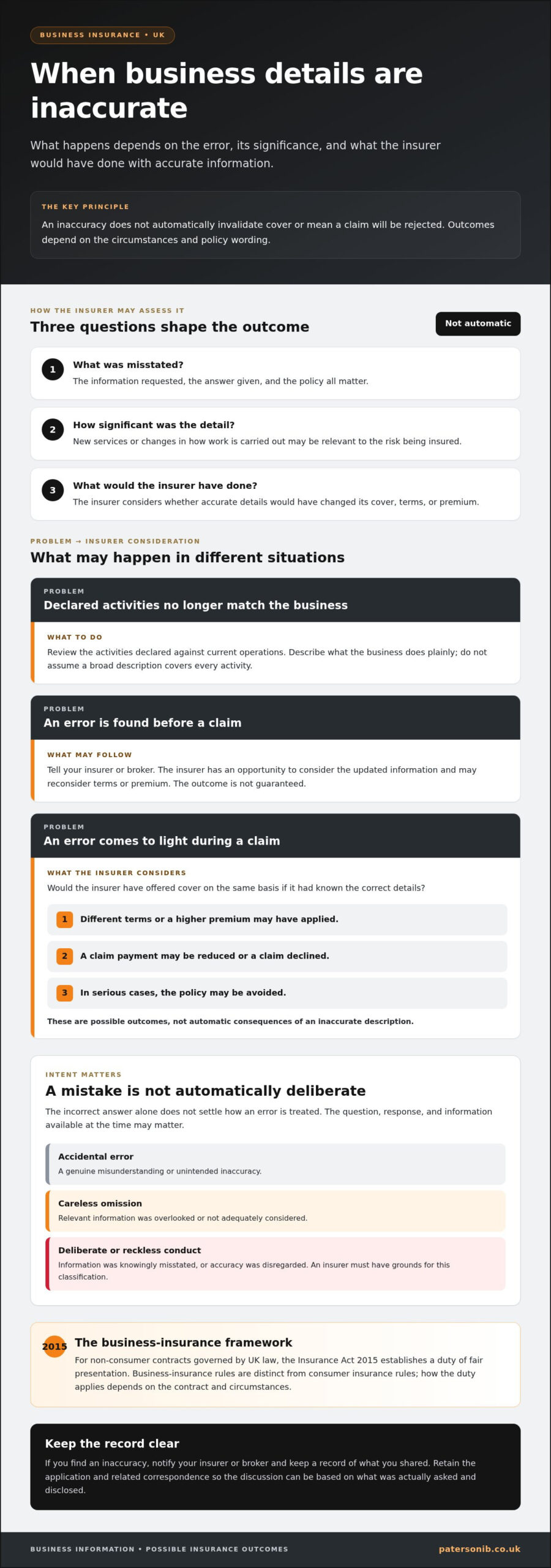
Could an inaccurate description of your business leave you without cover when you need it? The consequences of misrepresenting business activities to an insurer depend on what was misstated, how significant it was and what the insurer would have done with accurate information. An error is not automatically deliberate dishonesty, but it should be addressed clearly.
For UK business insurance, the Insurance Act 2015 sets a duty of fair presentation. Depending on the circumstances, a careless breach could lead to a reduced claim payment, different policy terms or the policy being avoided. A deliberate or reckless breach can have more serious consequences. These business-insurance rules are distinct from those for consumer policies, and outcomes depend on the facts and policy wording.
This article explains how inaccurate information may affect cover, claims and renewal, and what to review if your activities have changed. It also sets out practical steps for correcting details and keeping your insurer informed. Advice-led insurance brokerage and risk management consultancy can help you describe your operations clearly and review related risks.
Misrepresentation can mean giving an insurer inaccurate or incomplete information about what a business does. A genuine mistake is not automatically deliberate deception, and an inaccuracy alone does not automatically invalidate cover. Its relevance depends on the information requested and the policy.
For a general overview of the term, see Misrepresentation in law. The video below discusses fraudulent misrepresentation in contracts, a broader topic than business insurance.
Insurers ask about business activities to assess the risks they are being asked to cover. New services and changes to how work is carried out may be relevant. Their significance depends on the questions asked and the policy. Describe your operations plainly rather than assuming a broad description covers every activity.
Consumer insurance guidance should not automatically be applied to business policies. For non-consumer contracts governed by UK law, the Insurance Act 2015 establishes a duty of fair presentation. Broadly, this means presenting relevant risk information clearly, including material circumstances the business knows or ought to know. How the duty applies depends on the contract and circumstances.
An inaccurate declaration may lead an insurer to revise terms or premium, reduce a claim settlement, decline a claim or, in serious cases, avoid the policy. These are possible outcomes, not automatic ones. The consequences of misrepresenting business activities to an insurer depend on what the insurer would have done with accurate information.
If an error is found during a claim, the insurer may consider whether it would have offered cover on the same basis if it had known the correct details. For example, it may assess whether different terms or a higher premium would have applied. The claim outcome depends on that assessment and the policy. An inaccurate description does not by itself mean every claim will be rejected.
Correcting an error before a claim arises gives the insurer an opportunity to consider the updated information. If the error comes to light during a claim, it will be considered in that context. Neither timing guarantees a particular result, but raising the issue promptly avoids leaving the information uncorrected.
An insurer may reconsider cover when it receives material information, including at renewal. It might offer different terms, change the premium or decide not to continue the policy. Answer future application questions accurately. The effect of an earlier error depends on the circumstances, not on an assumed market-wide response.
A policy remedy and an allegation of fraud are separate matters. A careless disclosure may have insurance consequences without being deliberate deception. Under the Insurance Act 2015, remedies for business insurance breaches depend partly on whether the breach was careless or deliberate or reckless. An insurer must have grounds for classifying a breach as deliberate or reckless.
If you are reviewing an error, business insurance brokerage can help clarify the information and discuss it with insurers.
No. An error may be accidental, careless or deliberate or reckless. The incorrect answer alone does not settle which applies. An insurer may consider the question, the response and the information available to the business at the time.
| Situation | What it may indicate |
|---|---|
| Accidental error | A genuine misunderstanding or unintended inaccuracy. |
| Careless omission | Relevant information was overlooked or not adequately considered. |
| Deliberate or reckless conduct | Information was knowingly misstated, or accuracy was disregarded. |
The clarity of the question, the answer given and the importance of the omitted detail can all be relevant. An unclear question, for instance, may help explain why an answer was incomplete, but it will not settle the matter by itself. Intent is not the only consideration. Keep the application and related correspondence so the discussion can be based on what was actually asked and disclosed.
Financial Ombudsman Service guidance on misrepresentation focuses on consumer insurance complaints. It can illustrate consumer cases, but it is not a complete guide to commercial policies. The Consumer Insurance (Disclosure and Representations) Act 2012 applies to consumers; business insurance contracts governed by UK law are generally considered under the Insurance Act 2015. For a disputed commercial claim, get advice based on the policy and specific circumstances.
Keep your insurance information aligned with how the business operates. Compare declared activities with current operations, note changes, tell your insurer or broker, then retain the correspondence and updated documents. Repeat the review when services, working arrangements or other aspects of the business change. Do not assume an existing description will continue to fit.
Gather the application or proposal information, policy schedule and other relevant documents. Compare their descriptions with your current activities. Look for wording that has become too broad, too narrow or out of date, and check that details are consistent across documents. The aim is to identify where information may no longer reflect the operation being insured, not to reinterpret policy terms yourself.
Changes can be easy to overlook when they happen gradually. A new service, a different way of carrying out work or a change in working arrangements may affect the risk picture. Keep a simple record of what changed and when. This gives you a clear basis for explaining the update and avoids relying on memory when reviewing cover or speaking with your broker.
Contact your insurer or broker promptly. Explain which information appears inaccurate, provide a clear correction and, where helpful, describe when the change or error arose. Be factual and avoid guessing whether a detail matters. Do not assume the insurer already knows about a change through another source or that a past conversation updated the policy.
Ask for the effect on your cover to be explained in writing. The insurer may need to consider the corrected information and tell you whether terms or documents will change. Keep copies of your message, the reply and any revised policy documents. Check that updated records accurately reflect what was agreed. No single correction guarantees a particular outcome, but a clear, dated record makes the discussion easier to follow.
To prevent errors, assign responsibility for reviewing insurance information when business operations change, and include the review in your risk-management process. The consequences of misrepresenting business activities to an insurer depend on the details and policy wording, so raise uncertainties early rather than leaving them unresolved. Clear descriptions help an insurer assess the risk based on the information provided.
If you would value advice on reviewing business activities and related insurance information, speak with our insurance brokerage team.
It can be difficult to judge whether a business description still reflects the work being carried out. An insurance broker can help you explain your activities when arranging or reviewing cover, and communicate relevant information to insurers. This keeps the discussion focused on what the business does, how it operates and what may have changed.
A broker can help organise the information needed to discuss your business insurance and explain policy details in clear language. This includes identifying where a description may need clarification and presenting updated information to insurers for consideration. Advice should reflect your circumstances and protection needs, rather than focus on price alone.
Clear communication matters on both sides. We champion transparency, so you can discuss what your policy says, what your business does and where the two may not align. The consequences of misrepresenting business activities to an insurer can turn on the detail. An informed review can help you understand what information to share and what questions to raise, but it does not replace the insurer’s decision or guarantee a particular outcome.
Consider advice if a policy description seems inaccurate, your operations have changed or you are uncertain how to describe a new activity. A broker can help with insurance information and communication with insurers. Risk management consultancy can also support a broader review of operational risks and compliance, helping you consider whether business changes have implications beyond the insurance paperwork.
A business risk management guide can help structure a review of changing operations, exposures and existing controls. The insurance review can then consider how those risks are described to insurers. Keep the two conversations connected, while remembering that brokerage and risk management support are distinct from legal advice on a disputed claim or allegation. If a formal legal dispute or contractual issue arises, consulting a dedicated law firm such as Botelho Law Group can help ensure your legal rights and operational interests remain protected.
We take an advice-led approach and aim to make insurance clear, so you can discuss your circumstances openly and understand the next steps.
As your business develops, make checking your insurance information part of planning for change. A new service, a revised way of working or a shift in responsibilities can prompt you to revisit how your activities are described. This helps insurance conversations keep pace with the business rather than rely on earlier assumptions.
The consequences of misrepresenting business activities to an insurer can be difficult to assess without looking at the details. If you are uncertain about a description or how to raise a change, get advice suited to your circumstances. Clear communication is a sound basis for discussing your cover and deciding what to do next.
Paterson Insurance Brokers provides business insurance brokerage and risk management consultancy with an advice-based approach, not a price-based one. We champion transparency and aim to make insurance clear. Make an enquiry and tell us what support your business needs.
It may affect a claim, but rejection is not automatic. The insurer may consider what it asked, the information supplied, the significance of the error, how it arose and the policy wording. The consequences of misrepresenting business activities to an insurer can also depend on what the insurer would have done with accurate information. Keep the application, policy documents and related correspondence together, then explain the discrepancy to your insurer or broker.
Not necessarily. An honest misunderstanding, a careless answer and knowingly giving false information are different circumstances, and an error alone does not establish which applies. Someone completing a form, for example, may misunderstand a term, while another person may knowingly leave out information they recognise as relevant. The questions, answer and surrounding facts may help distinguish these situations. Do not label the issue as fraud or dismiss it as harmless without considering the specific policy and evidence.
A change may affect the information on which the policy was arranged, so review the relevant policy documents and notification terms. If your business begins offering an additional service, for example, describe what changed and when, then raise it with your insurer or broker. Keep their response and any revised documents. Do not assume an existing policy automatically extends to new or substantially changed activities; the effect depends on the contract and circumstances.
Yes. Tell your insurer or broker as soon as you discover the error, even if the policy has already renewed. Explain which detail needs correcting and provide accurate information without guessing at its effect. Ask whether the insurer will amend the policy or make another change, and from what date any revised terms apply. Keep the written response. A correction does not automatically cancel cover or guarantee that the policy will remain unchanged.
Not every minor change will necessarily affect the cover, but do not assume an update is irrelevant. Check the policy’s questions and terms, then consider whether the change alters the activities or risks described. A routine internal process adjustment, for example, may differ from starting a new service. If the relevance is unclear, explain the change to your broker or insurer and ask how it relates to the policy and any notification terms.
Not as a complete guide. The Financial Ombudsman Service material cited on misrepresentation focuses on consumer insurance complaints, while commercial policies have distinct legal and contractual considerations. Consumer rules under the Consumer Insurance (Disclosure and Representations) Act 2012 should not be assumed to govern a business policy. If a commercial dispute arises, review the relevant documents and seek advice that addresses the business policy and its circumstances.
A broker can help you understand the insurance information and communicate a correction clearly to the insurer. It can help to provide the original description, accurate details and relevant dates so the issue can be discussed with context. Keep a record of what you share and the response you receive. Brokerage support is different from legal advice on a disputed claim, so consulting specialist legal counsel such as JZ Law can help protect your position if complex corporate or regulatory issues arise.
Let us know your needs and we’ll be in touch shortly.