Make an enquiry
Let us know your needs and we’ll be in touch shortly.


Check out all the latest updates, insights and advice from our expert team.
An insurance purchase is a governance decision, not just a renewal task. A UK managing director’s fiduciary duty for insurance purchasing is to act in the company’s interests and make the decision with independent judgement and reasonable care, skill and diligence. The Companies Act 2006 sets out these duties, including the requirements in sections 173 and 174, according to UK Parliament.
It’s reasonable to expect that choosing suitable cover involves comparing risks and policy terms. But directors also need to consider how the decision serves the company, use their own judgement and disclose relevant personal interests. According to UK Parliament, section 177 requires directors to declare direct or indirect interests in proposed transactions or company business.
This article explains how a managing director’s fiduciary duty for insurance purchasing applies when a business buys or renews insurance. It covers what directors should consider, why disclosure matters and how specialist insurance and risk advice can support a considered decision.
UK directors’ fiduciary duties require decisions to serve the company, not personal interests. The Companies Act 2006 sets out statutory duties that also shape insurance decisions.
A breach occurs when a director fails to meet a duty, such as acting in the company’s interests. The company may challenge the decision, and a court may hear a claim. A director could also be removed from office. In insurance purchasing, a poorly considered decision may raise governance concerns, particularly if it exposes the company to avoidable loss.
Directors’ duties generally concern the company, though circumstances can affect who may be owed a duty. In England and Wales, a special relationship may create a duty to shareholders, for example in a closely held company where a personal relationship and a particular transaction are involved. A director’s knowledge of the company’s affairs alone does not establish such a relationship.
The Companies Act 2006 duties do not themselves identify a policy such as employers’ liability as compulsory. Directors should distinguish insurance obligations arising from a company’s activities from cover considered to manage other business risks.
A director is not automatically personally liable just because insurance proves inadequate. The key question is whether the decision breached a duty. If the company alleges a breach, the director may face court proceedings or removal from office. That makes it important to consider the available information, the company’s interests and the reasons for the insurance decision.
A company’s public or private status alone does not determine its insurance requirements. Its activities and any rules that apply to a regulated firm can affect the cover it needs. Directors should distinguish those requirements from their broader judgement about protecting the business.
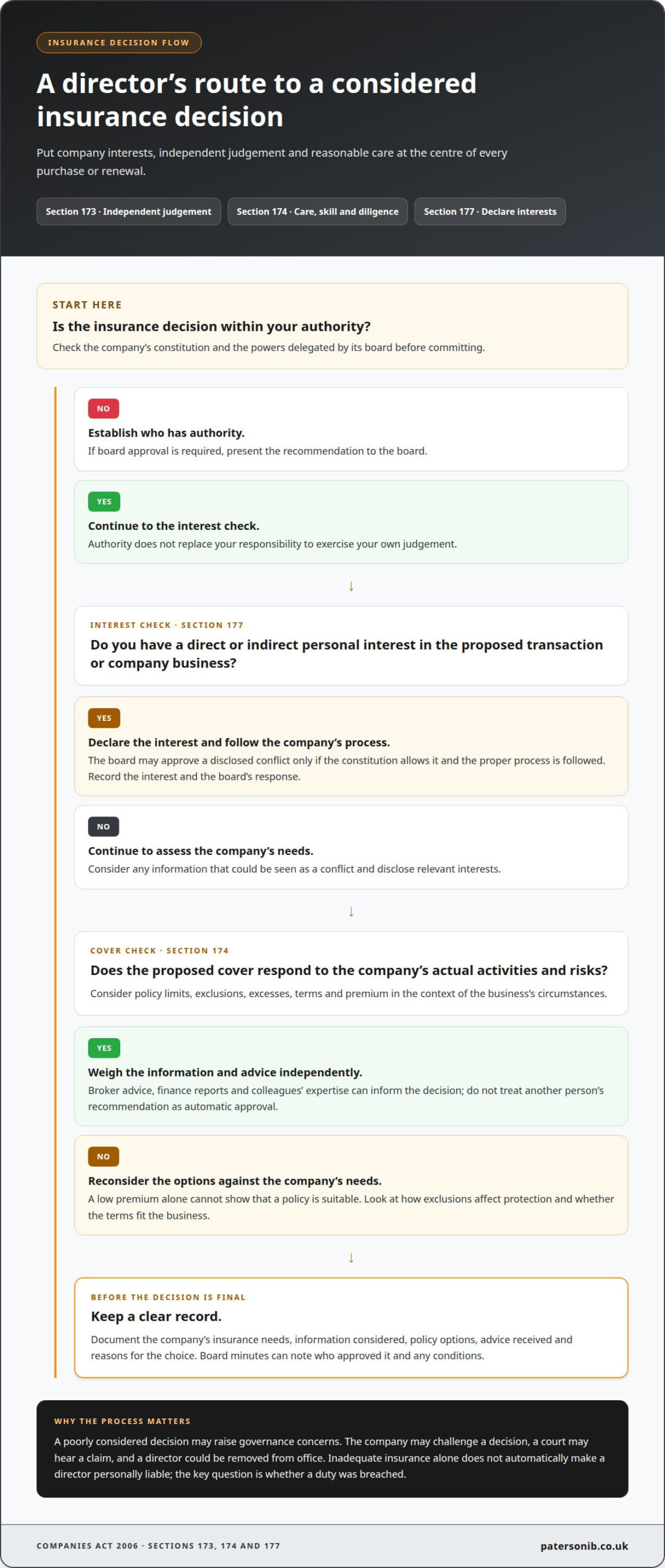
Insurance choices call for more than accepting a renewal on familiar terms. Under section 173 of the Companies Act 2006, directors must exercise independent judgement, according to UK Parliament. A managing director can consider broker advice, finance reports and colleagues’ expertise, but should still weigh whether the proposed cover benefits the company. The managing director's fiduciary duty for insurance purchasing includes making a reasoned decision, rather than treating another person’s recommendation as automatic approval.
Under section 174 of the Companies Act 2006, directors must manage the company with reasonable care, skill and diligence, according to UK Parliament. For an insurance decision, that means understanding the business’s activities, likely exposures, policy limits, exclusions and excesses. When comparing policies, consider whether the cover responds to the company’s actual risks, how exclusions affect protection, and whether the terms and premium fit its circumstances. A low premium alone cannot show that a policy is suitable.
A managing director’s authority to approve or buy insurance depends on the company’s constitution and the powers delegated by its board. Before committing, establish whether the decision falls within that authority. If board approval is required, present the recommendation to the board. The director remains responsible for exercising judgement, even when colleagues or advisers handle parts of the process.
Keep a clear record of the company’s insurance needs, the information considered, policy options, advice received and reasons for the final choice. Board minutes can note who approved the decision and any conditions. If directors question a broker’s advice or an insurance decision, compare it with the records, identify the disputed assumption or gap, and seek a reasoned explanation through the company’s governance process.
For a considered review of business exposures, risk management consultancy can help connect risk information with insurance decisions.
A managing director purchasing insurance must act loyally, in good faith and for the company’s benefit. The decision should reflect the company’s circumstances, constitution and the director’s authority, not personal advantage.
Fiduciary duties require directors to use company powers loyally and for proper purposes. When buying insurance, this means considering the company’s interests and disclosing any personal interest that could affect the decision.
Under section 177 of the Companies Act 2006, directors must declare direct or indirect personal interests in proposed transactions or company business, according to UK Parliament. A particular insurer, intermediary or transaction may create a relevant interest if the director stands to benefit personally. Disclosure allows the company to address the situation openly and decide how to proceed.
Acting in good faith means looking beyond an individual director’s preference. Assess the policy against the business’s risks and needs, and distinguish clearly between company benefit and personal gain.
To apply fiduciary duties, check that the decision falls within the director’s powers and serves a proper purpose for the company. A managing director should consider whether the proposed cover fits the business’s activities, rather than choosing only for convenience or personal relationships.
If a conflict arises, the director should disclose it and follow the company’s constitution and decision-making process. The board may approve a disclosed conflict if the constitution allows approval and the proper process is followed. Recording the interest and the board’s response helps show how the situation was handled.
For example, if a director has a personal connection with a party involved in an insurance transaction, they should disclose it before a decision is made. The company can then assess the proposal on its merits, maintain independent oversight and record why the purchase serves the business.
Disclosure gives the board a clear view of interests that could influence an insurance decision. A conflict may arise if a director has a personal or financial connection with an insurer, broker or another party involved. It may also arise if the director stands to gain from the company choosing a particular provider. The decision should serve the company, not secure an undisclosed personal advantage.
A director should disclose a relevant interest to the board before it considers the proposed transaction. Explain the connection and how it relates to the insurer, broker or policy choice. For example, disclose a financial interest in a brokerage or a close relationship with someone who may benefit from the placement. A clear record allows the board to assess the information and manage the conflict under the company’s constitution.
The board may approve a disclosed conflict if the company’s constitution allows it and approval follows the proper process. Record the disclosure, the board’s response and any decision about the director’s participation. This gives the corporate record a clear account of what was expected and how the company managed the situation. Directors should avoid unauthorised personal benefits and take care when offered gifts by third parties.
If a director did not disclose a relevant connection, the board can review how the decision was reached and whether the interest affected the process. It can examine meeting records, advice received and the reasons given for selecting the insurer or broker. Prompt, complete disclosure helps the board assess the transaction on its merits and maintain accountable governance.
For cover addressing claims connected with directors’ decisions, explore Directors & Officers Liability as part of your company’s risk planning.
Paterson Insurance Brokers helps businesses consider insurance in light of their activities and risks. Construction Insurance can support directors reviewing how the company’s work, projects and operational exposures shape its protection needs.
A considered insurance review supports sound governance: directors can assess the company’s circumstances, compare cover with its risks and record their reasoning. Paterson Insurance Brokers also works with businesses in agriculture, retail and wholesale, and manufacturing, where insurance needs vary by sector.
If your construction business is reviewing its insurance or risk management, contact Paterson Insurance Brokers to discuss your requirements.
The managing director’s fiduciary duty for insurance purchasing is a useful guide at renewal or when business activities change. Use that opportunity to assess whether the company’s insurance arrangements still reflect its operations, risk priorities and plans. A clear discussion can connect those circumstances with appropriate insurance and risk management considerations.
Paterson Insurance Brokers offers Construction Insurance, Agriculture Insurance, and Retail & Wholesale Insurance. If your business is reviewing its cover or its risk profile, speak with the team about the needs you want to address. Contact Paterson Insurance Brokers to start a straightforward conversation and take the next step with confidence.
A director who breaches their duties may face a claim, removal from office or court proceedings. The company may challenge the decision, and earlier decisions could be invalidated. In serious cases, legal costs and financial consequences could put personal assets at risk. For an insurance decision, the issue may be whether the director’s conduct harmed the company, not simply whether a claim later arose.
Use a consistent review process whenever the company’s operations change, such as taking on a new type of work or entering a new market. Keep together the information behind each insurance decision, including risk assessments, policy comparisons, advice and board records. Review the choice at renewal and after material business changes. This helps explain the decision and identify gaps before they lead to disputes.
A director must act within the company’s constitution, use company powers for proper purposes and support lawful, properly governed operations. Responsibilities also include financial reporting: under section 441, directors must file accounts and reports with Companies House every year. In an insurance context, a director should ensure the decision sits within their authority and that the company’s records accurately reflect the decision and its rationale.
A court may set aside a transaction affected by a conflict or require company property to be restored. If harmful conduct is ongoing, it may issue an interim injunction to stop it and limit further loss or irreversible damage. These outcomes differ from an internal board response, such as reviewing the decision or considering the director’s position.
A fiduciary relationship is a legally enforceable position of trust in which one party acts for another’s benefit and owes duties of loyalty, honesty and trustworthiness. Trustee and beneficiary, solicitor and client, and principal and agent are examples recognised as fiduciary relationships under UK common law. Other relationships may qualify when someone agrees to act on another’s behalf and a relationship of trust and confidence arises.
The company is often the party that pursues a director for breach of duty. Potential claimants may also include shareholders, creditors, employees, customers, suppliers, auditors, liquidators, and government or regulatory bodies. In limited circumstances, shareholders may bring litigation on their own behalf, for example if they fear other directors will support the alleged breach. A shareholder’s interest alone does not automatically create a personal fiduciary duty.
Let us know your needs and we’ll be in touch shortly.