Make an enquiry
Let us know your needs and we’ll be in touch shortly.


Check out all the latest updates, insights and advice from our expert team.
A spare part on the shelf can help, but an early warning gives your team time to act. Reducing anxiety about machinery breakdown and downtime starts with identifying critical equipment, parts that could delay repairs and signs of developing faults. A reactive repair can disrupt production longer than planned maintenance.
It’s understandable to worry about the knock-on effects of a machine stopping, from delayed orders to pressure on the rest of the operation. A clear plan makes the response more manageable: keep essential spares visible, schedule maintenance around production needs, and track the causes and duration of stoppages.
This guide explains how to prioritise critical equipment, choose a suitable maintenance approach and use monitoring data to spot changes in machine condition. It also covers how these practical steps can reduce repair delays and make downtime less disruptive.
Reactive, or breakdown, maintenance begins after a machine fails and stops production. It can suit a low-cost component whose failure has little operational impact. Scheduled preventive maintenance follows equipment manuals and usage hours, with cleaning, lubrication, replacement and calibration at planned intervals. Set intervals around workload: machinery running continuously or under heavy load needs closer attention. Where possible, schedule work during quieter production periods so planned downtime is less disruptive than an unexpected stoppage.
Routine maintenance covers repeat tasks such as inspections, cleaning and lubrication. Preventive maintenance adds planned component replacement before expected wear causes failure. Condition-based maintenance responds to real-time signs of a machine’s condition, rather than relying only on calendar dates. Predictive maintenance analyses monitoring data to forecast when a fault may occur, giving teams an opportunity to plan a repair. Predictive maintenance can reduce unplanned downtime by up to 50%, though results depend on the equipment, data and implementation.
Keep the schedule practical by recording completed work, faults found and recurring causes. Review equipment performance and operating needs regularly, then adjust the plan if records show wear or repeated stoppages. Pair scheduled maintenance with spare-parts planning: identify components whose absence could delay a critical repair and decide which to stock. For less critical equipment, running to failure may be reasonable if a breakdown has minimal impact.
During an incident, coordinate maintenance, operational technology (OT) and information technology (IT) teams. Maintenance can assess the machine and repair needs; operations can report production impacts; IT can investigate connected systems if monitoring or control data is affected. Use a shared incident record to capture the stoppage time, symptoms, actions taken and likely causes. Prioritise the response by safety, production impact, backup equipment and parts lead time. Clear roles help teams focus resources on failures with the greatest operational consequences.
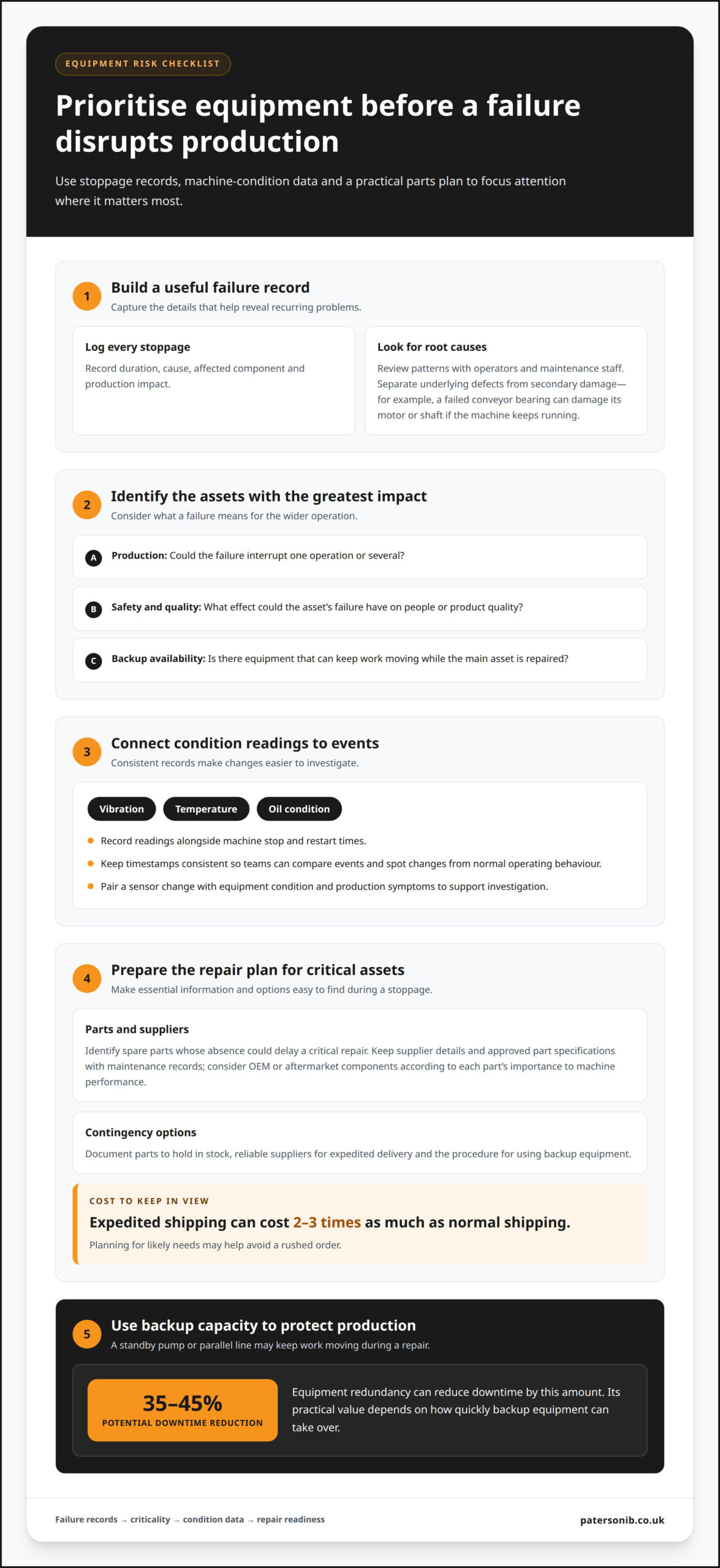
Start with a failure log recording each stoppage’s duration, cause, affected component and production impact. Review the records with operators and maintenance staff to identify recurring patterns, rather than treating every fault as isolated. Root cause analysis can distinguish an underlying defect from secondary damage. For example, a failed conveyor bearing may damage its motor or shaft if the machine keeps running. Assess each asset by its effect on production, safety and quality, as well as the availability of backup equipment. This directs preventive work towards machinery whose failure could interrupt several operations.
Reliable monitoring data makes this assessment more useful. Record readings such as vibration, temperature and oil condition alongside machine stop and restart times. Consistent timestamps help teams compare events and spot changes from normal operating behaviour. If a sensor reading changes, record the equipment condition and any production symptoms together. This context can help maintenance staff investigate likely causes, while accurate event records help managers distinguish equipment failure from a material shortage or another production constraint.
For critical equipment, identify essential spare parts and decide which should be held in stock. A contingency plan can name those parts, reliable suppliers for expedited delivery and the procedure for using backup equipment. Choose OEM or aftermarket components according to how critical each part is to machine performance. Expedited shipping can cost 2-3 times as much as normal shipping, so planning for likely needs may avoid a rushed order. Keep supplier details and approved part specifications with the maintenance records, so staff can act without searching through scattered files during a stoppage.
Redundancy can also protect production: a standby pump or parallel line may keep work moving while the main asset is repaired. Equipment redundancy can reduce downtime by 35-45%, though the practical value depends on how quickly a backup can take over. For a broader view of operational risks, explore Manufacturing Insurance alongside your maintenance and continuity planning.
Equipment downtime is the time a machine cannot perform its intended production task. Mean time to repair (MTTR) measures the average time to return equipment to operation, including diagnosis, repair and restart. Mean time between failures (MTBF) tracks the average operating time between unplanned stoppages. Together, these measures show whether failures are frequent or repairs take too long.
Financial effects include lost output, delayed orders and emergency labour. Emergency labour for unplanned repairs can increase repair costs by 30-50%. Estimate a line’s lost margin by multiplying hourly production capacity by downtime hours and average margin per unit. Include downstream delays, rejected work and idle staff in the operational review.
Repairing machinery can expose staff to moving parts, stored energy and hazardous substances; an unexpected restart can worsen the risk. UK health and safety requirements depend on the equipment, task and workplace. UK businesses must comply with the Provision of Use of Work Equipment Regulations (PUWER), Lifting Operations and Lifting Equipment Regulations (LOLER) and Control of Substances Hazardous to Health (COSHH).
Human error can contribute to failures when start-up sequences, load limits or shutdown steps are misunderstood. A maintenance programme should train operators in standard procedures, basic troubleshooting and safe equipment use. Teach staff to stop unsafe machinery and report faults promptly, rather than attempt unauthorised repairs. Inspections and clear fault logs help maintenance teams distinguish operating mistakes from worn components or other causes. For connected equipment, alerts and guided troubleshooting can help frontline workers resolve minor issues before they extend downtime.
To reduce stress after a stoppage, managers should assign incident roles, explain the next action and keep teams updated on repair progress. Regular emergency drills and practical training help staff know whom to alert, what information to record and when to leave repairs to qualified personnel.
Continuous monitoring turns machine behaviour into useful maintenance signals. Sensors can track vibration, temperature and oil condition, while software records when equipment stops and restarts. Compare each reading with the machine’s normal operating pattern. Rising temperatures or unusual vibrations can indicate a developing fault, giving maintenance teams a reason to investigate before production stops.
Predictive maintenance uses patterns in ongoing equipment data to forecast potential failures. It can help teams schedule repairs during planned maintenance windows instead of responding only after an emergency breakdown. Anomaly detection flags behaviour that differs from normal operation; predictive analysis then helps assess whether the change warrants inspection or repair. For businesses, reducing anxiety about machinery breakdown and downtime means turning early signals into timely, practical decisions.
Monitoring works best when every alert leads to a defined decision. Specify who reviews a warning, how they assess its urgency and how findings are entered in the maintenance record. For example, a temperature alert could prompt an inspection, followed by a repair scheduled around production needs. This turns data into a practical maintenance task rather than another notification staff might overlook.
Prescriptive maintenance goes a step further by recommending possible actions. Depending on the data, a recommendation might be to reduce running speed, shorten operating time or apply lubrication. Maintenance teams can weigh that advice against equipment instructions, production requirements and observed conditions. Record the action and result, then use them to refine future thresholds and scheduled maintenance.
Begin with critical machinery and a small set of meaningful signals, such as vibration, temperature and downtime frequency. Review alerts alongside inspection findings to distinguish useful warnings from normal variation. Discuss machinery breakdown risk planning as part of a broader approach to protecting business continuity.
Paterson Insurance Brokers helps businesses consider how machinery risks fit into their wider insurance and risk management needs. If breakdowns could disrupt production, delay orders or affect other operations, reviewing equipment risks and continuity plans can clarify where insurance may be relevant.
As an independent brokerage, Paterson Insurance Brokers provides tailored insurance and risk management solutions for businesses across the UK. The right approach depends on your sector, equipment and operational exposure, so it’s worth discussing how machinery failure could affect your business alongside your maintenance and recovery plans.
For an advice-led conversation about your business risks, make an enquiry with Paterson Insurance Brokers.
Machinery resilience is not only a maintenance decision. It also depends on how a business plans for financial disruption and adapts as production, equipment and supply arrangements change. Consider whether your risk planning reflects the machinery you rely on today and how a prolonged interruption could affect cash flow, commitments and recovery priorities.
Paterson Insurance Brokers can discuss business risks and tailored insurance options alongside your wider risk management approach. Its offerings include Construction Insurance, Agriculture Insurance and Retail & Wholesale Insurance, with cover tailored to each business’s needs. This conversation can clarify how insurance fits alongside practical maintenance and continuity measures, without treating a policy as a replacement for them.
Taking time to review these exposures can help make reducing anxiety about machinery breakdown and downtime part of a steadier business plan. Contact Paterson Insurance Brokers to discuss a thoughtful next step and move forward with greater clarity.
Keep parts likely to delay a critical repair easy to identify and access. For example, a labelled bearing stored near the maintenance area can save time locating the right component. Record compatible specifications, stock levels and reorder triggers together. This helps staff avoid ordering an unsuitable part and gives purchasing teams a clear basis for replenishment.
Equipment downtime is the period when an asset cannot carry out its required task. It can include diagnosis, waiting for a component, repair and checks before normal work resumes. Record start and end times, then note whether the machine was unavailable because of a fault, planned work or another production constraint. This distinction makes downtime records more useful for operational decisions.
Machine downtime refers to the time an individual machine is unavailable, rather than the overall interruption across a production site. If a packaging machine stops but a parallel line continues, the machine is down while the site may still be producing. Track each asset separately, including whether its failure affected connected processes or simply reduced available capacity.
Planned downtime is arranged in advance for work such as inspection, maintenance or a production changeover. Unplanned downtime follows an unexpected stoppage, such as a fault that interrupts a shift. For example, a scheduled service can be built into a production plan, while an unexpected motor problem requires teams to respond around current orders and operating conditions.
Breakdowns can result from component wear, poor lubrication, contamination, excessive load or faults in electrical and control systems. Dust, moisture and extreme temperatures can also increase wear over time. Not every stoppage is an equipment failure: a material shortage can halt production even when machinery works correctly. Recording the cause helps teams choose an appropriate response instead of misclassifying the event.
Base the schedule on the manufacturer’s instructions, operating hours and how heavily each machine is used. Include relevant inspections and routine tasks, then schedule work during lower-impact production periods where practical. A machine running continuously may need closer attention than lightly used equipment. Review maintenance records and performance data regularly, adjusting intervals when operating conditions or recurring faults change.
Let us know your needs and we’ll be in touch shortly.