Make an enquiry
Let us know your needs and we’ll be in touch shortly.


Check out all the latest updates, insights and advice from our expert team.
An acquisition can leave directors exposed even when the business appears well insured. Key insurance considerations for business acquisitions include reviewing both companies’ policies and claims histories, identifying coverage gaps, and checking how the deal affects directors’ and officers’ (D&O) cover. Change-in-control terms and run-off protection matter because claims may arise after completion.
It’s easy to focus on the purchase agreement and overlook the insurance arrangements that need to continue, change or end. A careful review can reveal unresolved claims, uninsured risks and gaps between the seller’s cover and the buyer’s needs.
This guide explains the main risks to assess, what to look for in the seller’s policy documents, and when to arrange or update cover before completion. It also explores representations and warranties (R&W) insurance and why D&O protection deserves attention during the deal and after it closes.
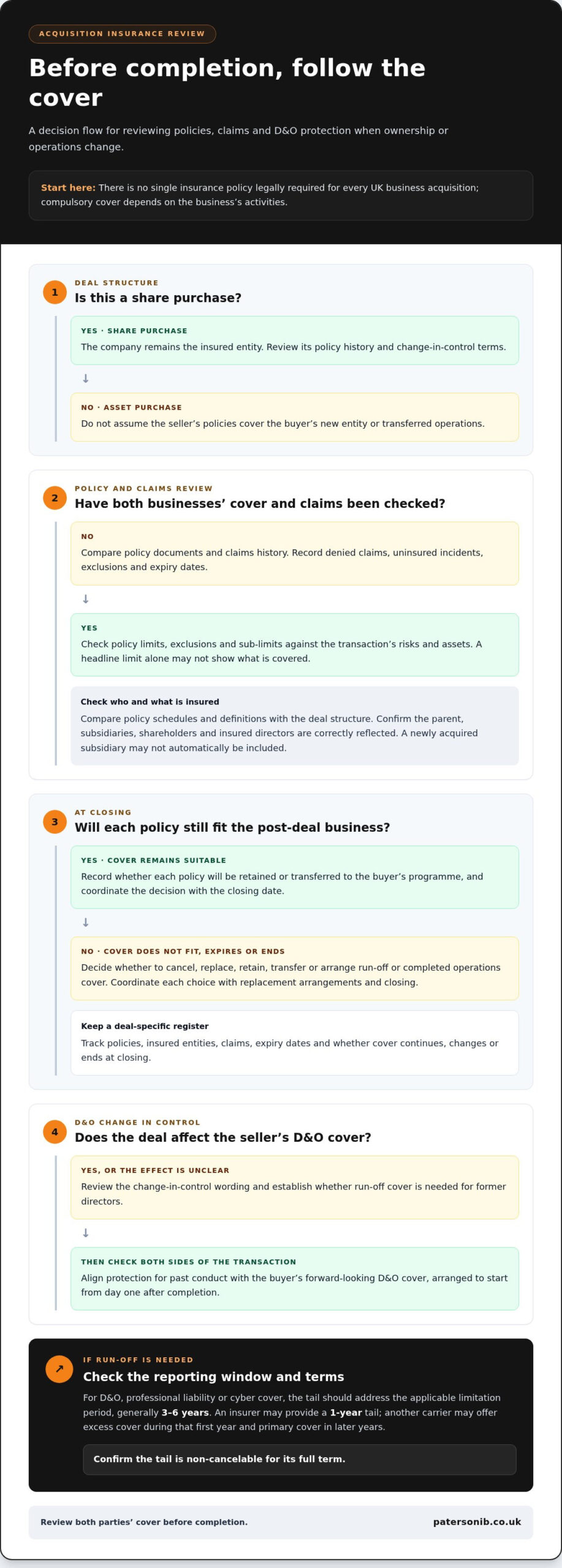
There is no single insurance policy legally required for every UK business acquisition; compulsory cover depends on the business’s activities. Review both parties’ policies before completion to identify gaps, unresolved claims and cover affected by the deal. These are central insurance considerations for business acquisitions, particularly when a change in ownership affects who is protected.
Checking cover across subsidiaries and shareholders means confirming which legal entities and people each policy protects. A group policy may not automatically include a newly acquired subsidiary, or may name the wrong parent company.
Compare the policy schedule and definitions with the deal structure. List the parent company, subsidiaries, shareholders and insured directors, then check each against the wording. For example, if a newly acquired subsidiary is absent from the schedule, establish whether the policy extends to it. One of the key insurance considerations for business acquisitions is ensuring policy details reflect the company structure at completion.
A change-in-control provision explains how a policy responds when ownership or control changes. Review it before completion, since an acquisition can affect cover under either party’s policies.
Tail, or run-off, cover extends the reporting period for certain claims after a policy ends. For directors’ and officers’, professional liability or cyber cover, the tail should address the applicable limitation period, generally 3-6 years. An insurer may provide a 1-year tail, with another carrier potentially offering excess cover during that first year and primary cover in later years. Check that the tail is non-cancelable for its full term.
D&O insurance can protect directors and officers against covered legal actions, investigations and other claims. Private companies can face deal-related exposures too, including allegations connected with disclosures or decisions made during negotiations.
Before completion, establish how the change in control affects the seller’s D&O policy and whether run-off cover is needed for former directors. Arrange the buyer’s forward-looking cover to start from day one after completion. Addressing this before the deal closes helps align protection for past conduct with cover for future decisions.
Insurance due diligence compares policies with claims history and actual business exposures. Review both parties’ cover rather than assuming the buyer’s existing insurance extends to the acquired operation.
The review may uncover an unresolved employment claim, missing key person cover or an acquisition threshold in the buyer’s policy. Thresholds can differ between policies, so assess each one before adding a subsidiary. Record denied claims, uninsured incidents, exclusions and expiry dates. These insurance considerations for business acquisitions can reveal liabilities that might otherwise remain uninsured after completion.
Keep a deal-specific register of policies, insured entities, claims and expiry dates. Use it to identify which cover continues, changes or ends at closing, and whether the combined business will be protected from completion.
In a share purchase, the company remains the insured entity, so review its policy history and change-in-control terms. In an asset purchase, don’t assume the seller’s policies cover the buyer’s new entity or transferred operations.
Assess claims history alongside policy limits, exclusions and expiry dates, comparing each with the risks and assets included in the transaction. Record denied claims and uninsured incidents, then identify any exposures the buyer’s programme needs to address.
Decisions about cancelling or transferring policies establish which seller policies end, continue or need replacing after the transaction. A policy that expires or is cancelled may leave earlier events without a route for reporting claims.
Build a schedule showing each policy, its expiry date, insured entities and proposed status: cancel, retain, transfer to the buyer’s programme, or arrange run-off or completed operations cover. For example, a policy covering the seller’s trading entity may not fit the buyer’s post-deal structure. Coordinate each decision with the closing date and replacement arrangements.
Policy limits set the maximum available under the relevant cover, while enterprise value reflects the business being acquired. Comparing them helps buyers assess whether existing limits appear proportionate to the assets, operations and potential liabilities involved.
Review limits alongside exclusions, sub-limits and the seller’s claims history, rather than treating the headline figure as the whole picture. A high limit may still leave a material exposure outside cover if an exclusion applies. Map key assets and liabilities to the policies intended to protect them, then flag gaps for the transaction’s risk review.
A claims-made D&O policy generally responds to claims made during its active period, subject to its terms. Timing matters because a claim made after expiry may not be covered by the seller’s policy.
Check the policy period, reporting requirements, change-in-control wording and any arrangements for reporting later claims. Match those terms to the transaction timetable and decisions about continuing or ending the policy. A past management decision may lead to a claim after completion, so buyers need to understand how the seller’s cover treats that timing.
The deal structure shapes which insurance arrangements remain relevant, but policy wording and transaction documents still need review. In a share purchase, examine the company’s existing policies and claims record because the acquired entity remains central to the insurance review.
In an asset purchase, identify which operations and liabilities move to the buyer, then assess whether its policies cover them. Don’t assume the seller’s insurance transfers simply because equipment, contracts or business activities change hands. Compare the purchase terms with policy schedules to identify any mismatch before closing.
A policy-by-policy review can help connect the seller’s insurance record to the buyer’s intended cover. A business insurance review can support that assessment alongside the transaction’s risk analysis.
In the UK, warranty and indemnity (W&I) insurance can cover a buyer’s losses from breaches of the seller’s warranties, subject to the policy terms. Traditional business policies typically don’t cover liabilities arising from inaccurate representations and warranties in an acquisition agreement.
W&I insurance transfers some financial risk from breached deal warranties to an insurer. It may suit a buyer seeking a route to claim through insurance rather than relying solely on a dispute with the seller.
The buyer or seller may arrange the policy, depending on the transaction. Cover is shaped by the warranties given, due diligence, exclusions and policy limits. Traditional warranties and indemnities policies are often arranged with cover of around 10% of the sale value, but that figure doesn’t determine the right cover for every deal.
W&I insurance may respond to unknown pre-acquisition liabilities when they result from a covered breach of the seller’s warranties. This can matter if information discovered after completion contradicts a promise in the sale agreement.
For example, a seller’s warranty may describe the company’s tax position, but later information reveals an undisclosed liability. The policy wording, exclusions and scope of the warranty determine whether the buyer can claim. It isn’t blanket cover for every historic liability; known issues or matters outside the warranties may not be covered.
Traditional insurance policies generally don’t insure the accuracy of statements made in a deal. Buyers should distinguish W&I cover from the seller’s existing business policies. One responds to covered breaches of transaction warranties; the other responds to insured events under its own terms. This distinction helps prevent buyers from assuming an existing property, liability or professional policy will cover an inaccurate deal representation.
Before arranging cover, map each warranty to the due diligence evidence supporting it. Identify which statements concern accounts, tax, employees, contracts or ownership, then note unresolved questions and relevant exclusions. This creates a clearer basis for assessing what the policy might cover and what remains a contractual exposure between buyer and seller.
W&I insurance can also affect negotiations. A buyer may gain a direct insurance route for a covered breach, while the seller can reduce post-completion liability. This may reduce the need to hold part of the purchase price in escrow, helping release sale funds sooner. The sale agreement and insurance terms still need to work together.
A seller may remain liable for accidental misrepresentations about a sold business for up to seven years after the sale. That potential exposure makes the allocation of warranties, policy protection and post-completion responsibilities important. Buyers and sellers should understand exactly which promises the policy addresses before agreeing how liabilities will be handled.
Buyers should align cover with the acquired business’s operations, locations and ownership before completion. Allow time to update existing policies or arrange new cover before current insurance expires.
Start with a schedule linking each acquired operation and location to the policy intended to cover it. Compare the schedule with the buyer’s existing programme, then identify where an update or separate policy is needed. For example, a new site should be included in the relevant property and liability arrangements, rather than assumed to fall within existing cover. This helps buyers identify gaps before the ownership change takes effect.
Next, establish how the seller’s policies respond to the change in ownership. A policy may treat a transaction differently from an ordinary renewal, so review its terms and coordinate the decision with closing. Record which cover will continue, which needs updating and which ends. Share that plan with those responsible for completion so replacement arrangements take effect at the right point.
Employment practices liability also deserves attention before a merger or acquisition. Review whether existing cover addresses the combined workforce and employment-related exposures, including allegations such as discrimination, harassment or wrongful termination. Consider whether higher limits are appropriate for the enlarged business. The assessment depends on the workforce, operations and policy terms, not simply the number of employees transferred.
Cyber cover needs a separate review of limits, exclusions and restrictions. The acquired company’s technology platform and security culture both shape post-merger cyber risk. Compare those features with the buyer’s cyber arrangements, including how the policies treat the combined organisation. This can reveal mismatches that a review of policy names alone would miss.
Before completion, bring the policy schedule, expiry dates and proposed changes together in one closing record. Confirm that new or amended cover aligns with the transaction date and acquired operations. If a pending claim or litigation affects the sale, include it in the insurance review and assess how existing policies respond. A coordinated record gives the parties a clear basis for implementing the agreed cover.
D&O insurance can protect directors and officers against covered legal actions, investigations and other claims. In mergers and acquisitions, exposure can arise during negotiations and continue after completion. Private companies face these deal-related risks too, not only listed businesses. Review the target’s and buyer’s arrangements before ownership changes.
Start by mapping the decisions and people connected with the transaction. Consider directors approving disclosures, negotiating terms or making decisions about the combined business. Then compare those exposures with the D&O policy wording, insured persons, limits, exclusions and reporting conditions. This shows whether the policy addresses relevant roles and activities, rather than simply confirming that a policy exists.
Review change-in-control provisions before completion. They can affect how the existing policy responds once ownership changes, including whether the seller’s policy continues to cover earlier conduct. Identify the transaction date, relevant wording and any claims-reporting requirements. For example, if a claim follows a pre-completion board decision, the policy terms determine which arrangement may respond.
Separate protection for past conduct from cover for future decisions. Run-off cover can preserve a route for reporting claims that arise after the seller’s policy ends. Meanwhile, the buyer should have D&O cover in place from day one after completion. Coordinating both arrangements helps avoid relying on the seller’s policy for the buyer’s later management decisions.
Keep a clear review record before the deal closes. Note the named insureds, policy period, change-in-control wording, reporting process and arrangements for former directors. Match these details against the transaction timetable and the buyer’s planned governance structure. If the target’s directors leave at completion, confirm how their earlier actions are treated under the agreed run-off arrangement.
D&O protection involves more than reviewing a single policy document. Consider how deal disclosures, board approvals and post-completion decisions fit together, then identify who needs protection under each arrangement. The review can also clarify whether the buyer’s existing programme accommodates the acquired company and its directors. These checks bring the coverage decision into the wider acquisition risk assessment.
For a focused review of directors’ and officers’ protection around a transaction, discuss D&O Liability cover with an insurance adviser before completion.
Paterson Insurance Brokers helps businesses assess Construction Insurance needs when an acquisition adds building work, sites or related operations. Start by reviewing the acquired business’s activities and how they fit the buyer’s existing cover.
For acquisitions in other sectors, Agriculture Insurance, Retail & Wholesale Insurance and Manufacturing Insurance may also be relevant. Reviewing cover alongside the transaction helps buyers account for operational changes, rather than treating completion as the end of the insurance review.
Contact Paterson Insurance Brokers to discuss cover for your business acquisition.
Completion is the start of integrating the acquired business, not the end of its risk review. Assign responsibility for tracking insurance changes as operations, assets and management arrangements become part of the combined company. This keeps insurance considerations for business acquisitions connected to practical decisions after the deal.
Paterson Insurance Brokers helps businesses consider cover suited to their sector, including Construction Insurance, Agriculture Insurance and Retail & Wholesale Insurance. Start with the activities and changes involved in your acquisition, rather than assuming one arrangement suits every business.
For a considered conversation about your business’s insurance needs, contact Paterson Insurance Brokers. A clear next step can help you move forward with greater confidence.
An insurance due diligence report usually presents findings in a structured record, rather than as a single policy summary. It can include a schedule of policies, insured entities, expiry dates, limits, exclusions and claims, followed by identified gaps and proposed actions. For example, a report might flag a subsidiary missing from a policy schedule and assign the issue for resolution before completion.
Compare the seller’s policy documents with its claims history, corporate structure and actual business activities. A practical review also maps acquired sites, contracts and operations against the buyer’s intended cover. For example, if a business operates from several locations, confirm each is reflected in the relevant policy details. Record issues requiring action, who is responsible and when in the transaction they must be addressed.
Don’t assume any policy transfers automatically. In a share purchase, the insured company remains in place, but ownership-change wording can affect how its policies respond. In an asset purchase, establish whether the buyer’s own cover applies to the acquired activities and assets. The sale structure, policy wording and insurer’s treatment of the transaction determine the practical position.
Premiums depend on the transaction and the cover sought, including the deal’s risk profile, due diligence and policy terms. Exclusions identify circumstances or losses the insurer won’t cover; their scope varies with the wording. Compare exclusions with the warranties in the sale agreement and note known issues that may fall outside protection. This helps clarify which liabilities remain with the parties.
Cover should reflect the business and assets the buyer controls from completion, with relevant policies arranged or updated for the acquired operations. Consider property, liability, cyber and other business cover according to the activities involved. D&O protection should also be in place for the buyer’s post-completion decisions. The transaction plan should identify which arrangements apply from the moment ownership changes.
A change of ownership can trigger policy terms that alter how existing cover responds, or require insurers to review the business’s risk profile. Changes to operations, locations, assets or management can also affect the cover needed and the terms offered. Buyers should disclose the transaction and updated business details through the agreed insurance process, then align policy arrangements with the new structure and activities.
Let us know your needs and we’ll be in touch shortly.