Make an enquiry
Let us know your needs and we’ll be in touch shortly.


Check out all the latest updates, insights and advice from our expert team.
Feeling confident your business can withstand a key supplier failure starts with identifying which suppliers could stop operations, how quickly the impact could reach customers, and whether alternatives can meet your needs. Using multiple suppliers in normal operations can reduce supply risk, but only if they have enough capacity and do not depend on the same vulnerable sources.
A backup supplier may seem like enough, but switching can take time. Different specifications, terms or production requirements may prevent another supplier from stepping in quickly. Resilience depends on the whole chain: your reliance on each supplier, available stock, the practicalities of switching and your commitments to customers.
This article explains how to assess that exposure. Review supplier concentration, alternative supply options, the operational and financial impact of reliance, and how disruption could affect customer commitments. This gives you a clearer picture of where your continuity plan is strong and where a supplier failure could leave the business exposed.
Start by mapping each business-critical supplier to the product, service or process they support. Record how quickly non-supply would affect production, cash flow and customer orders. A manufacturer dependent on one supplier for a specialist component, for example, may face a different risk from a retailer with readily replaceable stock. This map shows where supplier concentration could disrupt your business model.
Review supply agreements for continuity obligations, termination and exit rights, notice requirements and force majeure provisions. Also check inventory commitments, tooling ownership, intellectual property rights, transition assistance, alternative sourcing and dispute resolution. These terms can affect your access to essential materials or equipment after a supplier fails. Manufacturers should pay particular attention to rights over tooling needed to continue production.
Monitor warning signs such as changes in a supplier’s financial stability, operational performance, cybersecurity practices or compliance. Track these through due diligence and regular contact instead of relying only on past performance. A pattern of operational problems or a change in financial stability should prompt a closer review of your exposure and continuity arrangements.
UK requirements vary by sector and activity, so there is no single rule that applies to every business. Start by identifying critical suppliers, assessing the impact of non-supply and developing continuity arrangements that reflect your operations.
A business continuity plan should set out who makes decisions, how essential work continues and how the business communicates during disruption. Test it with relevant suppliers through an exercise, such as rehearsing how production would continue if a critical component stopped arriving. Record gaps, assign actions and update the plan as operations change.
Consider a mutual backup arrangement with a similar or complementary business, giving each party an option if the other faces difficulty. An insurance broker can review policy wording and explain how its terms relate to supplier disruption. Compare insured events and exclusions with the losses identified in your continuity plan.
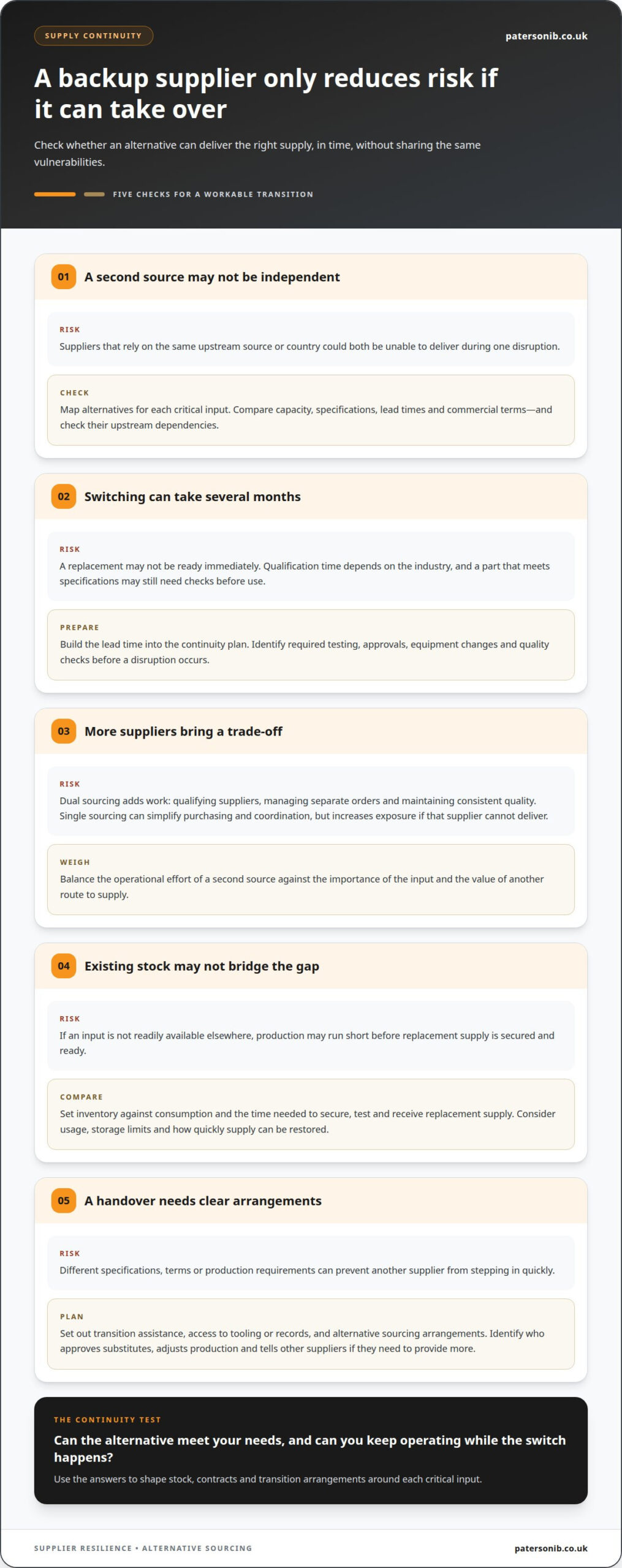
A backup supplier reduces reliance only if it can provide the right materials when needed. Map alternatives for each critical input, then compare capacity, specifications, lead times and commercial terms. Check whether suppliers depend on the same upstream source or country: shared exposure could leave both unable to deliver during one disruption. Feeling confident your business can withstand a key supplier failure starts with knowing whether your alternatives are genuinely independent.
Qualifying a replacement can take several months, depending on the industry. Include that lead time in your continuity plan rather than assuming a substitute can start immediately. Confirm what testing, approvals, equipment changes or quality checks production would require. A replacement part may meet the specification but still need inspection or process adjustments before use.
Dual sourcing can involve extra work, including qualifying suppliers, managing separate orders and maintaining consistent quality. In return, a second source may offer another route to supply if one supplier fails. Single sourcing can simplify purchasing and coordination, but increases exposure if that supplier stops trading or cannot deliver. Weigh these operational trade-offs against the importance of each input.
Stock buffers can help bridge the transition. Compare inventory levels with consumption rates and the time needed to secure, test and receive replacement supply. If a component is not readily available elsewhere, suitable stock may give production time to switch. The right buffer depends on usage, storage limits and how quickly supply can be restored. Feeling confident your business can withstand a key supplier failure also means knowing how long existing stock would last.
Plan the handover before losing the original supplier. Supply agreements can set out transition assistance, access to tooling or records, and arrangements for alternative sourcing. Identify who will approve a substitute, adjust production processes and tell other suppliers if they need to provide more. A mutual backup arrangement with a complementary business can provide another practical option.
To make these decisions part of a wider continuity plan, review supply-chain risk planning alongside your operational exposures.
Measure dependence by tracing each critical supplier’s role in daily operations. Consider which products, services, data or specialist knowledge they provide, and what work would stop without them. For example, a supplier may support several production lines even if its invoice accounts for a modest share of purchasing. Mapping these operational links can reveal dependencies that a spending review misses.
Regular due diligence helps keep supplier assessments current. Review financial stability, operational performance, cybersecurity practices and compliance obligations, then record material changes and their potential impact on your business. A supplier may remain financially sound but still present operational risk if performance deteriorates or cybersecurity practices change. Use consistent criteria to make changes visible across suppliers.
Dependence can also involve knowledge held by a small number of people. If one supplier contact understands a custom process, or one employee manages every order, disruption can slow decisions as well as supply. Document essential procedures, access arrangements and responsibilities. Systemising routine tasks reduces reliance on individuals, including the owner, and gives colleagues clear steps to follow when usual contacts are unavailable.
Bring these findings together in a supplier risk record. For each critical relationship, note the service provided, internal processes affected, warning signs, responsible decision-maker and planned response. Link the record to continuity exercises and update it after operational changes, such as adopting new software or changing production methods. This creates a practical view of where dependence sits and who must act if circumstances shift. Review your business risk arrangements alongside these supplier dependencies.
Map each critical supplier to the customer commitments it supports, including products, delivery dates, service levels and agreed prices. A shortage of one component, for example, could delay several orders while other production continues. Link supplier dependencies to contract schedules and identify which customers would be affected first. This reveals where disruption could cause missed deadlines, extra fulfilment work or strained commercial relationships.
Consider how supplier failure could affect contractual obligations and pricing commitments. If an alternative source costs more or requires a different production process, assess whether existing customer prices remain viable. Check contracts for delivery requirements, notice provisions and steps for managing disruption. Contract terms cannot remove operational risk, but they can influence the time and options available to respond.
Consider the wider impact on long-term customer relationships. A delayed order may affect a customer’s production schedule, retail availability or project milestones. Identify which commitments are time-sensitive, which orders can be rescheduled and what alternatives could meet customer needs. This helps the business prioritise scarce stock and production capacity according to operational impact, not just order value.
Prepare a communication plan before a supplier fails. Set out who assesses the disruption, who approves changes and who contacts affected customers. Share accurate information promptly, including which products or deliveries are affected, when customers can expect the next update and any available alternatives. Avoid promising a new delivery date until supply and production plans support it. Customers should not have to discover a delay themselves.
During disruption, activate the crisis plan and record decisions, customer messages and revised delivery arrangements. Notify unaffected suppliers if they may need to increase supply, and coordinate changes with the teams responsible for sales, production and fulfilment. After the incident, review missed commitments, customer feedback and response times. Use the findings to improve contract reviews and continuity exercises before another disruption.
Feeling confident your business can withstand a key supplier failure is an ongoing process, not a one-off exercise. As your operations, contracts or suppliers change, include continuity planning in regular business reviews. This lets you update responsibilities and decisions before a disruption puts them under pressure.
Insurance can form part of that review, alongside practical arrangements for keeping work moving. Paterson Insurance Brokers arranges Construction Insurance, Agriculture Insurance, and Retail & Wholesale Insurance. The right cover depends on your business and policy terms, so consider how insurance relates to the risks your operations face.
For a considered discussion about your business risks and insurance needs, contact Paterson Insurance Brokers. A clear conversation can help you identify the next steps for strengthening resilience and protecting the commitments your business depends on.
Yes, if you test the supplier’s ability to meet your actual requirements. A catalogue or initial assurance may not show whether it can handle your order size, quality standards or peak demand. A small trial order can reveal practical issues such as packaging compatibility, documentation or communication delays. Keep the results and agreed specifications available to staff responsible for purchasing and production.
Supply contracts can set out practical protections, though their effect depends on the wording and the relationship. For example, an agreement might specify who provides operational information during disruption, how quickly either party must give notice, and what assistance supports a handover. Align these terms with internal responsibilities so staff know who can invoke them and how to preserve relevant records.
A supplier failure may interrupt deliveries, production or services that depend on the supplier, affecting orders and cash flow. First establish what has stopped, which orders or operations are affected, and what stock remains usable. Record decisions and communications as the situation develops. This gives managers a clear basis for prioritising work and updating customers as circumstances change.
Assess dependence by tracing each supplier’s inputs through to the work your business delivers. A supplier may seem minor in purchasing records yet support a process with no practical workaround. For each relationship, note the affected functions, how much time you have before disruption becomes serious, and who holds essential knowledge. Compare these operational impacts to identify dependencies that need closer oversight.
Build the plan around clear activation points and assigned responsibilities. Specify who confirms a missed delivery, who decides whether to pause production and who approves customer updates. Include contact details, alternative ways to complete essential tasks and a process for tracking decisions. Test the plan with a realistic disruption scenario, then revise any steps that prove unclear or impractical.
Start with the exact function or material at risk, then identify potential suppliers that can meet its technical and operational requirements. Compare specifications, capacity, delivery arrangements and quality controls. Ask internal teams to assess samples or trial supply against the same acceptance criteria used for normal purchasing. Check whether alternatives share a vulnerable upstream source, which could leave them both exposed to one disruption.
Let us know your needs and we’ll be in touch shortly.