Make an enquiry
Let us know your needs and we’ll be in touch shortly.


Check out all the latest updates, insights and advice from our expert team.
The hidden risks of using labour-only subcontractors include uncertainty about employment status, employers’ liability insurance and responsibility for site safety. In the UK, a self-employed label or payment arrangement alone does not determine someone’s status: the working relationship and day-to-day practices matter. Employers’ liability insurance is generally legally required when a business has employees, including short-term employees.
Labour-only subcontracting can seem like a straightforward way to bring extra skills onto a job. The key distinction is that labour-only workers typically work under the hiring business’s direction, while bona fide subcontractors generally manage a defined task independently. The label alone does not settle the question.
This article explains how labour provision differs from subcontracting, when employers’ liability cover may apply, and what due diligence can help manage insurance, safety and compliance risks. It also explains why contracts need to reflect how work is actually carried out, and how clear responsibilities can help protect your business.
In the UK, the answer depends on the working relationship, not simply the contractor’s label or payment method. Employers’ liability, tax, employment rights and site safety each involve separate considerations.
Employers’ liability insurance is generally legally required when a business has employees, including short-term employees. For this insurance, an employee includes someone working under a contract of service, whether express or implied, oral or written, according to UK Government, legislation.gov.uk. That can matter even when someone joins a single project.
Do payments to labour-only subcontractors fall under the UK Construction Industry Scheme (CIS)? They may: labour-only status alone does not determine CIS treatment. Consider how CIS applies to the construction contract and payment, including subcontractor material costs and any relevant exemptions.
Employment status reflects both the contract and actual working practices. Assess personal service, whether substitution is genuine, the level of control, obligations to offer and accept work, integration into the business, and financial risk. A self-employed label, CIS registration or invoice alone does not settle the result.
Tax status and employment rights status are assessed separately. Someone treated as self-employed for tax may still qualify as a worker for employment rights, including possible entitlement to paid holiday and the National Minimum Wage. Employees may have additional rights, subject to applicable qualifying conditions. Misclassification can therefore affect more than insurance.
A UK business remains responsible for health and safety at work for labour-only subcontractors, while contractors remain responsible for their own employees. The site operator should provide relevant safety information and maintain a system for supervising contractor work. Agreements can clarify each party’s roles and liabilities.
OSHA’s multi-employer citation policy is a US policy, not the UK test. It illustrates how a controlling employer may be held accountable for subcontractor hazards, even without direct exposure of its own employees.
Labour-only arrangements can affect how a business’s insurance exposure is classified. Subcontractors may need their own Public Liability insurance and, in some cases, Employers’ Liability insurance. Align the classification of genuinely self-employed subcontractors with the insurance provider, and ensure the contract and working practices reflect the arrangement.
How do labour-only subcontractors affect a contractor’s public liability and contract works insurance? The answer depends on the policy wording and the work being done, so the declared arrangement should match the actual role. What penalties or compensation claims can result from misclassification? CIS errors can lead to unpaid CIS liabilities, penalties and increased HMRC scrutiny; an injured worker may also claim against a business where employers’ liability applies.
Understanding the hidden risks of using labour-only subcontractors starts with distinguishing labour supply from independent subcontracting. Subcontracting means appointing a party to deliver an agreed part of a project. Labour provision means bringing in people to supplement the hiring business’s own workforce. The distinction affects who directs the work, supplies resources and carries operational responsibilities.
On a construction site, labour-only subcontractors typically work under the main contractor’s supervision. The contractor may set their hours, location and daily tasks, and provide materials, tools or larger equipment. A labour-only worker generally cannot delegate the work or bring others onto the job. The arrangement supplies labour rather than an independently managed work package.
A bona fide subcontractor typically takes responsibility for a defined task, working under their own supervision and direction. They may supply tools and materials, use additional staff or delegate work. Payment is commonly made for a specific contribution, by invoice or under a fixed-price contract. These practical features help distinguish a completed service from labour added to the contractor’s team.
In private security, the distinction is framed around the customer contract. Subcontracting means another business takes responsibility for delivering a contract originally held by the first business. Labour provision means one business uses another company’s staff to supplement its own team while delivering that contract. The assessment should reflect the arrangement actually used, not just the wording of an agreement.
What are the risks of using labour-only subcontractors without written contracts? Without clear written terms, responsibilities for supervision, work scope, materials and payment can be difficult to establish. A written agreement records the intended arrangement, but daily working practices should match it. For example, a contract describing an independent roofing task may not reflect reality if the main contractor directs each worker’s daily activities.
A clear construction risk assessment can help identify where work arrangements and site responsibilities need closer attention.
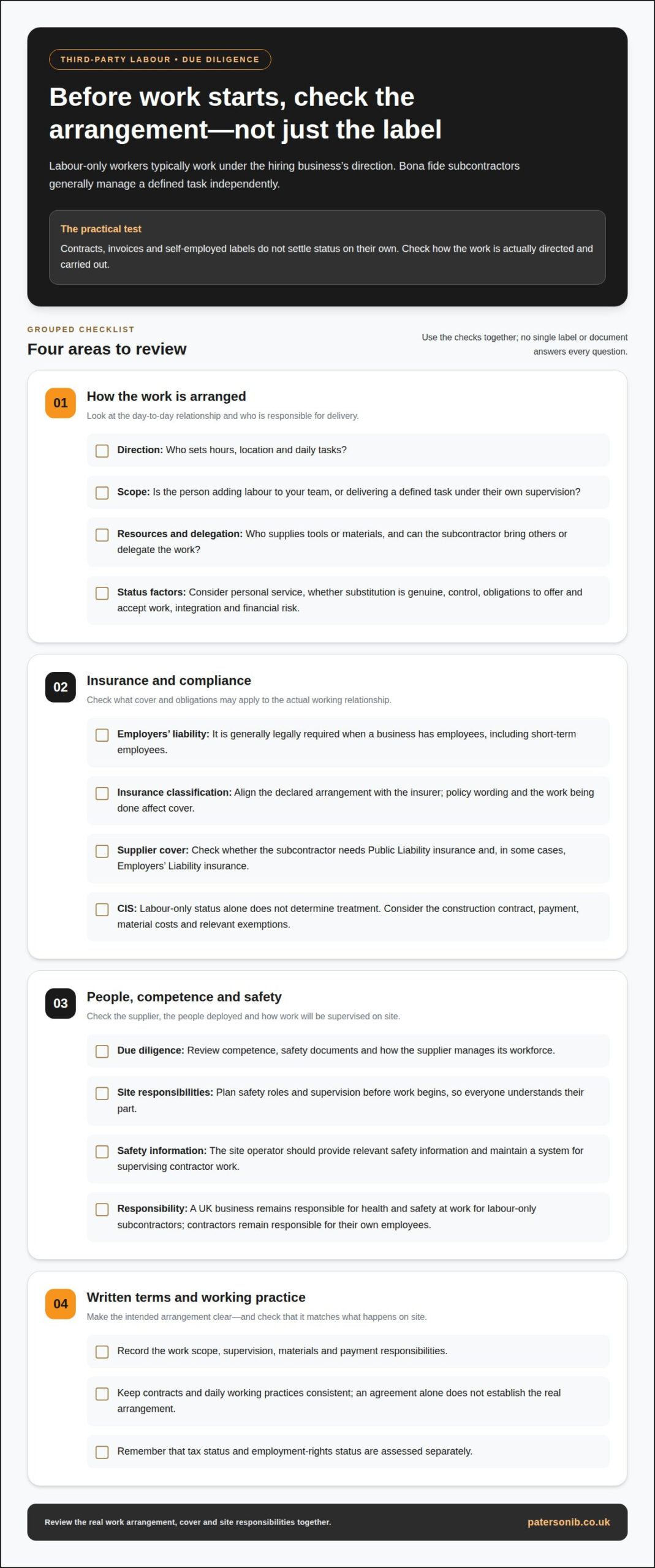
Good due diligence examines the labour supplier, the people deployed and the arrangement on site. In construction, checks should cover CIS compliance, insurance, competence, safety documents and how the supplier manages its workforce. Since 6 April 2026, construction companies in the UK have needed to strengthen labour-supplier due diligence to reduce exposure to tougher HMRC penalties and sanctions.
What checks should UK contractors make before hiring labour-only subcontractors? Assess the supplier’s CIS position, insurance, workforce competence and safety arrangements. Then record the agreed scope, responsibilities and supervision, and check that working practices match the agreement.
HMRC’s newer powers target businesses that knew, or should have known, a labour supplier was connected to fraud or non-compliance. Due diligence should therefore continue beyond onboarding. Review supplier performance during the work, document concerns and address changes in the workforce or working arrangements promptly.
Construction contracts can involve CIS questions beyond registration, including mixed contracts, off-payroll working rules, deemed contractor obligations, Regulation 22 exemptions and subcontractor material costs. Managing these details alongside site checks helps identify financial and operational risks before they affect the project.
For labour-only subcontractors, the hiring UK business is responsible for health and safety at work. These workers typically follow the contractor’s direction and use its site, equipment or materials. Calling someone self-employed does not remove the need to manage workplace risks.
On a construction site, the person responsible should provide safety information relevant to the work. This can include site hazards, safe routes, vehicles and equipment, and the presence of other contractors or visiting drivers. A site operator should also maintain a system for supervising contractor work. This helps identify unsafe practices and coordinate activity across the project.
For example, a site operator arranging roofing and deliveries should coordinate work areas, access routes and vehicle movements. The operator should provide relevant information and supervise the arrangement, while each contractor manages its own employees. Contracts can clarify site rules and the consequences of unsafe working, but they should reflect actual practices.
Clear allocation of responsibilities supports safer work and helps prevent gaps between the project plan and daily site activity. A practical review should consider supervision, information-sharing and how different contractors’ tasks interact.
To discuss how construction insurance with Paterson Insurance Brokers fits your business’s site risks, take the next step with a focused review.
Paterson Insurance Brokers helps businesses assess workforce risks through Risk Management Consultancy and relevant insurance advice. This can be useful when labour arrangements, site responsibilities or existing cover have changed, or when you are unsure whether your insurance reflects how work is carried out.
For construction businesses, a considered review can bring risk management and Construction Insurance into the same conversation. The aim is to understand your operations and identify where risk controls or insurance arrangements may need attention. The right approach depends on your work, workforce and contractual responsibilities.
To discuss your business’s workforce risks, make an enquiry with Paterson Insurance Brokers.
As projects and working arrangements evolve, include workforce risk in your regular planning. A new supplier, a different division of tasks or a change in supervision can affect how responsibilities and insurance fit together. Keep records of agreed roles and review them when the work changes, so decisions reflect current practice rather than an outdated assumption.
The hidden risks of using labour-only subcontractors are easier to address when insurance and risk management reflect how your business operates. Paterson Insurance Brokers offers Construction Insurance, Agriculture Insurance and Retail & Wholesale Insurance, alongside support for businesses reviewing their wider risk arrangements.
If you’re considering how your cover and risk controls fit your workforce model, contact Paterson Insurance Brokers for advice. A thoughtful review can help you approach your next project with greater clarity.
Yes, particularly if the paperwork describes independent subcontracting but the site operates through close day-to-day direction. For example, a person may be booked for a defined job yet follow the contractor’s set hours, use its equipment and receive daily task instructions. That mismatch can affect employment status, insurance arrangements and responsibility for safety. Review changes in how work is managed, not just the original contract.
No. “Subcontractor” describes a role in a project, while self-employment relates to a person’s working status. Neither a contract label nor an invoice settles that status by itself. A subcontractor may be genuinely self-employed, but the actual working relationship matters. For instance, consider whether the person can turn down work or arrange a genuine substitute, alongside the level of control exercised by the hiring business.
A bona fide subcontractor generally takes responsibility for delivering an agreed result independently, rather than simply supplying labour under another business’s direction. For example, a specialist business might plan and complete a defined installation, organise its own workforce and take responsibility for its working methods. The project agreement should describe the task and responsibilities clearly, while day-to-day practice should support that independent arrangement.
A labour-only subcontractor supplies their own labour to help carry out work managed by the hiring business. For example, a construction worker may join a site team, follow the contractor’s daily instructions and use materials provided for the job. The term describes how labour is provided; it does not, on its own, determine the person’s tax status or employment rights.
A labour-only subcontractor may be an employee where the real relationship amounts to a contract of service. UK Government guidance on legislation.gov.uk describes an employee for employers’ liability purposes as someone working under a contract of service, whether express or implied, oral or written. Relevant factors include personal service, control, work obligations and financial risk. Tax treatment and employment rights require separate assessments, so one classification does not automatically settle the other.
In UK private security, the business deploying operatives should have checks to ensure every deployed security operative is correctly licensed. Where one business subcontracts delivery of a customer contract, the subcontractor is responsible for screening and vetting the operatives it uses. The businesses should also agree who manages staff during shifts. These responsibilities concern security licensing and should not be assumed to apply to every construction worker.
Let us know your needs and we’ll be in touch shortly.