Make an enquiry
Let us know your needs and we’ll be in touch shortly.


Check out all the latest updates, insights and advice from our expert team.
A single supplier failure can disrupt far more than one delivery. If you’re asking how to sleep better knowing your supply chain is insured, start by checking whether your cover reflects the way disruption could affect your operations. Supply chain risks include external events beyond your control and internal vulnerabilities that may be easier to manage.
Insurance is often associated with damage to your own premises, but disruption can begin elsewhere. A supplier’s interruption, trade disruption or failure to deliver may affect your ability to operate, and different policies respond to different events and losses.
Contingent business interruption, broader trade disruption and supplier failure insurance can address different supply chain risks. Policy wording, named suppliers and the scope of cover all matter: they determine where insurance may help and where its limits apply.
Standalone supply chain interruption insurance can address losses when disruption starts outside your own premises. Its response depends on the insured events, suppliers and wording set out in the policy.
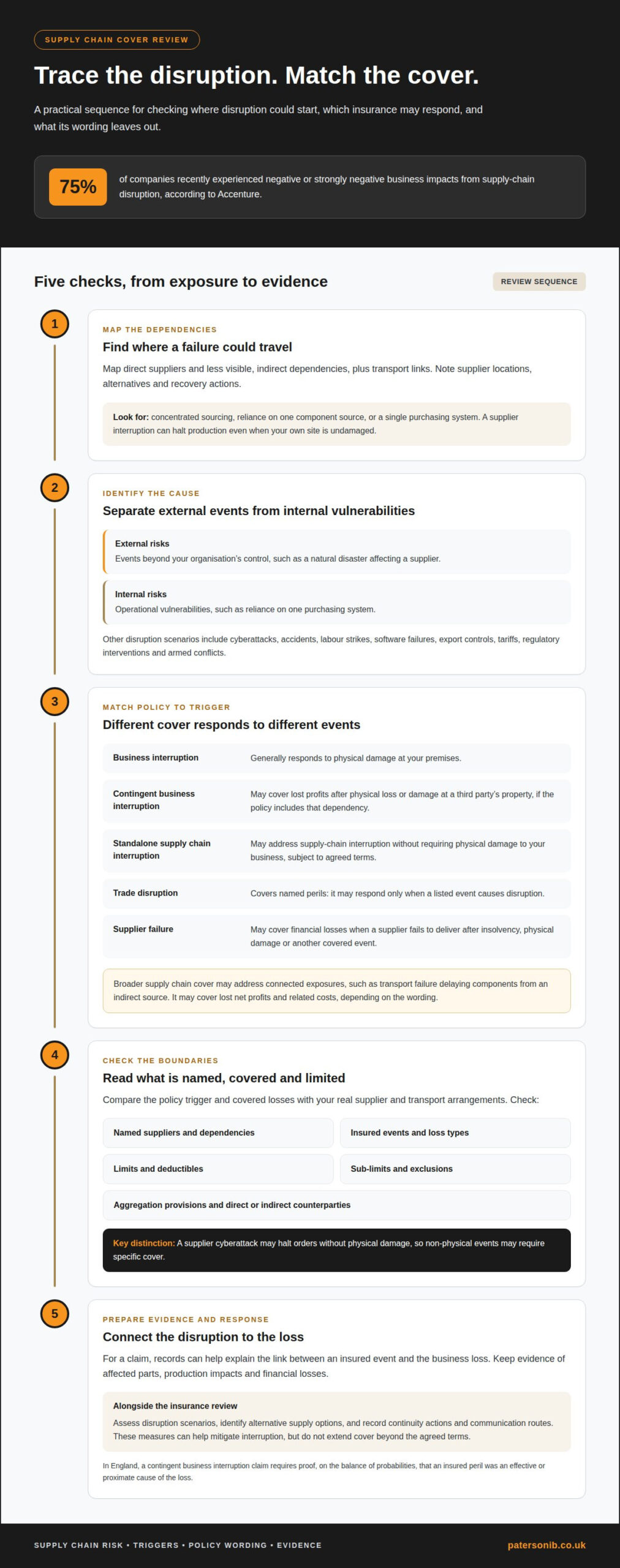
External risks arise beyond your organisation’s control, while internal risks stem from vulnerabilities in its operations. A natural disaster affecting a supplier is an external risk; reliance on a single purchasing system can create an internal one. Both matter because a supplier interruption can halt production even when your own site is undamaged.
Standard business interruption insurance generally responds to physical damage at your premises. Contingent business interruption can cover lost profits after physical loss or damage at a third party’s property, such as a critical supplier’s factory, if the policy includes that dependency. Standalone cover may address supply chain interruption without requiring physical damage to your business, subject to the agreed terms.
For an English contingent business interruption claim, the policyholder must prove on the balance of probabilities that an insured peril was an effective or proximate cause of the loss. An intervening event may complicate that link. The Insurance Act 2015 governs the fair-presentation and remedies framework relevant to commercial insurance disputes in England. Contracts can also shape exposure by setting delivery responsibilities and remedies, but don’t replace insurance cover.
UK policies may include business interruption, contingent business interruption, standalone supply chain interruption, trade disruption, supplier failure or cyber cover. Each responds to different insured events. For example, a supplier’s cyberattack may halt orders without causing physical damage, so the policy wording matters.
When making a claim, your broker can help present the loss, relevant policy wording and evidence linking the disruption to an insured event. After a supplier fire, for example, records of affected parts, production impacts and financial losses can help explain the claim. Limits, deductibles, exclusions and named dependencies affect what the policy can pay. Non-physical events may require specific cover.
A risk management professional can help map suppliers beyond tier one, assess likely disruption scenarios and coordinate continuity plans. Recording supplier locations, alternatives and recovery actions can help mitigate interruption. For example, a business relying on one component source can assess backup supply options alongside its insurance exposure, such as holding reserve inventory in self-managed units from providers like SafeHouse Storage to cushion against transport delays.
Supply chain insurance may cover lost net profits and related costs caused by disruption. It can address connected exposures beyond a direct supplier, such as transport failure delaying components from an indirect source. The policy’s trigger and scope depend on its wording, so the insured events and losses need to match the risks affecting your operations.
Trade disruption insurance is narrower in one important respect: it covers named perils. A policy may respond only when a listed event causes disruption, rather than to every interruption across a trading chain. Supply chains can face cyberattacks, natural disasters, accidents, labour strikes, software failures, export controls, tariffs, regulatory interventions and armed conflicts. Each event can affect procurement, production or delivery differently.
The scale of exposure is clear in Accenture’s finding that 75% of companies recently experienced negative or strongly negative business impacts from supply-chain disruption. For a UK manufacturer, for example, an export control affecting a key material could delay production, while a transport accident could prevent finished goods reaching customers. Broad cover may address resulting financial loss, but the policy must include the relevant cause and loss type.
Start by understanding how disruption could travel through your supply chain. Mapping direct suppliers and less visible dependencies can reveal where one failure might affect several operations. A risk register can help prioritise scenarios by likelihood, business impact and preparedness, while continuity plans set out responsibilities and communication routes. These measures can help mitigate disruption, but they do not extend insurance beyond its agreed terms.
Reviewing policy triggers against your actual supplier and transport arrangements can clarify whether the cover addresses your exposure. Businesses developing a wider risk picture may find supply chain risk support useful when considering connected operational risks.
Companies that relied on a single supplier in China faced disruption during a series of city lockdowns that began in January 2020. That example highlights how concentrated sourcing can expose operations to disruption.
Supplier failure insurance can compensate a business for losses when a supplier fails to deliver goods. The failure might follow insolvency, physical damage or another covered event, depending on the policy wording. For example, a food producer could lose income if a key ingredient supplier cannot fulfil an order and production stops. The cover focuses on financial consequences, not simply a missed delivery.
Contingent business interruption insurance may also respond when a covered event affects a supplier or other counterparty and causes lost profits. The policy’s definition of an insured supplier matters: direct suppliers may be named, while indirect dependencies can sit further along a global chain. A component maker’s closure, for instance, could delay a product even if the insured business buys through a wholesaler.
A broker can assess supplier-related insurance by comparing likely claim scenarios with limits, deductibles, sub-limits, exclusions and aggregation provisions. They can also consider whether cover extends to direct and indirect counterparties, and whether insured events match the business’s actual exposure. A high headline limit may offer less protection if a relevant failure is excluded or multiple losses share one aggregate limit.
Supplier arrangements can change. Adding a politically exposed market, changing a key supplier or relying more heavily on one source may mean your policy needs updating. Otherwise, named suppliers and covered dependencies may no longer reflect your operating chain when a claim arises. Reviewing the policy after material supply changes helps keep the insured picture aligned with the business.
Before a claim, useful records include supplier details, contracts, orders, delivery correspondence and evidence of the resulting interruption. These can help show which supplier failed, how the failure affected operations and what financial loss followed. Policy definitions and exclusions remain central: supplier insolvency, political events and delivery delays may be treated differently. Reviewing those terms against likely claims can reveal where protection is strong and where gaps may remain.
Supply chain insurance brings together different covers for different points in a business’s operations. A UK retailer may need protection for goods in transit, stock in storage, lost income after disruption and customer claims following a product recall. No single policy necessarily covers every loss, so the relevant trigger and insured property matter.
Business interruption insurance can cover lost income, fixed costs and wages when operations stop after an insured incident, usually one involving damage. Standard cover generally responds to physical damage at the insured premises. Contingent business interruption can address lost profits after physical loss or damage to third-party property, such as a supplier’s site. Cyber insurance can address disruption from cyberattacks, including denial-of-service attacks and data loss.
Goods in transit cover can protect goods a business is responsible for moving within the UK. Cargo insurance can protect shipments against loss or damage across transport modes, while marine and airfreight insurance normally cover overseas movements. Carrier liability is different: it is not cargo insurance. Stock throughput cover can follow stock from purchase through storage to final delivery, allowing businesses to consider several stages together.
Other policies address specific exposures. Trade credit insurance can protect against non-payment by suppliers or customers. Product recall insurance can cover recall-related costs, including legal fees, logistics and customer notifications. Political risk or special contingency cover may address events such as confiscation, regulatory changes, war or terrorism. Civil authority and ingress or egress cover may respond to interruption caused by authority orders, such as evacuation orders or curfews.
For temperature-sensitive goods, parametric cover can monitor cold-chain shipments for temperature deviations. Across these examples, check whether protection applies to first-party losses, third-party losses or both, and whether it includes goods in storage, transit, delays and delivery. Discuss your supply chain insurance needs to consider how the cover can fit your operations.
Paterson Insurance Brokers helps businesses consider insurance and risk management in the context of their operations and supply chain dependencies. If a supplier interruption could affect your production, stock or customer commitments, a discussion can clarify the risks and how policy terms relate to them.
Businesses in construction, agriculture, retail, wholesale and manufacturing can explore cover suited to their sector. The focus is on understanding how your operations rely on suppliers, what disruption could mean for your business and how insurance fits alongside wider risk management. Details about your suppliers, contracts and potential losses can help make that discussion practical.
For a considered discussion about your business’s supply chain risks, make an enquiry with Paterson Insurance Brokers.
Knowing how to sleep better knowing your supply chain is insured starts with checking that your protection reflects how your business operates. As suppliers, routes and trading arrangements change, your insurance should keep pace. A clear picture of your dependencies can help you decide which risks need attention and how insurance fits alongside continuity planning.
Paterson Insurance Brokers helps businesses consider insurance in the context of their operations. Its sector-focused options include Construction Insurance, Agriculture Insurance and Retail & Wholesale Insurance. A conversation can connect your business’s circumstances with relevant cover and risk management considerations, without treating every supply chain as the same.
Take the next step at a pace that suits your business. Discuss your supply chain risks with Paterson Insurance Brokers, and move forward with a clearer view of your protection.
A supply chain risk is anything that could interrupt the flow of materials, services or products a business depends on. For example, a supplier changing a component specification could make existing production equipment incompatible, even without a site closure. Understanding these dependencies is a practical step in how to sleep better knowing your supply chain is insured: it helps identify which disruptions matter most to your operations.
A risk management professional can map critical dependencies, assess how quickly alternatives could be put in place and consider which customer commitments rely on them. They can then relate those exposures to relevant policy terms and existing contingency plans. This tailored review can help you understand how to sleep better knowing your supply chain is insured by showing where protection aligns with your business and where risks need further attention.
Policies may have limits, deductibles, sub-limits, exclusions and aggregate provisions, and may cover only named suppliers, dependencies or perils. Standard business interruption cover generally requires physical damage, so non-physical disruptions may need specific cover.
Let us know your needs and we’ll be in touch shortly.