Make an enquiry
Let us know your needs and we’ll be in touch shortly.


Check out all the latest updates, insights and advice from our expert team.
Limited liability is a boundary, not an invincible shield. For UK business owners, avoiding personal asset exposure from corporate liability starts with choosing a structure that separates the business from its owners. A private limited company is a separate legal entity, and shareholders are generally not personally liable for its debts.
That protection has limits. A personal guarantee can make an owner responsible for a company debt, and according to the Insolvency Service, knowingly continuing to trade when a company is insolvent or engaging in fraudulent activity can also lead to personal liability.
It’s sensible to look beyond the company structure alone. This article explains how limited companies, trusts and holding companies may help protect personal assets, why separating business and personal finances matters, and when directors or owners may still face exposure. It also explains where insurance can help manage risks a legal structure does not remove.
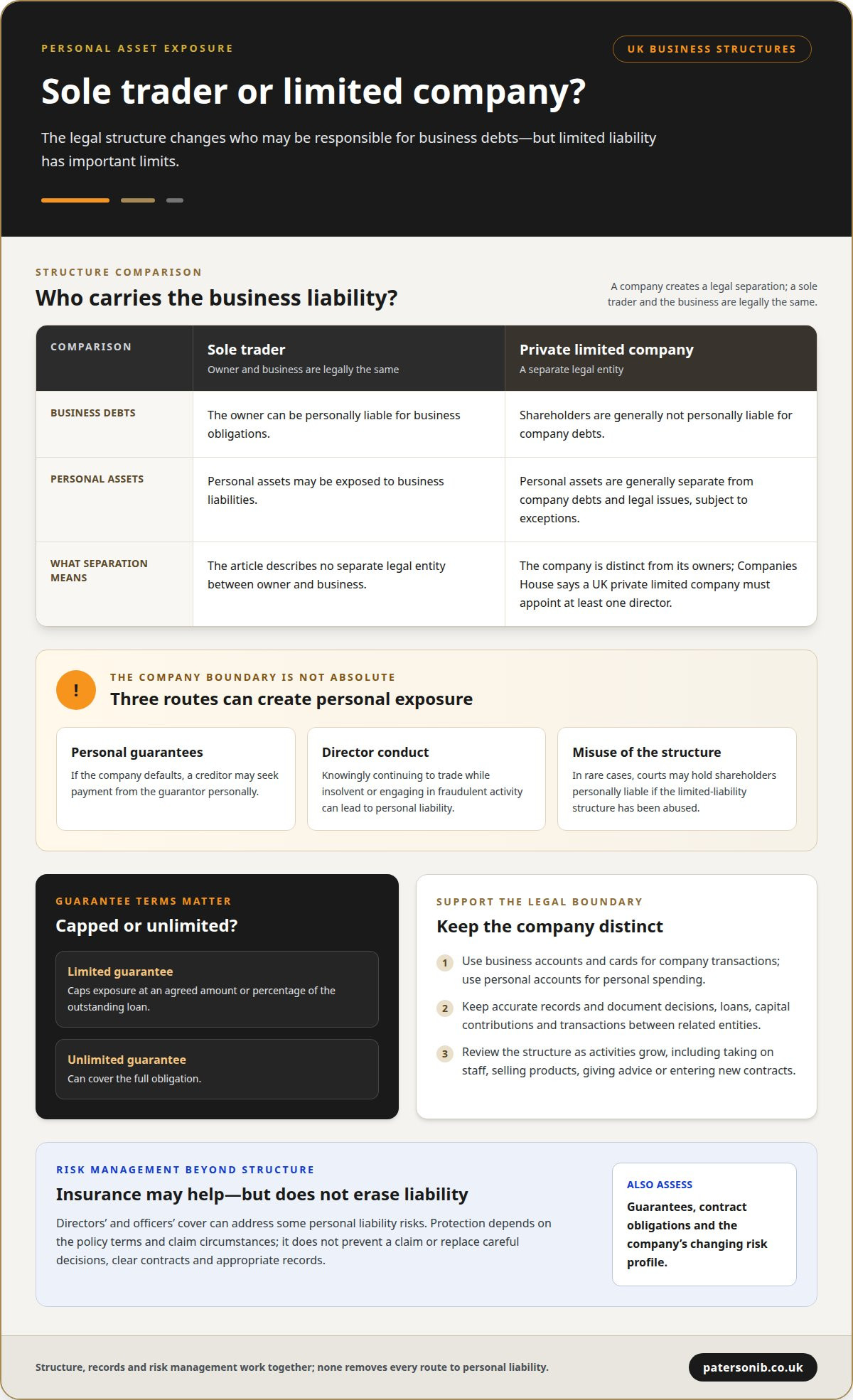
For UK business owners, formation affects who carries business debts. A sole trader and the business are legally the same, so the owner can be personally liable for business obligations. A private limited company is a separate business entity. Its shareholders’ personal assets are generally not at risk for company debts or legal issues. Companies House says a UK private limited company must appoint at least one director.
That separation works best when the company operates as a distinct organisation. Use business bank accounts and cards for company transactions, and personal accounts for personal spending. Keep accurate records of income, expenses and decisions. Record money you put into the company as a loan or capital contribution. Avoid using company funds for personal purchases, or personal funds for company costs without clear documentation.
Review the business structure as the company grows. Taking on staff, selling physical products, giving professional advice or entering new contracts can change its risk profile. A structure that suited a small operation may need reconsideration as activities expand. Keep company records current and document important decisions. Incorporation separates the company legally, but does not remove every route to personal liability.
Read financing and lease documents carefully for personal guarantees. If you sign one, a creditor may pursue you personally if the company defaults, despite its limited-company status. Consider the guarantee’s scope and duration before accepting it. Also assess how an owner’s illness or absence could affect business income. Business overhead insurance may help with operating expenses, while disability income insurance may support the owner’s income. These address financial disruption, rather than changing the company’s legal structure.
For avoiding personal asset exposure from corporate liability, treat incorporation, separate financial records, risk reviews and insurance as complementary safeguards. Each addresses a different source of exposure, and none replaces careful business operations.
Limited liability separates a company’s debts from shareholders’ personal assets, but it doesn’t make every owner or director immune from claims. Incorporation alone cannot prevent personal exposure if an owner gives a guarantee or a director’s conduct creates personal liability. In rare cases, UK courts may also hold shareholders personally liable if they have abused the company’s limited-liability structure.
A personal guarantee changes the position directly. If a company defaults on a loan or contract you guaranteed, the creditor may seek payment from you personally. A limited guarantee caps exposure at an agreed amount or percentage of the outstanding loan; an unlimited guarantee can cover the full obligation. Written contracts with clients, suppliers and team members can clarify responsibilities and set out liability limits, helping manage claims without removing liability for every possible event. Engaging experienced commercial practitioners like Aquarius Lawyers can help businesses ensure their commercial agreements and liability terms are thoroughly reviewed and properly structured.
Directors’ and officers’ insurance can help address some personal liability risks, but it doesn’t prevent a claim or erase liability. The protection depends on the policy’s terms and the circumstances of the claim. Consider it alongside clear contracts, careful decisions and appropriate company records, rather than as a substitute for them.
During UK company insolvency, a director’s personal assets don’t automatically become company assets. However, according to the Insolvency Service, a business owner could be held personally liable for knowingly continuing to trade when the company is insolvent or for fraudulent activity. A personal guarantee can also expose the guarantor’s assets if the company defaults, regardless of insolvency proceedings.
To limit exposure, identify guarantees before signing and understand whether liability is capped or unlimited. Review contract terms to understand the obligations they place on the company and any personal commitments. These steps help clarify where the legal entity’s protection ends, while directors’ and officers’ cover can address some risks arising from management decisions.
A holding company can own shares in an operating company, separating ownership from trading activity. This may help organise business assets and clarify which entity carries each risk. It does not make wealth unreachable to creditors. Give each company a genuine purpose, maintain distinct records and document transactions between related entities.
A trust arrangement can set out how assets are managed and distributed. Its practical effect depends on the deed, the trustee’s decisions and the circumstances of a claim. Before transferring property or shares, obtain advice from a UK solicitor and tax adviser. They can assess whether the proposed arrangement fits your objectives and explain its ongoing responsibilities.
Courts may assess the full circumstances when considering whether to pierce the corporate veil. Factors can include mixing company and personal assets, inaccurate records, ignored corporate formalities and a lack of arm’s-length dealings between related entities. Concealing company members or shifting assets and liabilities to avoid creditors may also raise concerns. Undercapitalisation and circumstances specific to the dispute can matter as well.
Directors can support liability protection with clear records and consistent compliance. Record major decisions, keep accounts accurate and document the purpose and terms of intercompany loans or shared services. Written agreements help show that each entity has been treated as a separate organisation, rather than an informal extension of its owners.
Tax compliance belongs in any UK asset-protection plan. Moving assets to avoid tax liabilities may expose personal assets and contribute to a court piercing the corporate veil. Seek tax advice before changing ownership, and retain records explaining the transaction’s purpose. Treat UK pension planning as a separate matter: a trust or holding company does not automatically determine how pension assets are treated in a creditor claim.
“LLC” is not the usual UK company label, so UK owners should apply these risks to their actual business structure. A private limited company is a separate legal entity, but incorporation alone doesn’t prevent personal liability for every debt, decision or action. The key distinction is whether a claim belongs to the company or arises from an owner’s own commitment or conduct.
A personal guarantee is a direct route to exposure. If an owner guarantees a company loan or contract, the creditor may pursue them when the company defaults. Personal assets pledged as collateral can also be at risk. Before signing, understand whether the guarantee is limited to an agreed amount or extends to the full obligation. A company’s liability protection doesn’t cancel a separate promise made by its owner.
Conduct can matter as much as structure. According to the Insolvency Service, a UK business owner could be held personally liable for knowingly continuing to trade when the company is insolvent or for engaging in fraudulent activities. Moving assets to avoid tax liabilities may also expose personal assets. These are not ordinary consequences of a company’s failure; they concern the owner’s actions and circumstances.
Courts may consider undercapitalisation, asset transfers intended to avoid creditors, and whether owners have abused the corporate veil. No single factor automatically decides every case. The practical strategy is to establish a genuine separation between owner and company, document transactions, and avoid using business structures to conceal assets or evade obligations. Tax and legal advice can help assess proposed changes before a claim arises.
Directors & Officers Liability cover can help address certain personal risks arising from management decisions, but it doesn’t make guarantees disappear or excuse wrongful conduct. For a considered review of management-related exposure and insurance, discuss Directors & Officers Liability.
Paterson Insurance Brokers can help businesses consider Directors & Officers Liability as part of their approach to management-related risk. This cover may help address certain personal liability risks for directors and officers, but it doesn’t replace sound decisions, accurate records or careful attention to personal guarantees. The protection available depends on the policy terms and the circumstances of a claim.
Consider reviewing this cover if you’re responsible for company decisions and want to understand how insurance fits alongside your legal structure and risk controls. An advice-based review can help you assess your business’s exposures and the role insurance may play.
Contact Paterson Insurance Brokers to discuss Directors & Officers Liability for your business.
As your business changes, its risk profile changes with it. A new contract, expansion into another activity or shift in how the company operates can alter the exposures your existing arrangements need to address. Use these changes as a prompt to review risk controls and insurance together, rather than treating each decision in isolation.
A practical approach to avoiding personal asset exposure from corporate liability is to align cover with the work your business actually does. Paterson Insurance Brokers offers Construction Insurance, Agriculture Insurance and Retail & Wholesale Insurance, alongside Directors & Officers Liability. An advice-based conversation can help you consider which risks belong in an insurance review and how cover fits with your wider plans. Insurance works alongside sound governance and legal advice; it does not replace either.
If your business activities or responsibilities have changed, contact Paterson Insurance Brokers to discuss your insurance needs. A considered review is a useful next step towards managing business risks with greater clarity.
Start by identifying who owns each asset and who accepts each business obligation. For example, before signing a lease, establish whether the company or you personally will be named as tenant and whether you must guarantee payment. Keep those decisions consistent across applications, invoices and agreements. Review the arrangement when the business takes on new activities, because changes can create exposures the original setup did not address.
These structures can reduce financial risks, but they don’t create the same separation as a private limited company. A sole trader is personally responsible for business obligations, while partners may face personal exposure connected with the partnership. Insurance and carefully drafted agreements can help manage particular risks, but they don’t change who is legally responsible. If personal exposure is a concern, consider whether a different structure suits the business.
Holding companies and trusts can be used to organise asset ownership, but their effects depend on the circumstances. These arrangements can organise ownership and separate activities, but they don’t automatically prevent creditors from making claims. Their effect depends on how they are established, maintained and used, as well as tax considerations. Get UK legal and tax advice before transferring assets or setting up a structure.
Corporate disregard describes a court treating a company’s separate legal identity as insufficient to protect its owners in particular circumstances. In the UK, courts may hold shareholders personally liable in rare cases involving abuse of limited liability. The risk matters because personal assets could be exposed to a claim. Keep company dealings genuine and properly documented, rather than using the structure to conceal ownership or avoid obligations.
A UK private limited company is a legal entity separate from its owners. It can enter contracts, sue and be sued in its own name, so the company, rather than a shareholder, is ordinarily responsible for its obligations. This distinction helps define ownership, business assets and liabilities. It doesn’t remove personal commitments made by shareholders or liability arising from their own conduct.
Limited liability is a legal separation that generally keeps a company’s debts distinct from its shareholders’ personal finances. For example, a supplier’s unpaid invoice is ordinarily a company obligation, not automatically the shareholder’s personal debt. The protection has limits: personal guarantees and certain conduct can create personal exposure. It also doesn’t prevent creditors from pursuing the company’s own assets to satisfy valid claims.
Let us know your needs and we’ll be in touch shortly.