Make an enquiry
Let us know your needs and we’ll be in touch shortly.


Check out all the latest updates, insights and advice from our expert team.
An insurer’s ESG questions can reveal as much about a company’s exposure as its existing policies. For ESG liability insurance for UK companies, expect questions about who oversees ESG decisions, how environmental impacts and climate risks are assessed, and how the business monitors supply-chain practices and public claims.
It’s understandable to want a clear view of what a policy may protect and what can affect its cost. Insurers may ask about directors’ responsibilities, climate-related disclosures, diversity and inclusion, human rights, and financial controls. The answers help them assess the company’s risk profile.
This article explains the ESG-related questions insurers may raise, how physical and transition climate risks can influence cover, and what may shape policy limits and premiums. It also outlines liability covers that may be relevant, so you can see how they fit your business.
Physical climate risks include flooding, storms and heat that can damage premises, interrupt operations or affect suppliers. Transition risks arise as legislation, technology and customer expectations change; for example, a carbon-intensive business may face scrutiny over its plans and public disclosures. The UK Prudential Regulation Authority’s SS3/19 sets expectations for banks and insurers managing climate-related financial risks.
UK legislation can also turn environmental claims into a corporate concern. Under the UK Digital Markets, Competition and Consumers Act 2024, the Competition and Markets Authority can impose fines of up to 10% of global annual turnover for substantive breaches of consumer law. The FCA anti-greenwashing rule came into force in May 2024, making accurate environmental representations a relevant risk for businesses.
ESG liability is an exposure category, not a guarantee that one policy covers every claim. Directors and Officers (D&O) insurance may address claims against directors over management decisions. Environmental liability cover concerns environmental damage, while professional indemnity may respond to claims linked to professional advice. Policy wording, triggers and exclusions determine how each policy responds.
Social risks include alleged discrimination, poor working conditions and failures to respect human rights. Diversity and inclusion commitments may draw scrutiny if company practices conflict with public statements. D&O claims may allege that directors failed to oversee these issues, while employment-related claims may involve other policies. The response depends on the allegation and policy terms.
Insurers and intermediaries face ESG risks of their own. A broker advising on climate exposure or sustainability disclosures may face a professional negligence allegation if its advice is said to be inaccurate or incomplete. Insurers also assess how climate, environmental and social factors feature in underwriting and governance. Clear records and accountable decision-making are valuable in addressing these concerns.
Companies seeking cover can work with a commercial broker to arrange D&O, professional indemnity or environmental liability insurance, and insurers that underwrite those policies. A broker can map activities, disclosures and supply-chain exposure against existing policies, then identify potential gaps and explain relevant terms.
After an ESG-related claim or investigation, a broker can help with prompt policy notification, organise relevant records and coordinate communications with the insurer. For example, a regulator’s questions about an environmental claim may make it important to preserve board decisions, supporting evidence and public statements, in line with the policy’s notification requirements.
For ESG liability insurance for UK companies, an appropriate limit reflects potential claims, not simply business size. Insurers may consider ESG metrics when assessing Directors and Officers (D&O) cover, including governance, sector exposure and directors’ responsibilities. A company operating across global markets may face different disclosure and litigation exposures from a business operating locally.
Professional indemnity limits also depend on the advice provided and clients’ potential losses. Sustainability consultants working with FTSE-listed clients on mandatory disclosure may need annual limits of £5 million to £10 million or more. Boutique sustainability advisers working with SMEs may need £1 million to £2 million. Circular-economy and refurbishment businesses may need manufacturer-level product liability cover of £5 million or more.
These figures are starting points, not a substitute for reviewing the particular work, contracts and policy wording. The limit should account for the largest plausible claim and whether defence costs reduce the amount available for compensation. Check how the policy treats related claims, multiple claimants and different activities, as these terms affect the protection remaining after a claim.
Premiums reflect the insurer’s view of how likely a claim is and how costly it could become. Factors include the company’s sector, turnover, claims history, geographic reach, employee profile and the nature of its ESG commitments. Clear governance and documented controls can show how risks are managed. Weak oversight or inconsistent environmental claims may increase concern.
When assessing ESG liability insurance for UK companies, insurers may look for evidence that directors understand and engage with the ESG strategy, and that senior managers receive training on risks such as greenwashing. Diversity, inclusion, human rights and supply-chain oversight may also affect the assessment. Accurate disclosures and a prompt action plan for identified weaknesses give underwriters a clearer picture of the company’s exposure.
A broker can help relate limits to operations, contracts and board responsibilities, then explain how exclusions and defence-cost provisions affect the result. For tailored business risk management support, consider a review of your current cover and ESG exposures.
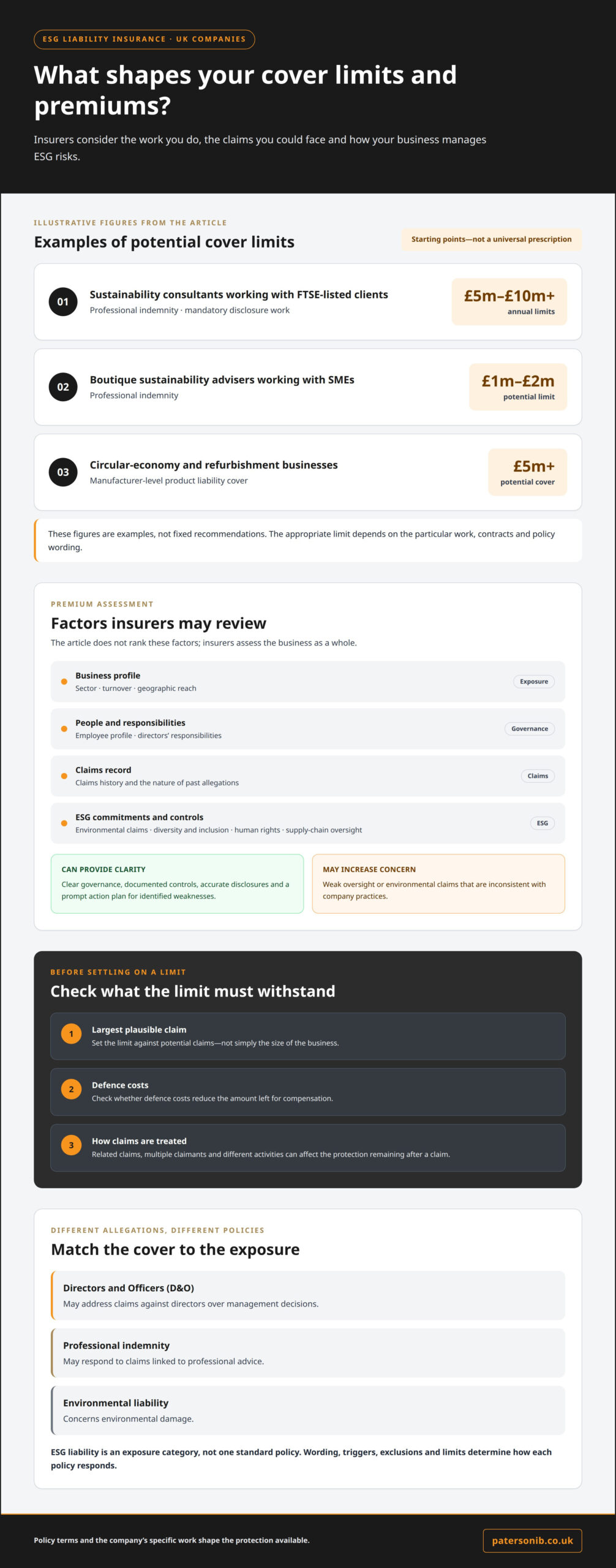
ESG liability insurance is a broad description, not one standard policy offering identical cover across UK insurers. Protection usually comes from existing policies, including Directors and Officers (D&O), professional indemnity and environmental liability. Each responds to different allegations, so the policy wording, insured parties, triggers and limits matter.
D&O insurance can protect directors and officers facing allegations linked to their management decisions. Climate-related examples include failing to consider climate change in corporate strategy or failing to disclose climate-risk information. Subject to policy conditions and primary limits, cover may reimburse a company for legal costs and awards after it indemnifies directors, or respond directly for directors if the company becomes insolvent.
Regulatory investigations can also involve directors. D&O policies should respond to investigations by bodies such as the Financial Conduct Authority, Health and Safety Executive or Competition and Markets Authority, subject to their terms. Policies generally cover defence costs until criminal or morally reprehensible conduct is finally established through legal process. They generally exclude fines and penalties imposed for that conduct.
Professional indemnity is relevant when a business’s advice or professional service leads to a claim. An accountancy firm, architect, engineer or construction business could face allegations after advising a client on climate risks or environmental disclosures. The policy’s definition of professional services and its exclusions determine whether the allegation falls within cover.
Environmental liability insurance addresses a different exposure: claims arising from environmental harm connected with business activities. It is not a substitute for D&O protection against directors’ decisions or professional indemnity for advice. Businesses need to distinguish the alleged harm, who is held responsible and which policy wording may apply.
For example, a claim alleging misleading climate information could raise questions about directors’ oversight, the accuracy of professional advice and any resulting environmental damage. Those allegations may involve different policies, but no single policy automatically covers every element. The insurer assesses the claim against the relevant wording, exclusions, notification requirements and available limit.
There is no single UK policy wording that covers every environmental, social and governance claim. Cover depends on the policy type, insured activity and allegation. A claim about a director’s decision may involve Directors and Officers (D&O) insurance, while alleged negligent sustainability advice may fall under professional indemnity wording. Neither automatically covers every loss connected with ESG.
D&O policies generally exclude fines and penalties imposed for a criminal or morally reprehensible act by the insured person. They generally cover defence costs until such conduct is finally established through legal process. This distinction matters if a regulator investigates a director: investigation costs and any eventual penalty may be treated differently under the policy.
Other limitations are set out in the wording. Review how it defines a claim, which people and activities it insures, and whether defence costs reduce the available limit. Check notification requirements, excesses, exclusions and how related allegations are treated. For example, a complaint about a public climate statement may involve both directors’ decisions and the professional work behind that statement.
Environmental liability wording also needs close attention. A business should understand which types of environmental damage and related claims fall within its policy, and which are excluded. A pollution exclusion in another policy, for instance, could affect how a particular allegation is considered. The exact wording determines the response, so broad labels such as “ESG cover” are not enough.
For a claim or investigation, prompt notification matters because policy terms set out how and when the insurer must be told. Preserve relevant board minutes, disclosures and advice records, then follow the policy’s claims procedure. A broker can help interpret the wording and coordinate notification, but cannot turn an excluded loss into covered insurance.
To review how exclusions and limits interact across your business policies, arrange a tailored insurance review.
Paterson Insurance Brokers can help businesses consider Directors & Officers Liability when ESG decisions may expose directors to claims or regulatory scrutiny. This cover is relevant where allegations concern board oversight, climate-risk decisions, public disclosures or the company’s handling of social responsibilities. Policy terms determine which claims, legal costs and investigations may be covered.
As an independent broker, Paterson Insurance Brokers can help assess a company’s activities and existing protection, then explain how D&O cover fits its wider risk profile. This is particularly useful when governance responsibilities or ESG disclosures change, or when directors want a clearer view of policy limits and exclusions. Businesses in construction, agriculture, retail and wholesale can discuss cover in the context of their operations.
Contact Paterson Insurance Brokers to discuss Directors & Officers Liability for your business.
As your company’s activities and responsibilities evolve, its insurance arrangements should stay aligned with the risks it faces. A considered approach to ESG liability insurance for UK companies looks beyond policy labels to how protection fits your operations, contracts and board responsibilities.
Paterson Insurance Brokers offers Construction Insurance, Agriculture Insurance, and Retail & Wholesale Insurance alongside Directors & Officers Liability. This broader commercial perspective can help keep insurance discussions grounded in how your business operates, rather than treating ESG exposure in isolation.
Use your next policy review to consider whether your cover still matches your activities and governance needs. Make an enquiry with Paterson Insurance Brokers to discuss your needs and clarify where a closer review may help.
Contact Paterson Insurance Brokers to discuss your business insurance needs and take a considered next step.
Insurers may ask how ESG commitments inform day-to-day decisions, not just what a policy document says. For example, they could ask who approves environmental claims in marketing, how supplier concerns reach senior management, and how directors track progress against stated goals. Clear, consistent answers help explain how the business assigns responsibility and responds when practices fall short.
A sustainability consultancy may consider professional indemnity for claims alleging its advice caused a client loss, and D&O cover for claims against its directors. The relevant mix depends on its services, contracts and risks. A broker can map those exposures against existing policies, identify possible gaps and explain how policy terms relate to the work the business undertakes.
The cost depends on the business and is determined after a quote request. Premium factors include the work performed, client and contract profile, claims history, risk controls, and the limits and excess selected. For example, a consultancy advising large organisations has a different exposure from a company making sustainability claims about its own products. There is no single price for every business.
Underwriters typically need enough detail to understand the company’s activities and how it manages related risks. Useful material can include a description of services, sample client contracts, relevant public statements, governance responsibilities, supplier oversight arrangements and claims history. For instance, a consultancy can explain which staff review published recommendations and how updates are recorded when its advice changes.
Let us know your needs and we’ll be in touch shortly.